

B2B lead generation in Canada’s tech market looks similar on the surface to that in the US or the UK. The same channels exist. Cold email, LinkedIn outreach, content, and paid acquisition are all in play.
But execution is different.
Canada’s tech ecosystem is smaller, more relationship-driven, and often more cautious in decision-making. Sales cycles tend to be longer, target markets are narrower, and outbound efforts require more precision.
For SaaS companies, IT service providers, and B2B tech firms, this changes how lead generation needs to be approached. Volume alone does not work. Messaging, targeting, and timing matter more.
This blog breaks down how B2B lead generation works in Canada’s tech market, which channels perform best, and what companies need to adjust to build a consistent pipeline.
Understanding the Canadian Tech Landscape
To understand how B2B lead generation works in Canada, you need to start with the market’s structure.
Canada’s tech ecosystem is concentrated, not spread out.
Most B2B tech activity sits in a few key hubs. Toronto leads in SaaS and fintech. Vancouver has a strong base in startups and enterprise tech. Montreal is known for AI and deep tech. Outside of these, the density drops quickly.
This directly impacts lead generation.
The total addressable market is smaller compared to the US. You are not working with endless prospect lists. In many cases, your ideal customer profile might only include a few hundred or a few thousand companies.
That changes the approach.
Broad targeting and high-volume outreach tend to underperform. Precision matters more. Lists need to be tightly defined, and messaging needs to feel relevant from the first touch.
There is also a noticeable difference in buyer behaviour.
Canadian companies tend to be more cautious in decision-making. Budget approvals can take longer. Multiple stakeholders are often involved early in the process. This means lead generation is not just about getting replies. It is about building enough trust to move conversations forward over time.
Funding cycles also play a role.
Many Canadian tech companies operate on tighter budgets than their US counterparts. This affects how aggressively they invest in outbound campaigns or paid acquisition. As a result, lead generation efforts often need to show clearer ROI and faster validation.
All of this leads to one key shift.
B2B lead generation in Canada’s tech market is less about scale and more about control. The companies that perform well are not the ones sending the most messages. They are the ones targeting the right accounts, with the right positioning, at the right time.
Core B2B Lead Generation Channels in Canada’s Tech Market
Once the market constraints are clear, the next step is understanding which channels actually drive B2B lead generation in Canada’s tech space.
The same core channels exist as in other regions, but their effectiveness depends heavily on how they are used.
Cold Email
Cold email remains one of the most widely used channels for B2B lead generation in Canada, especially for SaaS and IT services.
However, high-volume outreach does not perform well here.
Because the market is smaller and more interconnected, generic messaging gets ignored quickly. Decision-makers are used to receiving outbound emails, and they can filter out anything that feels templated.
What works better is controlled outreach.
Smaller, highly targeted lists, combined with personalised messaging, tend to generate higher response rates. Referencing industry context, recent company activity, or specific pain points makes a noticeable difference.
Follow-ups also matter more. Canadian buyers rarely respond on the first touch, but consistent and relevant follow-ups can move conversations forward.
LinkedIn Outreach
LinkedIn plays a critical role in B2B lead generation in Canada’s tech market.
It is often not the primary channel for conversion, but it supports credibility and visibility.
Decision-makers frequently check profiles before responding to emails. A strong LinkedIn presence can increase reply rates across other channels.
Direct outreach on LinkedIn works, but only when it is subtle. Hard selling or immediate pitching tends to be ignored. Connection requests followed by light, context-driven conversations perform better.
In many cases, LinkedIn serves as a reinforcement layer rather than a standalone lead-generation channel.
Content and Inbound
Content-led B2B lead generation is growing in Canada, particularly among SaaS companies.
Blogs, case studies, and SEO-driven pages help capture demand from prospects who are already researching solutions. This is especially important in a market where buyers take longer to evaluate options.
However, content alone is usually not enough to generate a consistent pipeline.
It works best when paired with outbound efforts. Content builds trust and authority, while outbound creates initial engagement. Together, they create a more stable flow of leads.
Paid Channels
Paid acquisition, including Google Ads and LinkedIn Ads, is used selectively in Canada’s tech market.
Because the audience size is smaller, costs can rise quickly without delivering proportional results. This makes paid channels harder to scale compared to larger markets like the US.
That said, they can still be effective for specific use cases.
Targeted campaigns focused on high-intent keywords or niche audiences tend to perform better than broad campaigns. Retargeting also plays an important role, especially when combined with content and outbound strategies.
What This Means in Practice
No single channel dominates B2B lead generation in Canada.
The companies that perform well combine multiple channels in a structured way. Cold email drives initial conversations. LinkedIn builds credibility. Content supports trust. Paid channels amplify targeted efforts.
The key is not choosing one channel over another. It is aligning them based on the market’s constraints and buyer behaviour.
| Channel | Role in Lead Generation | What Works in Canada | What to Avoid |
|---|---|---|---|
| Cold Email | Primary outbound channel | Highly targeted lists, personalised messaging, consistent follow-ups | Mass blasting, generic templates |
| Credibility and relationship building | Soft outreach, strong profiles, contextual conversations | Immediate pitching, aggressive selling | |
| Content (SEO) | Inbound demand capture | Niche topics, practical insights, problem-focused blogs | Generic content, low-value articles |
| Paid Channels | Targeted amplification | High-intent campaigns, retargeting, niche audiences | Broad targeting, unoptimised spend |
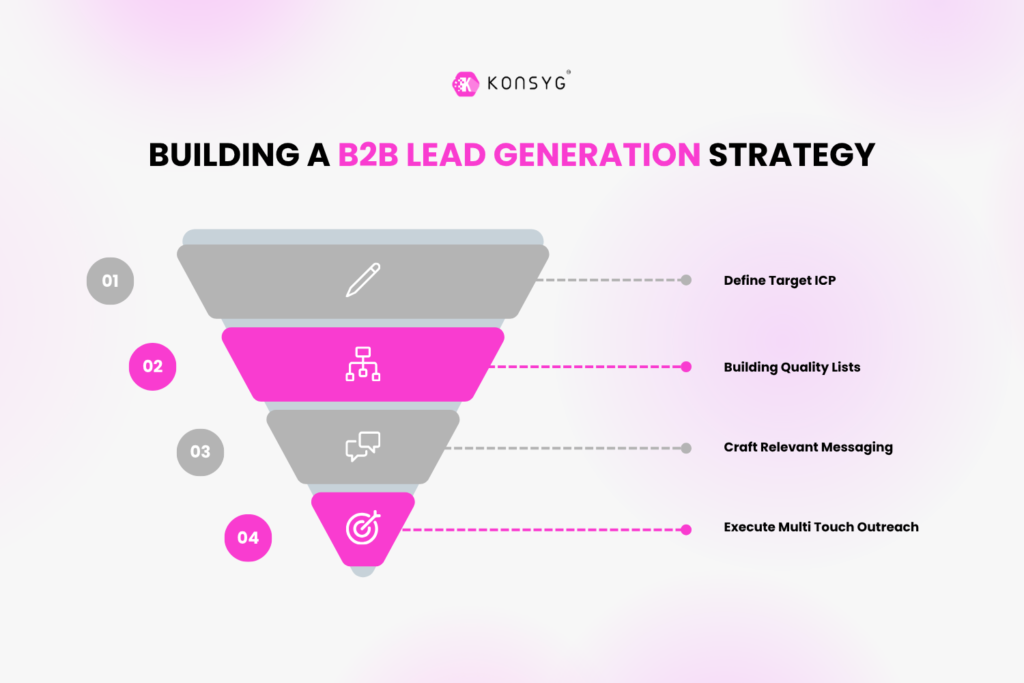
Building a B2B Lead Generation Strategy for Canada’s Tech Market
Once the channels are clear, the focus shifts to execution.
In Canada’s tech market, B2B lead generation strategies need to be structured with tighter control. The margin for error is smaller because the audience is smaller. Poor targeting or weak messaging does not just reduce performance. It limits your entire pipeline.
This is why strategy matters more than volume.
Defining a Narrow Ideal Customer Profile
A broad ICP does not work well in Canada.
Instead of targeting “SaaS companies” or “mid-sized businesses,” high-performing teams narrow this down further. They focus on specific industries, company sizes, funding stages, and even geographic clusters within Canada.
For example, targeting Series A SaaS companies in Toronto within fintech or healthtech creates a much more defined pool. This makes outreach more relevant and improves response rates.
The goal is not to maximise reach. It is to maximise relevance.
Building High-Quality Target Lists
Once the ICP is defined, list building becomes critical.
In a smaller market, list quality directly impacts results. Outdated data, incorrect job roles, or poorly segmented lists quickly reduce campaign performance.
Strong lead generation strategies rely on:
- Accurate company data
- Correct decision-maker identification
- Segmentation based on industry and growth stage
This allows campaigns to stay focused and prevents wasted outreach.
Crafting Market-Relevant Messaging
Messaging is where most B2B lead generation efforts fail.
Canadian buyers tend to respond better to clarity and relevance than to aggressive sales tactics. Overly promotional language or vague value propositions often get ignored.
Effective messaging is:
- Specific to the prospect’s industry
- Focused on a clear problem
- Direct and easy to understand
Referencing common challenges in Canada’s tech ecosystem, such as slower sales cycles or resource constraints, can make outreach feel more grounded.
Structuring Outreach Sequences
Consistency is key in Canada’s market.
Most responses do not come from the first message. They come from follow-ups that add context or reinforce value.
A typical sequence includes:
- An initial outreach message
- Multiple follow-ups spaced over time
- Variations in messaging to avoid repetition
The goal is to stay visible without becoming repetitive.
Aligning Channels for Better Results
No single channel drives consistent results on its own.
Strong B2B lead generation strategies in Canada align outbound and inbound efforts. Cold email initiates contact. LinkedIn supports credibility. Content builds trust over time.
When these channels work together, conversion rates improve across the board.
Common Mistakes in B2B Lead Generation in Canada’s Tech Market
Even with the right channels and strategy in place, many B2B tech companies in Canada struggle to generate a consistent pipeline. In most cases, the issue is not effort. It is misaligned with how the market actually works.
Targeting Too Broad an Audience
One of the most common mistakes is trying to reach too many companies at once.
In a smaller market like Canada, broad targeting quickly leads to weak results. Campaigns become less relevant, messaging feels generic, and response rates drop.
Companies that perform well focus on a narrow segment. They prioritise relevance over reach and build campaigns around clearly defined customer profiles.
Relying on Volume Over Precision
High-volume outreach might work in larger markets, but it rarely works in Canada.
Sending thousands of emails or connection requests without strong targeting and messaging leads to low engagement. It also risks damaging the domain’s reputation over time.
A smaller, well-qualified list with thoughtful outreach tends to outperform large-scale campaigns.
Generic Messaging
Messaging that could apply to any company does not work.
Canadian buyers expect clarity and context. If the message does not immediately connect to their situation, it gets ignored.
Strong campaigns focus on:
- Specific industry challenges
- Clear value propositions
- Direct and simple language
The difference between a generic message and a relevant one often determines whether a conversation starts at all.
Inconsistent Follow-Ups
Many companies stop too early.
In Canada’s tech market, responses often come after multiple touchpoints. Buyers take time to evaluate, and initial outreach is rarely enough.
Inconsistent follow-ups lead to missed opportunities. A structured sequence with clear spacing and variation improves overall response rates.
Treating Channels in Isolation
Another common issue is treating each channel separately.
Running cold email, LinkedIn, and content without alignment reduces effectiveness. Prospects often engage across multiple touchpoints before responding.
When channels are connected, results improve. Outreach feels more consistent, and credibility builds over time.
Ignoring Market-Specific Dynamics
Applying strategies from larger markets without adapting them to Canada is a frequent mistake.
What works in the US does not always translate directly. Differences in market size, buyer behaviour, and budget sensitivity require adjustments.
Companies that recognise these differences early are better positioned to generate a stable pipeline.
Frequently Asked Questions (FAQ)
What is B2B lead generation in Canada’s tech market?
B2B lead generation in Canada’s tech market refers to the process of identifying and engaging potential business customers for tech products or services through channels such as cold email, LinkedIn, content, and paid campaigns.
What makes Canada different is the smaller market size and more cautious buying behaviour. Companies often deal with fewer but more qualified prospects, making precision more important than scale.
Why is B2B lead generation challenging in Canada?
Generating consistent leads in Canada is difficult due to longer sales cycles, smaller target markets, and increased competition.
Nearly 45% of B2B companies report struggling to generate enough leads, while lead quality remains a major issue for over 40% of businesses.
This means companies need stronger targeting and better follow-up processes rather than simply increasing outreach volume.
Which channels work best for B2B lead generation in Canada?
The most effective channels include:
- Cold email for direct outreach
- LinkedIn for credibility and relationship building
- Content marketing for inbound demand
- Paid campaigns for targeted reach
Email remains one of the most effective channels, with 73% of B2B buyers preferring email communication.
However, the best results come from combining multiple channels rather than relying on a single channel.
How important is personalisation in B2B lead generation?
Personalisation is critical.
Modern B2B buyers expect tailored communication, and 76% of buyers now expect more personalised engagement from companies.
Generic messaging does not perform well, especially in Canada’s tech market, where decision-makers are selective and often receive multiple outreach attempts.
How long does it take to generate results from B2B lead generation?
B2B lead generation is not immediate.
In many cases, 63% of B2B leads do not convert for at least three months, highlighting the importance of consistent follow-ups and nurturing.
This is especially true in Canada, where decision-making cycles tend to be slower and involve multiple stakeholders.
What role does content play in B2B lead generation?
Content plays a supporting but essential role.
Around 76% of marketers use content marketing to generate leads, making it one of the most widely used strategies.
In Canada’s tech market, content helps build trust and credibility, particularly during longer evaluation cycles.
What is the biggest mistake companies make?
The biggest mistake is prioritising volume over relevance.
Sending more messages without improving targeting or messaging leads to low response rates and wasted effort. Companies that focus on smaller, well-defined audiences tend to see better results.
Conclusion
B2B lead generation in Canada’s tech market is not about doing more. It is about doing it right.
The market is smaller, the buyers are more selective, and the sales cycles are longer. This makes precision, consistency, and alignment across channels far more important than scale.
Companies that succeed are those that define a clear audience, craft relevant messaging, and execute outreach in a structured way. They do not rely on a single channel or campaign. They build systems that, over time, generate a pipeline.
If your current approach is not delivering consistent results, it is often not a lack of effort. It is a lack of alignment with how the market actually works.
Book a call with Konsyg to build a B2B lead generation strategy tailored for Canada’s tech market.
Share This Post
Recent Posts
What We Offer
Get Your Quote