

What Is B2B Lead Generation? Everything You Need to Know to Book Meetings in Singapore
In Singapore, where markets are competitive and decision-makers are highly selective, B2B lead generation goes beyond just generating interest.
B2B lead generation is a vital process in business-to-business marketing. It involves attracting, nurturing, and converting leads into customers to drive consistent revenue and long-term business growth.
In Singapore, where markets are competitive and decision-makers are highly selective, B2B lead generation goes beyond just generating interest. It requires a focused approach to reach the right companies and engage them effectively.
Without an effective B2B lead generation strategy, businesses often struggle to build a reliable pipeline of qualified leads. While generating awareness is one part of the process, attracting the right prospects and keeping them engaged as they move through the sales funnel is where most companies face challenges.
In this guide, we will cover the top B2B lead generation strategies, tools, and channels used by high-performing teams in Singapore to consistently generate qualified leads and book sales meetings.
What is B2B Lead Generation?
B2B lead generation is the process B2B businesses use to find, attract, and engage potential customers. It is a critical part of both marketing and sales, helping companies improve conversion rates and build a consistent pipeline of qualified leads.
The first step in B2B lead generation is identifying businesses that are most likely to benefit from your products or services. In competitive markets like Singapore, this step is essential, as targeting the wrong audience often leads to low response rates and wasted outreach.
Once your target audience is defined, you can capture potential customers’ contact information using a range of lead-generation strategies, including outbound outreach, inbound campaigns, and targeted prospecting.
Using this data, businesses can begin reaching out with personalised marketing campaigns and relevant sales messaging. The goal is to start meaningful conversations with decision-makers, not just generate interest.
As you engage with prospects and guide them through the sales funnel, you gain deeper insights into their needs, challenges, and readiness to buy. This allows you to segment and prioritise leads more effectively, improving your chances of converting them into sales meetings and long-term customers.
Why B2B Lead Generation Matters
For most B2B businesses, growth does not happen by waiting for customers to come in. B2B lead generation creates a steady, predictable pipeline of qualified leads that can convert into real revenue.
In competitive markets like Singapore, where decision-makers are selective and sales cycles are longer, relying solely on inbound interest often yields inconsistent results. A structured lead generation strategy ensures that businesses can consistently reach the right prospects and create new sales opportunities.
Without effective B2B lead generation, scaling revenue becomes difficult. Fewer leads mean fewer conversations, fewer meetings, and ultimately fewer closed deals. It also limits access to valuable lead data, which plays a key role in improving targeting and messaging.
Lead generation data provides insights into how your target audience behaves, what they respond to, and when they are most likely to engage. By analysing this data, businesses can refine their outreach, improve lead nurturing, and increase conversion rates across the sales funnel.
| Lead Type | Description | Intent Level | Typical Behaviour |
|---|---|---|---|
| Marketing Qualified Leads (MQLs) | Prospects who have shown initial interest in your product or service | Low to Medium | Blog visits, webinar sign-ups, and content downloads |
| Sales Qualified Leads (SQLs) | Prospects who show clear buying intent and are ready for sales engagement | High | Demo requests, pricing page visits, direct enquiries |
The key difference between MQLs and SQLs lies in their readiness to buy. An MQL may still be exploring options, while an SQL is actively considering a purchase and is more likely to engage in a sales conversation.
Another way to distinguish between the two is through content engagement. MQLs are typically in the research phase, interacting with educational content such as blogs and webinars. SQLs, on the other hand, engage with high-intent content like case studies, product demonstrations, and pricing pages.
Understanding this difference allows businesses to tailor their B2B lead generation strategy more effectively. Instead of treating all leads the same, teams can prioritise high-intent prospects and guide them towards sales meetings more efficiently.
Top B2B Lead Generation Strategies in Singapore
Effective B2B lead generation strategies vary from business to business. There is no one-size-fits-all approach. Success depends on understanding your target audience, choosing the right channels, and executing consistently.
In Singapore, where competition is high and decision-makers are selective, the focus is not just on generating leads. It is on attracting high-quality leads that can convert into real sales conversations and meetings.
By using the right mix of B2B lead-generation channels, businesses can build a strong, predictable pipeline. The goal is not just visibility, but engagement that leads to qualified opportunities.
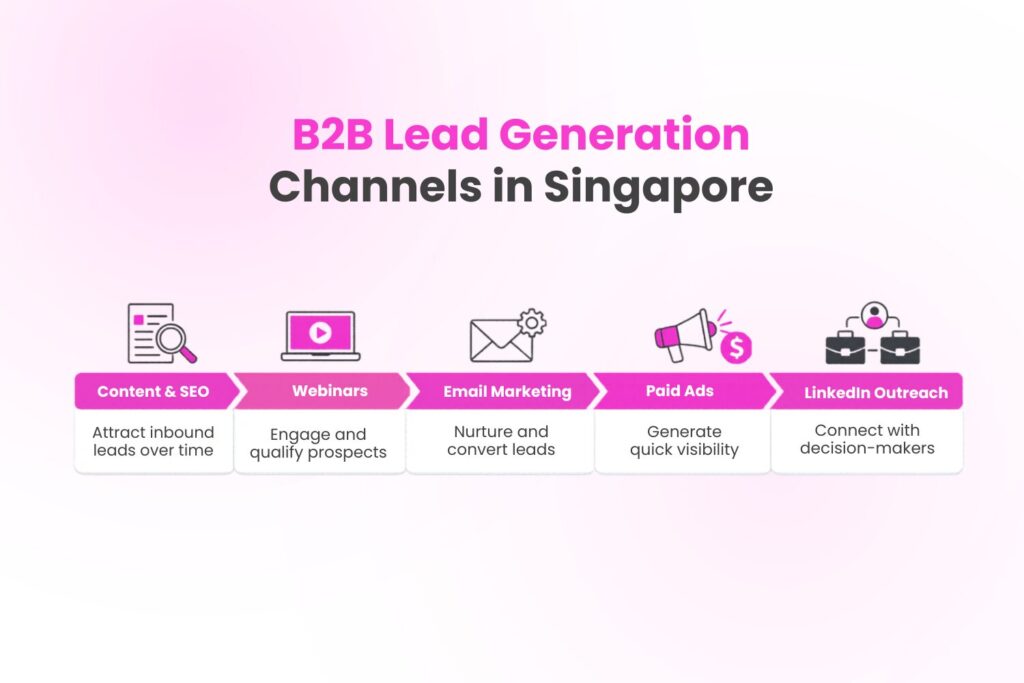
- Content Marketing and SEO
Content marketing is one of the most reliable ways to attract and nurture B2B leads over time. By creating valuable content such as blogs, whitepapers, and case studies, businesses can address common challenges and position themselves as industry experts.
However, content alone is not enough. Without proper SEO (search engine optimisation), even high-quality content may not reach the right audience. Optimising content ensures that businesses appear when potential customers actively search for solutions.
A structured approach typically includes keyword research, content planning, optimisation, and performance tracking.
In Singapore, this strategy works best for building long-term visibility and trust, especially in industries where buyers conduct extensive research before engaging with vendors.
- Webinars and Events
Webinars are a highly effective way to generate and qualify B2B leads. They allow businesses to demonstrate expertise while engaging directly with prospects.
Compared to static content, webinars create a more interactive experience through Q&As, polls, and discussions. This helps businesses understand audience needs and identify high-intent leads.
They also provide valuable data. Attendee behaviour can be used to segment leads into MQLs and SQLs, making follow-up more targeted and effective.
- Email Marketing
Email marketing remains one of the most effective lead-nurturing strategies in B2B.
It allows businesses to stay in touch with prospects, share relevant content, and guide them through the sales funnel. Because campaigns can be personalised and automated, email is especially useful for maintaining consistent engagement.
Segmentation plays a key role here. By grouping leads based on behaviour, industry, or intent, businesses can send more relevant messages and improve conversion rates.
- Paid Advertising and PPC
Paid advertising, including PPC (pay-per-click) campaigns, helps businesses generate leads quickly by targeting high-intent keywords.
Unlike SEO, which takes time, PPC delivers immediate visibility. This makes it useful for testing campaigns or scaling lead generation efforts in a short period.
Platforms like Google Ads and LinkedIn Ads are particularly effective in Singapore, where targeting decision-makers by role, company size, and industry can significantly improve lead quality.
- LinkedIn Outreach
LinkedIn is one of the most powerful platforms for B2B lead generation in Singapore.
It allows businesses to connect directly with decision-makers using personalised messaging. Unlike broad marketing channels, LinkedIn outreach is more targeted and often leads to higher response rates when executed correctly.
When combined with content and email, it becomes a key driver of sales conversations and meetings.
Tools for Effective B2B Lead Generation
The growth of B2B marketing technology has made it easier to manage every stage of the lead generation process. From identifying prospects to scoring and nurturing leads, the right tools can significantly improve efficiency and results.
However, tools alone do not generate leads. Their effectiveness depends on how well they are integrated into a clear B2B lead generation strategy.
CRM Systems and Lead Scoring
CRM systems play a central role in managing and converting B2B leads.
One of their most important functions is lead scoring, which helps businesses prioritise prospects based on their behaviour, engagement, and fit. Instead of treating all leads equally, teams can focus on those most likely to convert into sales meetings.
A well-implemented CRM provides a complete view of each lead, including:
- contact details
- engagement history
- communication preferences
- buying intent signals
By assigning values to these data points, businesses can generate a lead score that reflects a prospect’s readiness to move forward.
Modern CRM platforms can automate this process using predefined criteria, ensuring that high-potential leads are identified quickly and consistently. This not only improves efficiency but also strengthens alignment between marketing and sales teams, reducing friction when moving leads from MQL to SQL.
Lead Generation Tools
While CRM systems help manage existing leads, lead generation tools are used to identify and connect with new prospects.
These tools provide access to large databases of verified contacts, allowing businesses to find decision-makers that match their ideal customer profile (ICP).
| Tool | What It Does | Best Use Case |
|---|---|---|
| Hunter.io | Finds and verifies professional email addresses | Email outreach and prospecting |
| UpLead | Provides access to verified B2B contact data | Targeted lead lists |
| LinkedIn Sales Navigator | Advanced prospecting on LinkedIn | Reaching decision-makers directly |
Best Practices to Convert B2B Leads into Sales Meetings in Singapore
The goal of B2B lead generation is not just to generate leads, but to convert them into sales meetings and paying customers. Every interaction throughout the buying journey influences whether a prospect moves forward or drops off.
In Singapore, where buyers are selective and decisions often involve multiple stakeholders, businesses need a more structured and consistent approach to convert qualified leads into real opportunities.
Personalising Outreach
B2B buyers do not respond to generic messaging. They need to clearly see how your product or service fits their specific challenges before committing budget.
Each prospect has different priorities, so outreach needs to be tailored based on industry, company size, role, and stage in the sales funnel. This includes personalised messaging, relevant content, and the right choice of communication channel.
Using lead data effectively allows businesses to create outreach that feels relevant rather than promotional. When messaging reflects a prospect’s actual needs, it becomes easier to build trust and move them towards sales conversations.
Timing and Follow-Up
Timing plays a critical role in lead nurturing. Even strong interest can fade if follow-ups are delayed or inconsistent.
In Singapore, decision-making cycles can be longer and more structured, which makes consistent follow-up essential. Businesses that stay visible and relevant throughout the process are more likely to convert leads into opportunities.
An effective approach involves using multiple channels depending on the stage of the buyer journey. Early-stage leads tend to engage more with educational content, while later-stage prospects respond better to direct outreach.
Automated email sequences: Help maintain consistency by guiding leads through a structured journey, moving from introduction to value demonstration and eventually to a meeting request. A typical sequence progresses from a clear value proposition to useful resources, followed by product insights, case studies, and a direct invitation to speak.
Triggered responses: They also play an important role. Following up after specific actions, such as webinar participation or content engagement, allows businesses to build on existing interest and maintain momentum.
Retargeting: It can further support this process by keeping your brand visible to prospects who have already shown intent but have not yet converted.
At the same time, outreach frequency should match the lead’s level of engagement. As interest increases, communication can become more direct and frequent, helping move prospects closer to a decision.
Monitoring lead generation metrics is essential for refining this approach. By analysing engagement patterns and conversion data, businesses can continuously optimise their timing and follow-up strategy to improve results.
Frequently Asked Questions (FAQ’s)
What is B2B lead generation?
B2B lead generation is the process of identifying and engaging potential business customers. It focuses on reaching the right companies, building interest, and guiding them towards sales conversations and meetings.
Why is B2B lead generation important for businesses in Singapore?
In Singapore, competition is high, and buyers are selective. Without a strong B2B lead generation strategy, businesses often struggle to maintain a consistent pipeline of qualified leads, which directly affects revenue and growth.
What are the most effective B2B lead generation strategies?
The most effective B2B lead generation strategies typically combine multiple channels. Businesses rely on content marketing and SEO for long-term visibility, while outbound channels such as LinkedIn and email are used to generate faster engagement and move leads towards sales conversations.
What is the difference between MQL and SQL?
A Marketing Qualified Lead (MQL) is a prospect who has shown initial interest but is still in the research stage. A Sales Qualified Lead (SQL), on the other hand, shows clear buying intent and is ready for direct sales engagement. Understanding this distinction helps teams prioritise leads more effectively.
How long does B2B lead generation take?
The timeline for B2B lead generation depends on the approach. Outbound and paid strategies can generate leads relatively quickly, while content and SEO take longer but build a more sustainable pipeline. In Singapore, longer decision cycles often require consistent follow-up before leads convert.
What tools are used for B2B lead generation?
Businesses typically use a mix of tools to manage and generate leads. CRM systems help track interactions and prioritise prospects, while platforms like LinkedIn Sales Navigator and email outreach tools support direct engagement with decision-makers.
How do you convert B2B leads into customers?
Converting B2B leads requires a combination of personalised outreach, consistent follow-up, and relevant communication. The focus should be on building trust and moving prospects towards a sales conversation, which increases the likelihood of conversion.
What is the biggest challenge in B2B lead generation?
The biggest challenge is not generating leads, but converting them into qualified opportunities. Many businesses struggle to target the right audience and maintain consistent engagement, making it difficult to move leads toward sales meetings.
Conclusion
B2B lead generation is essential for building a consistent pipeline of qualified leads that can convert into real business opportunities. It is not just about generating interest, but about creating meaningful engagement that leads to sales conversations and revenue.
In Singapore, where competition is high and decision-making processes are more structured, businesses need a clear and consistent approach. Combining the right B2B lead generation strategies, tools, and follow-up methods makes it easier to move prospects through the sales funnel and improve conversion rates.
However, execution is where most businesses struggle. Identifying the right prospects, maintaining consistent outreach, and converting leads into sales meetings requires time, precision, and experience.
If you are looking to build a predictable pipeline and consistently book meetings, you can book a call with Konsyg for B2B lead generation in Singapore.
Share This Post
Recent Posts
What We Offer
Get Your Quote