

Many UK B2B companies are already spending between £5,000 and £15,000 a month on lead generation.
The assumption is simple.
If the budget is there, the pipeline should follow.
But that is rarely the case.
Leads come in, but they do not convert.
Meetings get booked, but they do not turn into deals.
Activity looks strong on paper, but revenue does not reflect it.
The issue is not effort.
And it is not a lack of tools.
It is that most teams do not have a clear handle on what “working lead generation” actually looks like in the UK market.
This is why even at £10K a month, results feel inconsistent.
Where the £10K Actually Goes
To understand why results fall short, it helps to look at where the budget is being spent.
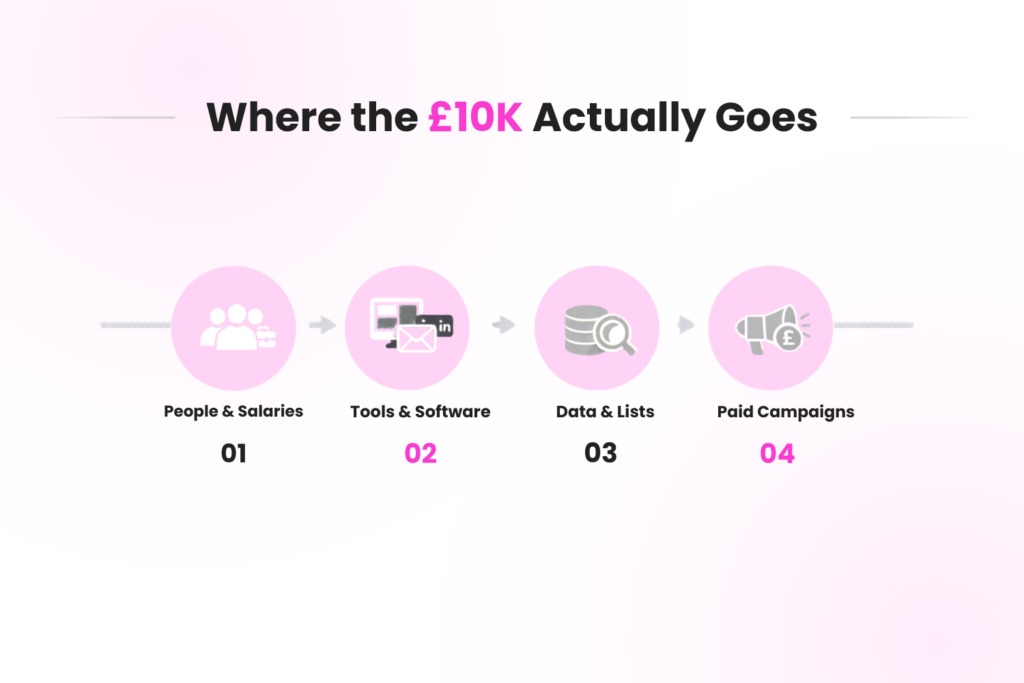
For most UK B2B companies, that £10K is spread across a few key areas.
A large portion goes into people. This could be an in-house SDR or a small external team handling outreach. Salaries, retainers, and commissions quickly add up.
Then come the tools. Data platforms, email infrastructure, LinkedIn subscriptions, and sequencing tools are now standard. Individually, they feel manageable. Together, they become a high monthly cost.
On top of that, there is spending on data. Lists, contact databases, and enrichment tools are meant to improve targeting, but they often introduce their own set of issues if not handled carefully.
In some cases, companies also layer in paid campaigns, adding another stream of spend expected to support lead-generation efforts.
On paper, this setup should be enough to generate a steady flow of qualified leads.
But in practice, most teams struggle to connect this spend to a consistent pipeline.
That is where the gap begins.
More Outreach Is Not the Fix
One of the most common assumptions in B2B lead generation is that increasing volume will improve results. When campaigns underperform, teams usually respond by scaling activity. More emails go out, more LinkedIn messages are sent, and larger contact lists are built.
On paper, this makes sense. More outreach should lead to more replies, more meetings, and a stronger pipeline. But for most UK companies, that is not what happens.
Response rates stay low, meetings do not translate into real opportunities, and the overall quality of leads remains inconsistent. The issue is not effort. It is that increasing volume does not address the underlying problem.
In the UK market, buyers are already used to outbound outreach. Most decision-makers receive multiple cold emails and messages every week. When the messaging is generic or poorly targeted, it gets ignored regardless of how often it appears.
This is where many B2B lead generation campaigns start to lose direction. Teams focus on reaching more people rather than the right people. They expand lists, increase touchpoints, and push harder on activity without improving relevance.
The result is predictable. As volume increases, engagement drops. Lower engagement leads to more aggressive outreach, which further reduces response rates. Over time, this creates a cycle in which activity increases but results do not.
Strong B2B lead generation in the UK does not come from doing more. It comes from being more precise. Fewer, well-targeted conversations will consistently outperform high-volume outreach that lacks focus.
Why Targeting Breaks Most B2B Lead Generation in the UK
A large part of the struggle with B2B lead generation in the UK does not come from outreach. It starts earlier, with how companies define their target audience.
Most teams work with a broad idea of their ideal customer but lack precision. This creates lists that look relevant but do not convert.
Common issues show up quickly:
- Targeting industries instead of specific buying roles
- Relying on outdated or incomplete contact data
- Including companies that are not actively in a buying cycle
- Missing key decision-makers involved in the purchase
Individually, these seem like small gaps. Together, they weaken the entire campaign.
Data quality adds another layer. Lists are often pulled and enriched at speed, then pushed into outreach without proper validation. This leads to emails and messages being sent to the wrong people or at the wrong time.
At this point, even strong outreach struggles to perform.
This is why many B2B lead generation efforts in the UK feel inconsistent. Teams increase activity, test new channels, and invest in tools, but the core issue remains unchanged.
The problem is not always what is being said. It is who it is being said to.
Improving targeting does not require more spend. It requires a clearer definition, better data discipline, and a stronger understanding of who is most likely to convert.
Without that foundation, even a well-funded lead generation strategy will continue to underperform.
What Actually Starts Working in B2B Lead Generation
At some point, most UK B2B teams realise the issue is not effort or budget. It is how that effort is directed.
The shift does not come from adding more tools or increasing outreach. It comes from tightening the entire approach.
A few changes consistently make the difference:
Clearer targeting from the start
Teams that perform well are specific about who they go after. Instead of broad industries, they focus on defined segments, roles, and buying signals. This reduces wasted outreach and improves response quality.
Fewer, more relevant conversations
High-performing campaigns do not aim for volume. They focus on reaching the right accounts with messaging that reflects actual context. This leads to better engagement and more meaningful discussions.
Messaging built on real problems
Instead of generic value propositions, effective outreach speaks directly to situations the buyer is already dealing with. This makes the message harder to ignore and easier to respond to.
Ongoing iteration, not fixed campaigns
Campaigns that work are constantly refined. Targeting is adjusted, messaging evolves, and outreach is shaped by what is actually getting responses, not assumptions.
This is where B2B lead generation in the UK starts to feel different.
| Step | Focus Area | What Changes | Outcome |
|---|---|---|---|
| 01 | Targeting | Right accounts and decision-makers instead of broad lists | Better fit and higher response quality |
| 02 | Outreach | Lower volume with higher relevance instead of mass messaging | More meaningful conversations |
| 03 | Messaging | Problem-led and context-driven instead of generic value props | Higher engagement from UK buyers |
| 04 | Iteration | Continuous testing and refinement instead of fixed campaigns | Consistent improvement over time |
The Gap Between Leads and Pipeline
One of the biggest disconnects in B2B lead generation, especially in the UK market, is the gap between activity and actual pipeline.
Most teams measure success based on visible metrics.
Replies, booked meetings, and campaign activity all give the impression that things are working.
But those numbers rarely tell the full story.
It is common to see calendars filling up while revenue remains flat. Leads come in, conversations happen, but very few of them progress into serious opportunities. Over time, this creates frustration because the effort feels high, but the commercial impact is low.
A few patterns tend to explain this gap:
- Leads are not properly qualified: Conversations start, but there is no clear alignment with budget, need, or timing. Meetings happen, but they do not move forward.
- Meetings are booked for volume, not intent: Outreach focuses on getting responses rather than identifying genuine buying signals. This leads to conversations that go nowhere.
- Sales and outreach are misaligned: What is promised in outreach does not always match what the sales team can deliver. This weakens trust early in the process.
- No clear definition of a “good lead”: Teams track activity but lack clarity on what actually qualifies as a valuable opportunity.
This is where many UK B2B companies feel stuck.
The lead generation effort appears active and even successful on the surface, but it does not translate into a predictable pipeline or revenue.
Strong B2B lead generation is not just about generating leads. It is about generating the right leads and ensuring they move forward.
Without that alignment, even a £10K monthly spend will continue to produce inconsistent results.
When It Makes Sense to Rethink Your Lead Generation Approach
By this stage, most UK B2B teams no longer question whether lead generation matters. They are questioning why their current approach is not delivering consistent results.
There is usually a point where the pattern becomes clear. The budget is in place, activity is ongoing, but the outcome does not improve. Instead of short-term dips, the issues start to repeat.
That is when a rethink becomes necessary.
A few signals tend to show up at this stage:
- Spending is consistent, but the pipeline is not
- Outreach is active, but conversations lack depth
- Internal teams are stretched across too many variables
- There is no clear path to improvement
This is where many companies pause and reassess how their lead generation is being handled.
For some, it means tightening internal processes and focusing on fewer, higher-quality campaigns. For others, it means bringing in external support to introduce structure, consistency, and a clearer link between outreach and pipeline.
The decision itself is less important than the shift in approach.
Lead generation starts to work when it is treated as a structured, continuously improving function rather than a set of isolated activities.
FAQ’s
What is a good cost per lead in the UK for B2B companies?
A good cost per lead in the UK varies by industry, but most B2B companies see costs ranging from £50 to £500. Higher-value industries such as SaaS, fintech, and cybersecurity tend to sit on the higher end due to longer sales cycles and more complex decision-making.
Why is my B2B lead generation not working in the UK?
In most cases, the issue comes down to three areas: weak targeting, generic messaging, and a lack of alignment between outreach and sales. Increasing volume rarely fixes the problem if these fundamentals are not addressed.
Is outsourcing B2B lead generation worth it for UK companies?
Outsourcing can be effective when internal teams lack the time, structure, or expertise to run consistent campaigns. It becomes especially valuable when companies need a predictable pipeline without having to build a full in-house team.
How long does it take to see results from B2B lead generation?
Most campaigns show early signals within the first few weeks, such as replies or meetings. However, a consistent pipeline usually takes 2 to 3 months, depending on targeting, messaging, and the complexity of the offering.
What matters more in B2B lead generation: volume or quality?
Quality consistently outperforms volume in the UK market. Reaching the right accounts with relevant messaging leads to better engagement and higher conversion rates than high-volume outreach with low relevance.
What £10K a Month Should Actually Be Delivering
By the time a UK B2B company is spending around £10K a month on lead generation, expectations are clear.
There should be consistency.
Not just activity, but a steady flow of conversations that move forward. Not just meetings but opportunities with a realistic chance of closing. At this level of investment, lead generation should start to feel like a system, not an experiment.
But for many teams, that is not the case.
Instead of consistency, results fluctuate. One month shows promise, the next drops off. Some campaigns generate replies but no pipeline. Others bring in meetings that do not convert.
This is where expectations and reality begin to separate.
At this stage, lead generation should be doing a few things reliably:
Producing conversations with the right decision-makers
Not just responses, but engagement from people who can actually move a deal forward.
Creating opportunities, not just meetings
The focus shifts from filling calendars to building a pipeline that sales teams can work with.
Maintaining momentum over time
Results should not depend on short bursts of activity. They should hold steady across weeks and months.
Giving visibility into what is working
There should be a clear understanding of which segments, messages, and channels are driving results.
When these outcomes are missing, the issue is not subtle.
It means the system behind the spending is not yet strong enough.
And that is usually the point where companies stop asking how to do more, and start asking how to make what they are already doing actually work.
How Konsyg Approaches B2B Lead Generation in the UK
Most companies we speak to are not starting from zero.
They already have outreach running. There is a team in place, tools are set up, and campaigns are live. On the surface, everything looks like it should be working.
But when you look at the pipeline, it is inconsistent.
That is usually where we come in.
Not to rebuild everything, but to fix what is already there.
The first step is understanding where the breakdown is happening. In some cases, the targeting is too broad. In others, the messaging is not landing. Sometimes the issue is not obvious until you look at how leads are moving through the pipeline.
Once that is clear, the focus shifts to tightening the system.
- narrowing down the accounts that are actually worth pursuing
- improving how outreach is structured and sequenced
- Rewriting messaging so it reflects the real buyer context
- and making sure campaigns are adjusted based on what is working
Nothing here is complicated on its own.
But when these pieces start working together, the results become more predictable.
That is usually the difference.
Not more activity, but better alignment between what is being done and what actually drives the pipeline.
If you are already investing in B2B lead generation but not seeing a consistent pipeline, it is worth stepping back and looking at how everything is working together. In many cases, a few focused changes can make a significant difference in how outreach performs and how leads convert.
If that is something you are looking to fix, you can book a call with Konsyg.
Share This Post
Recent Posts
What We Offer
Get Your Quote