

Buyers are responding to fewer messages.
In some industries, companies generate thousands of outbound touches every month yet still struggle to create consistent sales conversations.
A few years ago, a decent list, basic personalisation, and enough outbound volume could still produce meetings fairly predictably. That environment no longer exists, especially in crowded B2B markets across the USA.
The infrastructure side became harder, too.
Deliverability is no longer a background technical issue. Many outbound campaigns now fail long before a buyer even sees the message.
Domains burn faster. Microsoft became stricter. Google became stricter. Spam filtering became less forgiving. A surprising number of outbound teams still underestimate how much this affects results.
At the same time, buyers have become more selective about who they engage with. Relevance matters more. Timing matters more. Credibility matters more. Generic outbound struggles much faster now than it did in 2023 or even early 2024.
What is interesting is that some outbound teams are still performing extremely well in this environment.
But they usually don’t operate the way most companies expect.
The teams producing consistent meetings in 2026 are often sending fewer emails, researching accounts more carefully, tightening targeting, improving infrastructure, and focusing heavily on message quality instead of pure activity volume.
That shift is reshaping B2B lead generation in the USA right now.
And if you want a strong B2B lead generation strategy for your business in the U.S., click this button to schedule a call.
Why B2B Lead Generation in the USA Feels Different in 2026
One of the biggest problems in B2B lead generation in the USA right now is that many outbound programmes still look healthy inside company dashboards, even when they are producing very little actual sales momentum.
This is happening far more often than most leadership teams realise.
A company sees outbound activity increasing: SDRs are sending large numbers of emails every week, meetings are still appearing on calendars, LinkedIn outreach is active, and reporting dashboards continue to show movement across the funnel. From the outside, the outbound engine appears operational.
But underneath that activity, something weaker is happening.
Sales cycles are slowing down. Prospects are replying later. Discovery calls are producing lower progression rates. More conversations are ending after the first meeting. In many cases, the pipeline appears larger, while actual buying intent weakens.
That distinction matters enormously in modern B2B lead generation in the USA because outbound volume has become much easier to manufacture with the rise of AI-assisted sales tooling.
A few years ago, high outbound activity itself created a competitive advantage because relatively few companies had mature SDR systems, sequencing tools, prospecting infrastructure, or scalable outbound workflows.
Today, almost every outbound sales agency, SDR outsourcing provider, and internal sales team has access to similar tooling.
The barrier to sending outbound collapsed.
The barrier to creating genuine buyer interest did not.
According to the Landbase report, 81% of business buyers now know their preferred sales vendor before first contact.
That expectation is reshaping outbound performance across the US market because many outreach systems are still designed around operational efficiency rather than commercial relevance.
This is where a surprising number of outbound campaigns quietly begin breaking down.
The reporting layer often still rewards activity: emails sent, outbound touches, sequence volume, connection requests, and meeting counts.
But buyers do not experience outbound through internal SDR dashboards.
Buyers experience it through attention.
And attention became significantly harder to earn in 2026.
Many decision-makers are now receiving outreach that sounds structurally identical across vendors. The same “personalised” introductions. The same AI-assisted formatting. The same broad value propositions. The same meeting requests appear in slightly different wording across hundreds of emails every month.
In practice, this creates a strange situation where companies increase outbound effort while prospects emotionally disengage from outbound as a channel.
That does not mean outbound sales stopped working.
Far from it.
Some outbound teams are still performing extremely well in the current environment. What changed is that the strongest teams are no longer relying on pure activity scale as their main advantage.
Instead, they are becoming far more selective operationally.
They narrow account targeting more aggressively. They spend longer researching prospects before launch. They pressure-test messaging harder. They pay closer attention to timing, account maturity, and actual buying context rather than relying entirely on automation sequences to generate conversations.
That shift is quietly becoming one of the defining realities of modern B2B lead generation.
See how modern outbound teams are adapting to changing buyer behaviour in the US market.
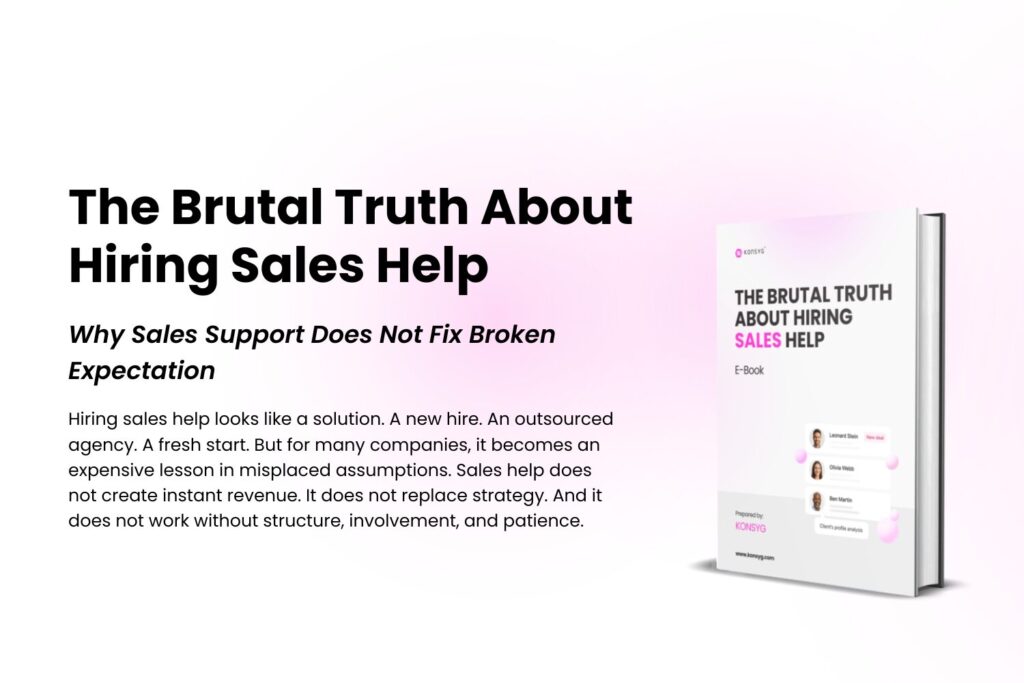
[Download Konsyg’s The Brutal Truth About Hiring Sales Help]
What Is Actually Creating Conversations in 2026
One thing a lot of companies are discovering right now is that outbound performance changes significantly when targeting becomes narrower.
For years, many SDR teams were taught to maximise coverage. Bigger prospect lists meant more potential pipeline. More outbound meant more opportunities to find interested buyers at some point in the sequence.
That logic became weaker once outreach volume exploded across the US market.
The outbound teams producing strong results in 2026 are often operating with far more restraint than people expect.
- Smaller account pools.
- Tighter ICP definitions.
- More selective prospecting.
- Longer research before launch.
That sounds slower operationally, but it usually creates stronger conversations because the outreach feels commercially relevant instead of broadly distributed.
That shift is changing how stronger outbound teams structure campaigns.
A cybersecurity company selling into enterprise finance should not sound like a SaaS company selling into mid-market operations teams. A manufacturing prospect in Texas should not receive the same outbound positioning as a VC-backed software company in New York.
A surprising amount of outreach still ignores those distinctions.
| What Weaker Campaigns Still Prioritise | What Stronger Teams Focus on |
|---|---|
| Prospect volume | Account relevance |
| Broad messaging | Industry-specific positioning |
| Sequence activity | Buyer engagement quality |
| Generic personalisation | Commercial context |
| Outreach scale | Conversation depth |
The Companies Getting Better Results Are Building Trust Before Outreach
Buyers Research Before They Reply: One major shift in the US market is that outbound is no longer the first real interaction buyers have with a company.
Before replying, many prospects now check: the website, leadership team, LinkedIn activity, case studies, client proof, and whether the company actually understands the space it is selling into.
That behaviour is becoming much more common across modern B2B lead generation.
According to Edelman’s B2B Thought Leadership Impact Report, 64% of decision-makers say thought leadership content is a more trustworthy way to evaluate a company than traditional marketing materials.
Outbound Alone Is Not Creating Trust Anymore: A few years ago, a strong SDR sequence could often create enough curiosity to start a conversation. That became harder once outbound volume increased across almost every industry.
The companies performing well now usually support outreach with: visible expertise, stronger positioning, educational content, customer proof, and leadership presence.
This is one reason outbound campaigns often perform differently, even when two companies use similar prospecting tools or SDR workflows.
Buyers respond differently when the company is already perceived as credible.
Market Authority Is Becoming Part of Outbound Strategy: The strongest outbound teams in 2026 are increasingly treating content, positioning, and SDR execution as a single system.
- A founder discussing industry problems publicly.
- A company publishing useful operational insight.
- Clear case studies.
- Recognisable positioning.
Those things now influence reply behaviour much earlier in the sales cycle than many teams expected.
That shift is quietly changing how modern outbound works in the USA.
See how modern outbound teams are combining SDR execution with stronger market positioning and buyer trust.
Watch William Gilchrist, founder of Konsyg, share his outbound insights.
Deliverability Quietly Became One of the Biggest Problems in Outbound Sales
Many companies still think that outbound struggles begin with messaging.
In reality, many campaigns fail before the prospect even sees the email.
That became much more common after Google and Microsoft tightened sender requirements over the last two years. Domains now burn faster, spam filtering became less forgiving, and poor infrastructure setups damage outbound performance much earlier than many SDR teams expect.
This is one reason some companies continue to increase outbound activity while reply rates steadily weaken.
The important part is that deliverability problems rarely look dramatic at first.
- Campaigns still send successfully.
- Sequences still run.
- Open tracking may still appear healthy.
But actual buyer visibility slowly weakens over time.
Many outbound teams only notice the issue once conversation quality drops consistently across multiple campaigns.
More Companies Are Moving Back Toward Smaller, More Experienced SDR Teams
One interesting shift happening across the US market right now is that many companies are becoming less obsessed with aggressively scaling outbound headcount.
A few years ago, growth often meant building larger SDR teams, launching more sequences, and increasing outbound coverage as quickly as possible.
Now, many companies are becoming more cautious about that approach.
Part of the reason is that buyers became harder to engage with generic outreach. But another part is that outbound mistakes have become more expensive.
- Weak targeting damages domains faster.
- Poor positioning burns buyer trust faster.
- Low-quality outreach creates noise instead of a pipeline.
That is pushing many companies toward smaller outbound teams with higher execution quality, rather than larger teams built mainly on activity volume.
This is also changing what companies expect from outbound sales partners.
There is more focus now on:
- strategic thinking
- message quality
- market understanding
- SDR maturity
- account research
- sales judgment
The interesting part is that some of the strongest outbound programmes in 2026 actually look less operationally aggressive from the outside.
Frequently Asked Questions
Why are reply rates dropping across many outbound campaigns in the USA?
Many buyers are receiving significantly more outreach than they did a few years ago. The issue is not just inbox volume. Many outbound campaigns now sound structurally similar, which makes it easier for buyers to ignore messaging that feels generic or disconnected from their actual priorities.
Is cold email still effective in 2026?
Yes, but the way strong outbound teams operate has changed considerably. Better targeting, stronger positioning, cleaner infrastructure, and commercially relevant messaging matter far more now than pure outbound volume alone.
Why are companies becoming more selective with prospecting?
Broader prospect lists often generate more internal activity but weaker downstream buyer engagement. Many companies discovered that tighter account selection and stronger market relevance produce healthier conversations than large-scale outreach.
What industries are still responding well to outbound sales?
Outbound continues performing well across sectors where timing, positioning, and commercial context matter heavily. SaaS, professional services, cybersecurity, manufacturing, fintech, logistics, and enterprise technology companies continue to generate strong outbound results when execution quality is high.
Why are companies investing more in positioning and thought leadership?
Buyers increasingly research vendors before replying. Leadership visibility, case studies, educational content, and industry expertise now influence whether outreach feels credible in the first place.
What changed most about outbound sales over the last two years?
The barrier to sending outbound collapsed because automation became widely accessible. The harder challenge now is creating outreach that feels commercially relevant enough to earn genuine buyer attention.
Conclusion
Many companies entered 2026 expecting that more outbound activity would automatically create more pipeline.
Instead, many discovered that modern buyers have become harder to engage, more selective with their attention, and far quicker to ignore outreach that feels generic or overly automated.
That does not mean outbound stopped working in the USA.
It means the companies still producing strong results are operating differently now.
The strongest teams are no longer trying to reach everybody.
They are trying to sound relevant to the right buyers at the right moment.
That shift is quietly reshaping modern B2B lead generation in the USA.
If your outbound strategy still looks similar to what worked a few years ago, it is probably time to rethink how conversations are created, how trust is built, and how buyer attention is earned in today’s market.
See how Konsyg helps companies build outbound systems designed for the realities of modern B2B sales.
Share This Post
Recent Posts
What We Offer
Get Your Quote