

Forget about chasing volume. For most AI companies in Canada, the challenge is not getting more leads. It is reaching the right companies, saying something that actually lands, and using the right B2B lead generation tools to turn that into a consistent pipeline.
This guide explains:
- What B2B lead generation actually looks like for AI companies today
- How inbound and outbound work together when supported by the right tools
- Why data quality, targeting, and compliance directly impact results in Canada
- How to build a lead generation system that scales with your business
If you are responsible for revenue, expansion, or entering a new market, the difference is not in how many tools you use. It is in how well your B2B lead generation tools and execution work together. That is what determines whether you end up with a pipeline or just an activity.
What is lead generation?
B2B lead generation is the process of identifying companies that match your ideal customer profile and moving them towards a meaningful sales conversation.
For AI companies in Canada, this is rarely a simple handoff. Buyers are more informed, sales cycles are longer, and multiple stakeholders are involved. That means lead generation is not just about collecting contacts. It is about reaching the right accounts at the right time with the right message.
This typically involves using B2B lead generation tools to capture and validate company and contact data through channels such as outbound outreach, targeted campaigns, events, and content.
However, effective lead generation depends on more than tools alone. You need accurate data, clear segmentation, and a structured approach to outreach. In Canada, compliance and data handling also play a role in how you build and activate a pipeline.
What is the difference between lead generation and demand generation?
We have covered this in more detail elsewhere, but the difference comes down to intent, timing, and how results are measured.
Demand generation is focused on building awareness and interest. It reaches a broader set of companies, including those that are not yet actively looking for a solution. The goal is to create visibility, educate the market, and influence future buying decisions.
B2B lead generation, on the other hand, is where that interest turns into action. It focuses on specific accounts and decision-makers, using structured outreach and B2B lead generation tools to move them into real sales conversations.
In practice:
Demand generation builds interest.
Lead generation turns that interest into a pipeline.
For revenue teams, this distinction matters because each requires a different approach to data, targeting, and execution.
When both are aligned, demand generation expands your reach and warms up the market, while lead generation focuses on converting the right accounts into measurable opportunities.
As William Gilchrist, Founder of Konsyg, often explains, most teams do not struggle with generating interest. They struggle with converting that interest into a consistent pipeline. That gap is where execution matters.
Watch this video where he explains “Why B2B Sales Team Isn’t Closing Deals?“
Both demand generation and lead generation are important. But predictable growth depends on how effectively you connect the two.
What Is the B2B Lead Generation Process for AI Companies in Canada?
For most AI companies in Canada, B2B lead generation is not straightforward. Access to B2B lead generation tools is no longer the challenge. Turning that into a consistent pipeline is.
It also demands consistency over time.
The results you generate depend on the quality of your data, how clearly you define your ideal customer profile, and how effectively you execute across channels. In Canada, data handling and compliance also influence how you approach outreach and engagement.
At its core, effective B2B lead generation is a structured, repeatable system for turning market coverage into a qualified pipeline.
It can be broken down into a five-step funnel:
Creation: Developing content and messaging tailored to your ideal accounts
Discovery: Making your company visible through outbound outreach, social channels, and targeted campaigns
Action: Encouraging prospects to engage through clear next steps and calls to action
Submission: Capturing interest through forms, replies, or direct conversations
Nurturing: Building relationships with prospects to move them towards a sales conversation
Below is a strategic overview of how the B2B lead generation process works in practice.
- Define your addressable market
Start with clarity. Identify the organisations that fit your ideal customer profile based on firmographics, technographics, geography and commercial potential.
This stage depends on accurate, up-to-date company data. If your market view is incomplete or outdated, downstream activities become less predictable.
- Build awareness and attract engagement
This is part of the creation and discovery process. You will need to develop content and lead-generation campaigns aligned with your target accounts’ needs.
This may include SEO, paid media, events, partnerships, and outbound activities such as email marketing campaigns or sales cadences.
If you are doing it right, you will see relevant engagement from organisations that match your commercial criteria.
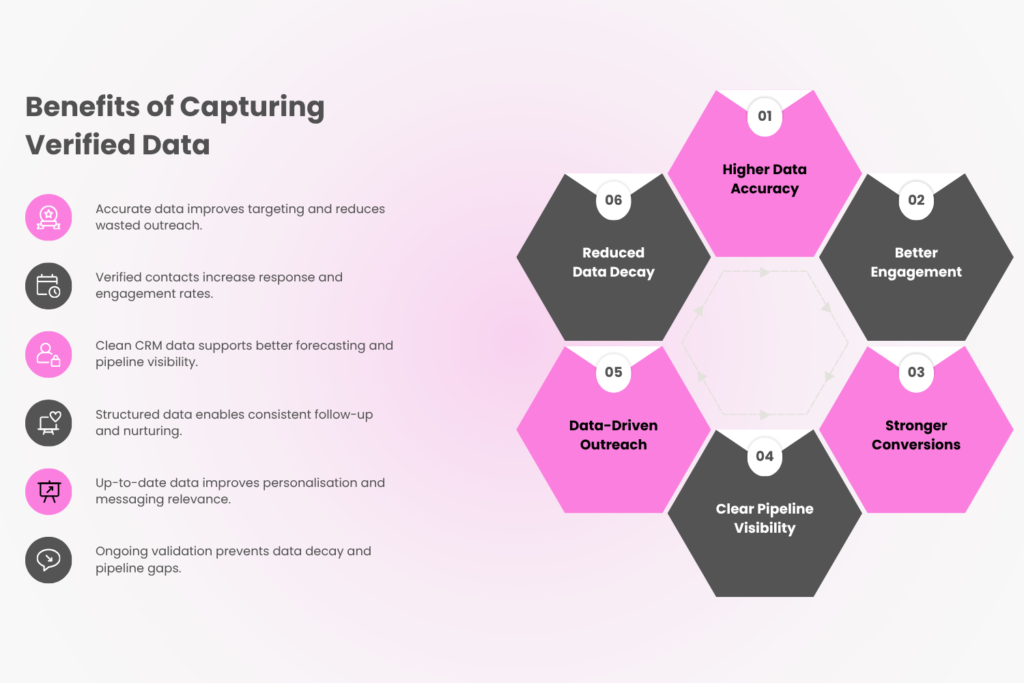
- Capture verified data
Once you have generated enough interest, use that momentum to capture structured, compliant contact information.
Landing pages, event registrations and content downloads should feed directly into your customer relationship management system with validated company and contact records.
Poor data hygiene at this stage can reduce your conversion rates and distort forecasting, so ensure your data is enriched for the best accuracy.
30–50% of customer relationship management data becomes outdated each year. Job changes, company growth and organisational restructuring quickly make contact records inaccurate.
Lead enrichment tools can help address this challenge. However, without consistent execution, data alone rarely converts. Konsyg helps you to turn enriched data into structured outreach and a measurable pipeline.
- Qualify Leads Against Commercial Reality for AI Sales Cycles
Before moving leads into nurturing, you need to assess whether they have real commercial potential. For AI companies in Canada, interest alone is not enough. It must translate into a realistic opportunity.
Frameworks such as BANT, CHAMP or MEDDIC provide structure, but the core questions remain consistent:
- Is there a defined problem?
- Is there a budget and authority?
- Is there a credible decision process?
- Is there a realistic timeframe?
If these conditions are met, the lead is commercially viable.
However, a qualification is only as strong as the data behind it. Leads become significantly more reliable when supported by accurate firmographic and role-based insights, often sourced through B2B lead-generation tools rather than relying solely on self-reported data.
- Score and Prioritise Leads Based on Pipeline Potential
Not every lead should be pursued. Some will not fit your ideal customer profile, while others may not convert in a meaningful timeframe.
Lead scoring helps ensure your team focuses on accounts with the highest potential.
Most models evaluate:
- Profile fit: alignment with your ideal customer profile
- Behavioural signals: engagement across channels
- Buying stage indicators: intent and urgency
Scoring allows you to prioritise leads based on commercial potential and determine where to invest time during the nurturing stage.
- Nurture Leads with Relevant and Timely Outreach
Not every account is ready to buy immediately. For those who are not, structured nurturing helps maintain engagement without losing momentum.
This may include targeted email sequences, relevant content, and consistent outreach aligned to the buyer’s context. The goal is to move leads forward gradually, rather than overwhelming them too early.
For many teams, this is where execution breaks down. Tools can automate communication, but without clear messaging and timing, engagement drops. This is why combining B2B lead generation tools with consistent execution becomes critical.
- Sales Handover and Pipeline Activation
At this stage, qualified leads move from marketing into sales, where they are developed into revenue opportunities.
A strong handover includes:
- Engagement history across campaigns and channels
- Firmographic and technographic insights
- The lead’s role in the buying process
- Qualification data from earlier stages
When this information flows cleanly into your CRM, sales teams can prioritise the right accounts and tailor outreach effectively.
This stage connects directly to everything that comes before it:
- Targeting defines whether the account fits your ideal profile
- Data capture ensures accuracy
- Qualification and scoring confirm commercial viability
If any of these stages are weak, the handover becomes unreliable. Sales teams spend time on leads without authority, budget or urgency. Pipeline quality drops, and forecasting becomes less predictable.
This is why alignment between marketing and sales is not optional. It is structural.
Both teams must agree on:
- What defines a marketing-qualified lead
- What moves a lead to sales-qualified status
- When ownership transfers between teams
In practice, many companies use B2B lead generation tools to manage this flow, but rely on partners such as Konsyg to ensure that qualified leads are actively converted into a pipeline through consistent outreach and execution.
When the handover is structured correctly, the lead generation process becomes a continuous revenue system rather than a set of disconnected activities.
- Analyse and Optimise Lead Generation Performance
Next, evaluate how effectively your B2B lead generation system is performing.
Start by tracking key performance indicators such as:
- Lead conversion rates between funnel stages
- Lead quality and qualification rates
- Cost per lead and cost per opportunity
- Return on investment
These metrics help you understand whether your targeting, messaging, and channels are producing commercially viable opportunities.
Experimentation is equally important.
A/B testing elements such as calls to action, landing pages, form length, and email messaging allows you to identify which approaches drive stronger engagement and conversion.
- Retention and Account Expansion
B2B lead generation does not end once a prospect becomes a customer. Long-term growth depends on how effectively you retain and expand existing accounts.
The process begins with onboarding. When customers quickly see value, they are more likely to remain engaged and continue investing.
Ongoing communication is equally important.
Product updates, relevant insights, and targeted outreach help maintain relationships and ensure customers remain aware of new opportunities.
As trust builds, expansion follows. Upselling and cross-selling allow you to increase account value by introducing additional services aligned with evolving needs.
- Invest in B2B Lead Generation Tools and Execution
At scale, lead generation depends on the quality of the data and how effectively it is used.
Revenue teams need accurate, compliant company and contact data to identify the right accounts, reach decision-makers, and maintain a reliable view of their market.
Without this foundation, targeting becomes inconsistent, and forecasting becomes unreliable.
B2B lead generation tools provide access to verified data and help structure outreach workflows. They allow teams to identify relevant organisations, enrich CRM records, and engage buyers with greater confidence.
However, tools alone are not enough.
Many companies combine these tools with partners such as Konsyg to ensure that data is actively converted into a pipeline through consistent outreach, targeting, and execution.
The impact is measurable when both data and execution are aligned.
The Most Effective B2B Lead Generation Tactics for AI Companies
B2B lead generation involves a mix of inbound and outbound methods to attract and convert the right accounts.
For AI companies in Canada, relying on a single channel rarely works. The most effective strategies combine multiple approaches, supported by the right B2B lead generation tools and consistent execution.
Inbound Lead Generation
Inbound focuses on attracting potential buyers by providing useful, relevant information.
Instead of reaching out first, this approach brings prospects to you by addressing their challenges and questions. When done well, inbound builds awareness and trust before a sales conversation even begins.
A strong inbound strategy typically includes several channels working together.
Content Marketing for Lead Generation
Content remains one of the most reliable ways to attract the right audience.
Blogs, whitepapers, videos, and guides allow you to explain complex ideas and position your company as a credible source. For AI companies, this is especially important, as buyers often need education before they engage.
High-quality content supports B2B lead generation by encouraging visitors to explore further, subscribe, or request more information.
SEO for Lead Generation
Your website acts as the centre of inbound activity.
Well-structured landing pages guide visitors from discovery to action, while search engine optimisation ensures your content appears when buyers are actively looking for solutions.
Effective SEO focuses on relevance. The goal is not just traffic, but attracting organisations that match your ideal customer profile.
Social Media Lead Generation
Social platforms help build visibility and create opportunities for engagement.
A structured approach may include consistent content, interaction within industry communities, and targeted paid campaigns designed to capture interest.
For AI companies, this also helps reinforce credibility in a crowded and competitive space.
Email Marketing for Lead Generation
Email continues to play a key role in nurturing relationships.
By collecting contact details through content, events, or sign-ups, companies can guide prospects through targeted campaigns that move them closer to a decision.
The effectiveness of email depends heavily on timing, relevance, and data quality.
Webinar Lead Generation
Webinars and online events allow organisations to engage directly with potential buyers.
They work well because participants actively choose to attend, making them more likely to convert into qualified opportunities.
For complex AI solutions, webinars are often a strong way to demonstrate value and build trust.
PPC for Lead Generation
Paid campaigns can accelerate inbound performance.
By placing your content or offers in front of a targeted audience, PPC helps generate traffic quickly and supports lead capture through dedicated landing pages.
The key is alignment between targeting, messaging, and the offer itself.
Outbound Lead Generation
Outbound focuses on proactively engaging organisations that match your ideal customer profile.
Instead of waiting for interest, outbound creates it by starting conversations with the right accounts.
For many AI companies, this is where the pipeline is built more consistently, especially when supported by accurate data and B2B lead generation tools.
Cold Calling
Cold calling remains one of the most direct ways to engage potential buyers.
When targeted correctly, it allows you to understand challenges in real time and introduce relevant solutions.
Accurate contact data is essential. Without it, outreach becomes inefficient and inconsistent.
Cold Email
Email is a scalable outbound channel when executed thoughtfully.
Effective cold email strategies focus on relevance and personalisation rather than volume. Messaging should reflect the prospect’s industry, priorities, and current challenges.
When supported by strong data and sequencing, cold email becomes a consistent driver of conversations.
LinkedIn Outreach
LinkedIn has become a key platform for B2B engagement.
It allows teams to identify decision-makers, engage with their content, and initiate conversations through personalised messages.
Many organisations combine LinkedIn with email and calling as part of a coordinated outbound strategy.
Appointment Setting
Appointment setting focuses on securing meetings with qualified prospects.
Structured programmes help move conversations into discovery calls or product discussions, making it easier for sales teams to focus on high-value opportunities.
This is often where B2B lead generation tools and execution come together to produce a measurable pipeline.
Video Outreach
Video is increasingly used to make outbound engagement more personal.
Short, targeted videos can introduce your company, explain a concept, or highlight a relevant use case.
This approach often improves response rates by making outreach more human and easier to remember.
How AI-Powered Lead Generation Is Changing the Way AI Companies Sell
Artificial intelligence is not just changing lead generation tools. It is changing how buyers behave.
For AI companies in Canada, this creates a more competitive and complex sales environment. Buyers are more informed, expectations are higher, and generic outreach is easier to ignore.
As a result, lead generation is shifting from volume to precision.
Instead of building large prospect lists and reaching out broadly, revenue teams are now expected to identify the right accounts earlier and engage them with relevant context.
From Broad Targeting to Signal-Based Selling
Traditional lead generation relied on static lists and assumptions about who might be interested.
AI changes this by analysing signals such as hiring trends, product launches, funding activity, and technology adoption.
This allows teams to focus on organisations that are more likely to be in-market, rather than reaching out to everyone.
For AI companies, this is critical. The difference between relevant timing and random outreach often determines whether a conversation happens at all.
From Manual Prospecting to Automated Insight
AI reduces the need for manual research.
Instead of spending hours identifying accounts, teams can use B2B lead generation tools to surface companies that match their ideal customer profile in real time.
This does not remove the need for human judgment. It shifts the focus from finding data to deciding how to act on it.
From Generic Outreach to Contextual Messaging
Buyers expect relevance.
AI can analyse account data, previous engagement, and industry context to help shape messaging that feels specific rather than templated.
For AI companies, this is especially important. Buyers are often evaluating multiple similar solutions, so context and clarity matter more than volume.
From Activity to Pipeline Accountability
AI also changes how performance is measured.
It is no longer enough to track emails sent or leads generated. Teams are expected to show how the activity translates into the pipeline.
AI helps identify patterns, but it does not guarantee results.
This is where most teams struggle. They have access to data and tools, but lack the structure to turn insight into consistent outreach.
Turning AI Insight into Pipeline
The real shift is not just technological. It is operational.
AI can highlight opportunities, but execution determines whether those opportunities convert.
Konsyg to ensure insights are translated into structured outreach, consistent engagement, and a measurable pipeline.
FAQs
Why is lead generation important?
B2B lead generation is important because it determines how consistently a business can build a pipeline and drive revenue.
For AI companies in Canada, this matters even more. Buyers are more informed, sales cycles are longer, and competition is high. Without a structured approach supported by the right B2B lead generation tools, it becomes difficult to reach the right accounts and turn interest into real opportunities.
What are the best tips for effective lead generation?
Effective lead generation starts with clarity. You need a well-defined ideal customer profile and access to accurate data.
From there, success depends on how well you combine inbound and outbound efforts, and how consistently you execute across both. B2B lead generation tools can improve efficiency, but results come from aligning targeting, messaging, and follow-up. Without that alignment, even strong campaigns fail to convert.
What are the most common lead generation challenges?
Most challenges come down to poor data and inconsistent execution. Many teams struggle with outdated contact information, unclear targeting, and low response rates from generic outreach.
There is also often a disconnect between marketing and sales, which makes it harder to convert leads into a pipeline. While tools can help solve parts of the problem, turning data into consistent outreach is where most teams fall short.
What is a lead?
A lead is an individual or organisation that has shown interest in your product or service. In B2B lead generation, a lead becomes valuable when it matches your ideal customer profile and shows signs of potential buying intent. This is where B2B lead generation tools and qualification processes help determine whether a lead is worth pursuing.
What is the best lead generation software?
There is no single “best” B2B lead generation software. Most tools solve specific parts of the process, such as data access, enrichment, or outreach automation.
However, tools alone rarely generate a pipeline.
For AI companies in Canada, the real challenge is not access to data. It is turning that data into consistent outreach, meaningful conversations, and qualified opportunities.
This is why many revenue teams combine B2B lead generation tools with execution support.
With Konsyg, the focus is not just on providing data but on using it effectively. This includes:
- Building targeted outreach around your ideal customer profile
- Identifying and engaging the right decision-makers
- Running structured outbound campaigns across email, LinkedIn, and calling
- Converting engagement into qualified meetings and pipeline
The result is not just better data, but a more consistent pipeline and measurable revenue impact.
See how Konsyg supports lead generation at scale. Click here to speak with our team.
Share This Post
Recent Posts
What We Offer
Get Your Quote