

In the USA, the AI market has become increasingly competitive. New companies are entering every quarter, and buyers are exposed to more tools, platforms, and promises than ever before. As a result, getting attention is harder. Getting replies is harder. And turning that into real meetings is even harder.
Most teams are already doing outbound.
They are sending emails, testing LinkedIn, building prospect lists, and trying to generate interest. On the surface, there is activity.
But activity is not the problem.
The real issue is that B2B appointment setting is not structured to consistently produce qualified meetings. Sales teams spend time prospecting, but conversations with the right buyers remain limited. Pipeline grows in bursts instead of following a predictable pattern.
This is where many AI companies start to feel stuck.
They are doing the work, but not seeing enough return in the form of high-quality meetings.
This blog breaks down 10 clear signs that your AI company needs a stronger approach to B2B appointment setting in the USA, and what needs to change to build a more consistent pipeline.
1. Your Founder Is Still Driving Most Sales Conversations
Founder-led sales is common in early-stage AI companies.
It works because the founder understands the product deeply and can communicate its value with clarity. Early deals often come through direct conversations, networks, or inbound interest handled personally.
But this does not scale.
When the founder is still responsible for generating and running most sales conversations, it usually means B2B appointment setting is not functioning as a system.
There is no consistent engine creating meetings.
Instead:
- Outreach happens when there is time
- Follow-ups are inconsistent
- Meetings depend on the founder’s availability
This creates a ceiling on growth.
No matter how strong the product is, the number of sales conversations is limited by how many meetings the founder can personally handle. Pipeline becomes dependent, not predictable.
In the US market, where buyers expect timely and relevant engagement, this gap becomes even more visible. Opportunities are missed simply because there is no structured process to consistently book meetings with the right prospects.
Strong B2B appointment setting removes this dependency.
It creates a steady flow of qualified meetings, allowing founders to step into conversations at the right stage instead of being responsible for generating every opportunity.
When the founder is still the primary driver of sales conversations, it is a clear sign that appointment setting needs to be built as a dedicated function.
2. You Are Getting Interest, But Not Enough Qualified Meetings
This is one of the most common gaps in B2B appointment setting for AI companies.
There is activity.
People are opening emails, engaging with content, and even showing curiosity about your product. On the surface, it feels like things are moving in the right direction.
But when you look at the calendar, there are not enough qualified meetings.
This happens because interest is not the same as intent.
AI naturally attracts attention. Many prospects want to explore what your solution does, but they are not actively looking to solve a problem right now. They may not have a budget, urgency, or internal alignment.
The result is a pipeline that looks busy but does not move.
Sales teams spend time on calls that do not progress. Follow-ups stretch without clear outcomes. Forecasting becomes unreliable because initial interest does not convert into real opportunities.
Strong B2B appointment setting focuses on filtering before the meeting happens.
It is not about booking more calls. It is about booking conversations with the right people, at the right time, with a clear problem to solve.
For AI companies targeting the USA, this becomes even more important. Buyers are selective and expect relevance from the first interaction. If the qualification is weak, meetings drop off quickly.
When your team is generating attention but not converting it into qualified meetings, it is a clear sign that your appointment setting process needs to be more precise.
3. Your Messaging Sounds Like Every Other AI Company
This is where many AI companies lose momentum in B2B appointment setting.
The outreach goes out. It is written well. It may even get opened.
But it does not lead to meetings.
The reason is simple. The message does not create urgency or relevance for the buyer.
Most AI companies describe what their product does. They talk about automation, efficiency, or intelligence. While these points are valid, they are not enough to make someone agree to a call.
Buyers in the USA are exposed to similar messaging every day. If the outreach does not connect directly to a problem they are currently facing, it gets ignored.
This is where appointment setting breaks down.
Strong B2B appointment setting is not built on generic positioning. It is built on messages that make the buyer feel that the conversation will be worth their time.
That means:
- Referencing a specific workflow or challenge
- Showing clear relevance to the buyer’s role
- Making the outcome of the meeting obvious
For example, a message that connects to a revenue team struggling with data accuracy or a security team dealing with alert fatigue is far more likely to convert into a meeting than a general statement about improving efficiency.
When messaging does not create that level of clarity, outreach may attract attention but not generate conversations.
And without consistent conversations, appointment setting cannot produce predictable results.
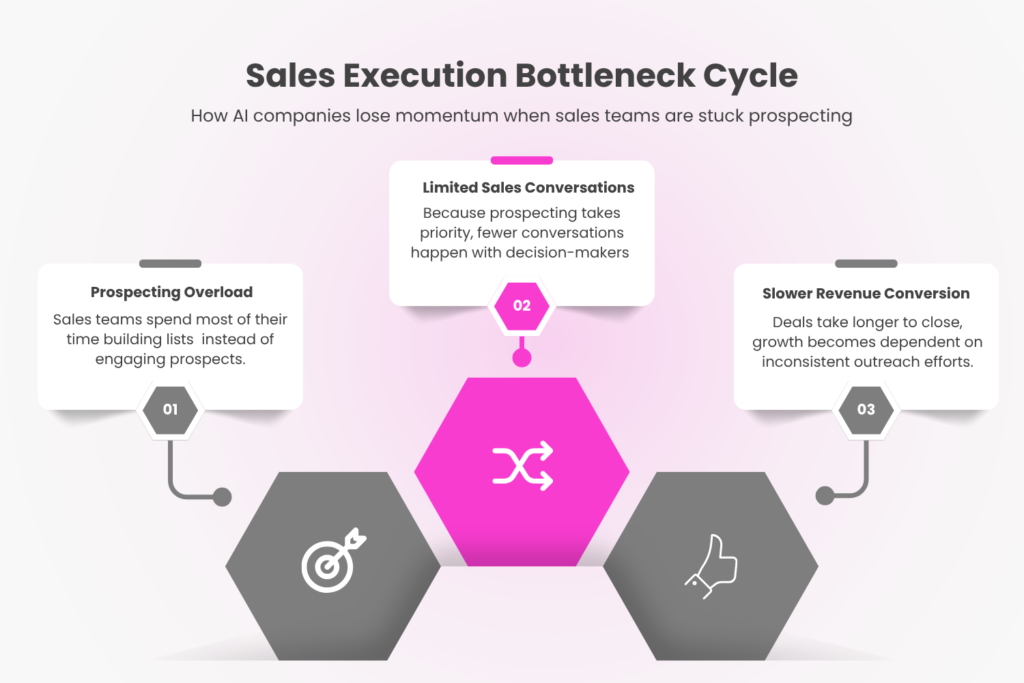
4. Your Sales Team Is Spending More Time Prospecting Than Closing
This is a structural issue that directly impacts B2B appointment setting.
In many AI companies, sales teams are responsible for everything. They identify prospects, build lists, send outreach, follow up, and then try to run sales conversations.
It looks productive.
But it reduces the number of actual meetings.
When most of the team’s time is spent prospecting, there is less time and energy available to run high-quality conversations with qualified buyers. As a result, even with consistent outreach, the number of meaningful meetings stays low.
This creates a gap between effort and outcome.
Activity increases, but meetings do not scale at the same rate.
Effective B2B appointment setting clearly separates these functions.
Prospecting and outreach are handled as a dedicated process focused on consistency and targeting. Sales teams then focus on discovery, qualification, and closing conversations.
For AI companies operating in the USA, this distinction matters even more. Buyers expect focused, relevant discussions from the first interaction. When sales teams are stretched across too many responsibilities, maintaining that level of quality becomes difficult.
When your sales team spends more time generating meetings than actually running them, it is a clear sign that your appointment-setting process is not structured for scale.
5. Your Pipeline Changes Too Much Month to Month
This is one of the clearest signs that B2B appointment setting is not working as a system.
One month from now, there are meetings on the calendar. The next month, it slows down. Then it picks up again after a push from the team.
This pattern is common in AI companies.
Pipeline depends on bursts of activity rather than a steady flow of qualified conversations.
It usually happens when B2B lead generation and appointment setting are tied to internal bandwidth rather than a structured process.
For example:
- Outreach increases when pressure builds
- Follow-ups happen inconsistently
- Prospecting pauses when the team focuses on closing
The result is an unstable pipeline.
From a B2B sales perspective, this creates bigger problems.
Forecasting becomes unreliable. Revenue planning becomes difficult. Sales teams shift between being overwhelmed and underutilised.
Strong B2B appointment setting creates consistency.
It ensures that:
- Outreach happens continuously
- Follow-ups are structured
- Meetings are booked at a predictable rate
For AI companies targeting the USA, this consistency is critical. Buyers operate in a fast-moving environment, and missed timing often means missed opportunities.
When your pipeline depends on effort spikes rather than a steady meeting flow, it is a clear sign that your appointment-setting approach needs to be more structured and consistent.
This is often where companies begin to evaluate whether their current B2B lead-generation setup is sufficient or whether they need a more dedicated system to drive meetings.
6. You Are Trying to Sell to Too Many Different Buyers at Once
This usually sounds like a good strategy at the start.
More industries. More use cases. More potential meetings.
But in B2B appointment setting, this approach creates friction.
When your targeting is too wide, your outreach has to stay general. And when your messaging is general, it becomes easy to ignore.
Buyers in the USA do not respond to broad positioning. They respond to relevance.
If the message does not immediately reflect their role, their workflow, or a problem they are actively dealing with, the conversation does not start.
This is where many AI companies see a drop in meeting conversion.
The outreach is going out, but it is not landing with enough clarity for the buyer to act.
Strong B2B lead generation works differently.
Instead of expanding the target market, it narrows it down.
A focused segment makes it easier to:
- Speak directly to one problem
- Align the message with one type of buyer
- Create a clear reason to take a meeting
From a B2B sales perspective, this also improves the post-meeting process. Conversations are more relevant, and decision-making is faster.
When appointment setting is built on broad targeting, results stay inconsistent. When it is built on a defined segment, meetings become easier to book and easier to convert.
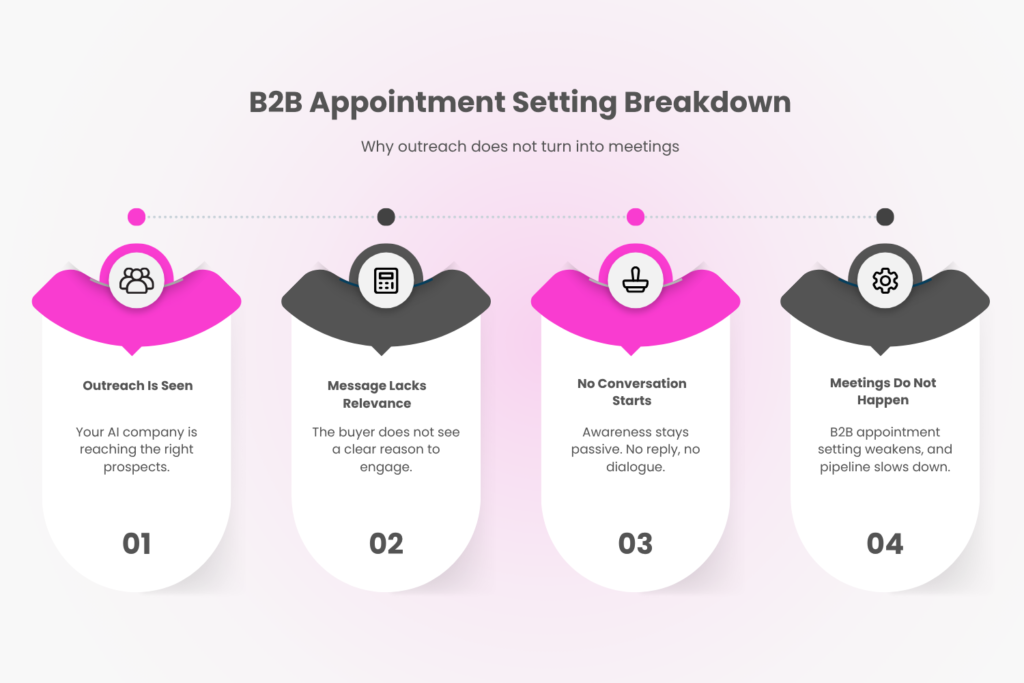
7. Your Outreach Creates Awareness, But Not Conversations
Many AI companies are not being ignored.
Their outreach is reaching the right people. Prospects recognise the category. Some are even familiar with the problem being addressed.
But recognition does not turn into dialogue.
There is no reply. No follow-up. No meeting.
This is where B2B appointment setting breaks down subtly.
The gap is not visible. It is the absence of a clear reason to engage.
Buyers in the USA are constantly filtering out what doesn’t deserve their time. If the message does not make the next step obvious or valuable, it gets deprioritised.
So even when outreach lands in the right inbox, it does not move forward.
Inside the pipeline, this shows up as a quiet problem.
There is activity at the top, but conversations are not increasing at the same pace. The calendar does not reflect the effort going out.
Strong B2B appointment setting is built around creating momentum in a conversation. Not just getting seen, but giving the buyer a clear reason to respond.
When outreach creates awareness but fails to start conversations, meeting flow becomes inconsistent, no matter how much activity is added.
8. You Do Not Have a Clear Follow-Up System
Most meetings are not lost in the first message.
They are lost in what happens after.
Many AI companies stop too early. One or two follow-ups go out, and when there is no reply, the prospect is dropped.
But buyers in the USA rarely respond on the first touch.
They are busy. They delay. They revisit later. Timing plays a big role.
Without a structured follow-up system, potential conversations disappear quietly.
This creates a gap in B2B appointment setting that is easy to miss.
On the surface, it looks like outreach is not working. In reality, the process is incomplete.
Strong appointment setting treats follow-up as part of the core strategy, not an afterthought.
That means:
- Multiple touchpoints over time
- Each follow-up adds new context or value
- Consistent tracking of where prospects drop off
When this discipline is missing, meetings never materialise, even when there is an underlying interest.
Over time, this reduces the total number of conversations your team could have had, without increasing effort.
9. You Are Entering the US Market Without a Clear Meeting Strategy
Expanding into the USA creates opportunity.
But it also exposes gaps in how B2B appointment setting is being handled.
Many AI companies assume that what worked in one market will translate directly. The same messaging, the same outreach style, the same cadence.
In reality, US buyers respond differently.
They expect:
- Direct and relevant communication
- Clear value tied to their role
- A strong reason to take a meeting early
Without this, outreach gets ignored, even if the product is strong.
This is where teams start to see friction.
Meetings are harder to book. Responses slow down. Conversations take longer to start.
The issue is not demand. It is alignment.
Effective B2B appointment setting in the USA requires adapting how conversations are initiated.
That includes:
- Sharper positioning
- More confident outreach
- Better qualification before the meeting
When companies enter the US market without adjusting their approach, they often generate activity but struggle to convert it into consistent meetings.
And without consistent meetings, expansion slows down.
9. You Are Entering the US Market Without a Clear Meeting Strategy
Expanding into the USA creates opportunity.
But it also exposes gaps in how B2B appointment setting is being handled.
Many AI companies assume that what worked in one market will translate directly. The same messaging, the same outreach style, the same cadence.
In reality, US buyers respond differently.
They expect:
- Direct and relevant communication
- Clear value tied to their role
- A strong reason to take a meeting early
Without this, outreach gets ignored, even if the product is strong.
This is where teams start to see friction.
Meetings are harder to book. Responses slow down. Conversations take longer to start.
The issue is not demand. It is alignment.
Effective B2B appointment setting in the USA requires adapting how conversations are initiated.
That includes:
- Sharper positioning
- More confident outreach
- Better qualification before the meeting
When companies enter the US market without adjusting their approach, they often generate activity but struggle to convert it into consistent meetings.
And without consistent meetings, expansion slows down.
10. You Cannot Clearly See What Is Driving Meetings
At some point, the question becomes simple:
What is actually working?
Many AI companies run multiple outreach efforts at once. Different messages, different segments, different channels. Activity is there, but clarity is not.
Meetings happen, but it is not always clear why.
This creates a blind spot in B2B appointment setting.
If you cannot identify:
- Which audience is responding
- Which message is converting
- Which channel is driving meetings
then it becomes difficult to improve results.
Teams end up repeating the same efforts without knowing what to refine.
Over time, this slows down progress.
Instead of building a predictable system, appointment setting remains trial-and-error.
Strong B2B appointment setting relies on visibility.
Every step, from outreach to reply to meeting, needs to be tracked and understood. Not just in terms of volume, but in terms of quality and conversion.
When that clarity is missing, growth depends on guesswork rather than a structured approach.
And without a clear understanding of what drives meetings, it becomes difficult to scale what works.
When Should an AI Company Rethink Its B2B Appointment Setting Approach?
Most AI companies do not change their approach after a single missed opportunity.
The shift usually happens when patterns become clear.
Meetings are inconsistent. Pipeline feels unpredictable. Sales teams are active, but results do not scale at the same pace.
At that point, it is no longer a short-term issue.
It becomes a structural one.
If your team is experiencing multiple signs from this list, it usually means that B2B appointment setting is not operating as a dedicated system.
Instead, it is:
- Dependent on internal bandwidth
- Spread across different roles
- Lacking consistency in execution
This creates a gap between effort and outcome.
More outreach does not fix it. More tools do not fix it.
What is needed is a more focused approach to how meetings are generated, qualified, and handed into the sales process.
For AI companies targeting the USA, this becomes even more critical. Competition is higher, buyer expectations are sharper, and timing plays a larger role in whether conversations occur.
Rethinking B2B appointment setting is not about doing more.
It is about building a process that consistently turns outreach into qualified meetings.
And once that process is in place, everything else becomes easier.
Pipeline stabilises. Sales teams focus on closing. Growth becomes more predictable.
What to Look for in a B2B Appointment Setting Partner
Once an AI company recognises the need to improve its approach, the next step is choosing how to execute it.
Not all B2B appointment setting approaches deliver the same results.
The difference usually comes down to how well the process is built around your market, your buyers, and your sales goals.
A strong partner does not just increase activity. It improves how meetings are generated.
Here are a few things that matter.
Understanding of AI Buyers in the USA
Appointment setting is not just about outreach.
It requires a clear understanding of how buyers evaluate AI solutions. What problems they prioritise, how they respond to messaging, and what makes them agree to a meeting.
Without this, outreach may reach the right people but fail to convert into conversations.
Clear Targeting and Segmentation
Effective B2B lead generation starts with precision.
A good partner helps define:
- Who to target
- Why they should care
- When to reach out
This directly impacts the quality of meetings being booked.
Messaging That Drives Conversations
Generic outreach does not work in competitive markets.
Appointment setting should be built around messaging that addresses specific problems and provides a clear reason to engage.
This is where many internal teams struggle to maintain consistency over time.
Structured B2B Appointment Setting Process
Consistency is what drives results.
That includes:
- Ongoing outreach
- Planned follow-ups
- Clear qualification before meetings
Without structure, meeting flow becomes unpredictable.
Alignment with Your B2B Sales Process
Meetings alone are not enough.
They need to fit into your broader B2B sales motion.
That means:
- Relevant prospects
- Clear context before the call
- Smooth handover to your sales team
This improves conversion after the meeting, not just booking rates.
Transparency and Continuous Improvement
Strong appointment setting is not static.
A good system continuously improves based on:
- What messages get responses
- Which segments convert
- Where prospects drop off
This visibility helps refine both outreach and sales strategy over time.
FAQ
What is B2B appointment setting for AI companies?
B2B appointment setting is the process of identifying the right prospects, reaching out to them, and booking qualified sales meetings with decision-makers.
For AI companies, this means more than just outreach. It involves targeting the right use cases, speaking to the right roles, and creating enough relevance for buyers to agree to a conversation.
Why is B2B appointment setting important for AI companies in the USA?
The US market is highly competitive and fast-moving.
Buyers are exposed to multiple AI solutions and only engage when the value is clear and immediate. Without a structured B2B appointment setting process, even strong products struggle to generate consistent meetings.
This directly impacts pipeline growth and revenue predictability.
What is the difference between B2B lead generation and B2B appointment setting?
B2B lead generation focuses on attracting potential prospects.
B2B appointment setting focuses on converting those prospects into qualified meetings.
For AI companies, the gap between interest and actual conversations is where most opportunities are lost. Appointment setting bridges that gap.
When should an AI company consider outsourcing B2B Appointment Setting?
AI companies typically consider B2B Appointment Setting when:
- Internal teams cannot maintain consistent outreach
- Sales teams are spending too much time prospecting
- Meeting flow is unpredictable
- Expansion into the USA is a priority
At this stage, outsourcing helps build a more structured and scalable approach to appointment setting.
How many meetings should a strong B2B appointment setting system generate?
There is no fixed number, as it depends on your market, deal size, and targeting.
However, a strong system should produce:
- A consistent flow of meetings each month
- A high percentage of qualified conversations
- Clear visibility into what is driving results
The focus should always be on quality and conversion, not just volume.
Conclusion
AI companies are not lacking opportunities.
They are lacking consistent access to the right conversations.
In a market like the USA, where buyers are selective and competition is high, B2B appointment setting becomes the difference between activity and actual pipeline.
Without it, outreach remains inconsistent, meetings remain unpredictable, and growth becomes difficult to sustain.
With it, sales teams spend more time speaking to the right prospects, the pipeline becomes more stable, and opportunities move forward with clarity.
The companies that scale are not the ones doing more outreach.
They are the ones consistently turning outreach into qualified conversations.
If your AI company is already investing in outreach but not seeing enough qualified meetings, it may be time to take a closer look at how your B2B appointment setting is structured.
At Konsyg, we work with B2B companies to build outbound systems that focus on one thing:
Consistently booking qualified meetings with the right decision-makers.
If you want to understand:
- Why your current outreach is not converting
- Where meetings are being lost in your process
- How to build a more predictable pipeline
You can schedule a conversation with our team.
👉 Book a meeting with Konsyg to explore how your appointment setting can be improved.
Share This Post
Recent Posts
What We Offer
Get Your Quote