

Hiring a B2B cold email agency should help your sales team generate qualified conversations, not just send more emails.
For US businesses investing in B2B sales and lead generation, the real value lies in reaching relevant decision-makers, identifying genuine buyer interest, and turning promising conversations into qualified sales meetings.
That requires more than prospect lists and automated sequences. It requires accurate targeting, reliable contact data, personalised messaging, effective reply management, and clear qualification standards.
In this guide, we explain the six essential deliverables every B2B cold email agency should provide, how to evaluate campaign performance, and what to look for before choosing an outsourced outreach partner.
Quick Answer: What Should a B2B Cold Email Agency Deliver?
A B2B cold email agency should deliver six core services: ideal customer profile (ICP) research, verified prospect data, email deliverability management, relevant outreach messaging, reply handling, and qualified meeting handoffs.
For US businesses, these deliverables should be supported by clear reporting that connects outreach activity with buyer interest, meeting quality, and sales opportunities.
The goal is to understand how effectively the agency turns targeted outreach into conversations your sales team can act on.
Need More Qualified B2B Sales Conversations?
Konsyg helps B2B companies reach relevant decision-makers through targeted prospect research, personalised cold email outreach, and outsourced sales development.
Whether you’re expanding into the US market or looking to improve your existing outbound campaigns, let’s discuss your sales goals.
What Are You Actually Paying a B2B Cold Email Agency to Do?
When a US company hires a cold email agency, it’s usually because the sales team needs more conversations with potential buyers but doesn’t have the time or resources to manage every part of outreach.
Sending emails is one part of that work. The agency also needs to understand who the business wants to reach, why those buyers might be interested, and how to start a conversation worth pursuing.
For example, a cybersecurity company targeting IT directors in the US needs more than a database of technology executives. It needs outreach that reflects those buyers’ responsibilities, the problems they face, and the reasons they might consider a new solution.
That’s where the scope of an agency’s work becomes important.
A company investing in B2B cold email outreach services should understand who owns research, campaign execution, prospect responses, and sales handoffs.
Agree on these responsibilities before the campaign begins, with clear expectations for what the agency will deliver and how performance will be evaluated.
The Six Deliverables Every B2B Cold Email Agency Should Explain
Before signing with a B2B cold email agency, US companies should know exactly what they’re getting. Two agencies might offer the same number of emails per month while providing very different levels of research, campaign management, and sales support.
Here are six deliverables worth discussing before a campaign begins.
- ICP Research and Account Selection
A cold email agency should understand which companies are most likely to benefit from your product or service.
That means identifying target industries, company sizes, locations, relevant job titles, and potential buying triggers.
For example, a US SaaS company selling compliance software may want to reach financial services businesses with growing regulatory responsibilities. Its target list should reflect those criteria rather than include every company in the financial sector.
What to ask: Can the agency explain why each target account belongs in your campaign?
- Verified Contact Data
Even strong messaging struggles when it reaches outdated email addresses or people who have no influence over the purchasing decision.
An agency should verify business email addresses, check job relevance, remove duplicates, and maintain contact records as campaigns progress.
Contact verification also needs ongoing attention. People change roles, companies restructure, and previously accurate records become outdated.
What to ask: How does the agency verify contacts, and how often is the data reviewed?
- Email Deliverability Management
Before outreach begins, the agency should review the technical setup used to send emails.
This includes SPF, DKIM, and DMARC authentication, sending-domain configuration, bounce monitoring, and appropriate sending practices.
For US campaigns, the agency should also explain how it handles applicable CAN-SPAM requirements, including accurate sender information and opt-out requests.
Technical configuration alone cannot guarantee inbox placement. Agencies should be able to explain how they monitor deliverability problems and respond when they occur.
What to ask: What deliverability checks are completed before launch, and what happens when sending performance deteriorates?
- Messaging That Reflects Buyer Priorities
A CFO, IT director, and operations manager may work at the same company, but they rarely evaluate a purchase for exactly the same reasons.
Cold email messaging should reflect the recipient’s responsibilities, business challenges, and potential reasons to engage.
A capable agency should develop relevant messaging for different buyer segments, test approaches, and use prospect feedback to improve future outreach.
Personalisation should make the message more useful to the recipient, not just insert their company name into a template.
What to ask: How does the agency decide which messages to test, and what evidence guides changes?
- Reply Handling and Follow-Up
A positive response is an opportunity to continue a conversation, but someone needs to manage it.
The agency should have a process to identify interested prospects, answer appropriate questions, handle objections, record outcomes, and pass relevant conversations to the sales team.
Not every reply indicates buying interest. An unsubscribe request, referral to another colleague, and request for a product demonstration require different actions.
What to ask: Who manages prospect replies, and how quickly are interested buyers handed over?
- Qualified Meeting Handoffs
A booked calendar appointment is useful only when the sales team understands who they’re meeting and why.
Before handing over a meeting, the agency should verify the agreed qualification criteria and provide relevant context.
This may include the prospect’s company, role, expressed interest, previous conversation, and expected next step.
For US B2B companies with longer sales cycles, this information helps account executives prepare for meaningful discussions.
What to ask: What information accompanies every booked meeting, and how does the agency handle meetings that sales rejects?
These six deliverables provide a starting point for evaluating a cold email agency. The next step is understanding how to measure whether the agency is consistently delivering on those commitments.
Why Human Expertise Still Matters in B2B Cold Email
AI and sales technology can help identify prospects, organise contact information, and make outbound sales processes more efficient.
But technology alone cannot determine whether every prospect is relevant, understand the full context behind a buyer’s response, or replace meaningful sales conversations.
At Konsyg, we combine technology-supported prospect research with human-led sales development.
Our sales professionals bring practical experience, market understanding, and human judgement to prospect engagement, follow-ups, and qualification.
This approach is particularly valuable when prospects ask detailed questions, refer conversations to other stakeholders, or express interest without being ready to schedule a meeting.
For businesses investing in B2B lead generation, the goal should not simply be more emails or more replies. It should be better conversations with potential customers who match their sales objectives.
How Can You Tell Whether Your Cold Email Agency Is Actually Delivering?
Imagine two US SaaS companies working with different cold email agencies.
Both receive monthly reports showing thousands of emails sent, prospect responses, and meetings booked.
The first company knows how many people replied but has little visibility into whether those prospects match its target market. Its sales team spends time reviewing conversations and deciding which meetings are worth pursuing.
The second company receives more context. Its agency explains which buyer segments responded, what interested prospects wanted to discuss, and which meetings met the agreed qualification criteria.
That information matters when sales representatives prepare for conversations and decide where to focus their time.
Look at What Happens After the Reply
A useful way to evaluate an agency is to follow a prospect’s journey from the first email to the sales conversation.
Consider three questions:
- Are the right people responding? A reply from someone outside your target market may offer feedback, but it doesn’t necessarily represent a sales opportunity.
- Is the conversation moving forward? Interested prospects should receive relevant follow-ups and a clear next step.
- Does sales have enough context? A meeting handoff should explain who the prospect is, what prompted their interest, and what they expect to discuss.
For US companies investing in outbound sales, these details help distinguish campaign activity from meaningful progress.
An agency should be able to show how its work contributes to the conversations your sales team wants to have, even when those conversations take time to develop into opportunities.
What Should a B2B Cold Email Agency Report Every Month?
A cold email agency’s monthly report should help you answer a simple question: Are we reaching potential buyers who are genuinely interested in having a conversation?
For US B2B companies, email volume and response rates are useful, but they only tell part of the story.
Your agency should also explain which industries are responding, what prospects care about, how many conversations become qualified meetings, and what feedback the sales team provides.
What Konsyg’s Outbound Campaign Data Tells Us
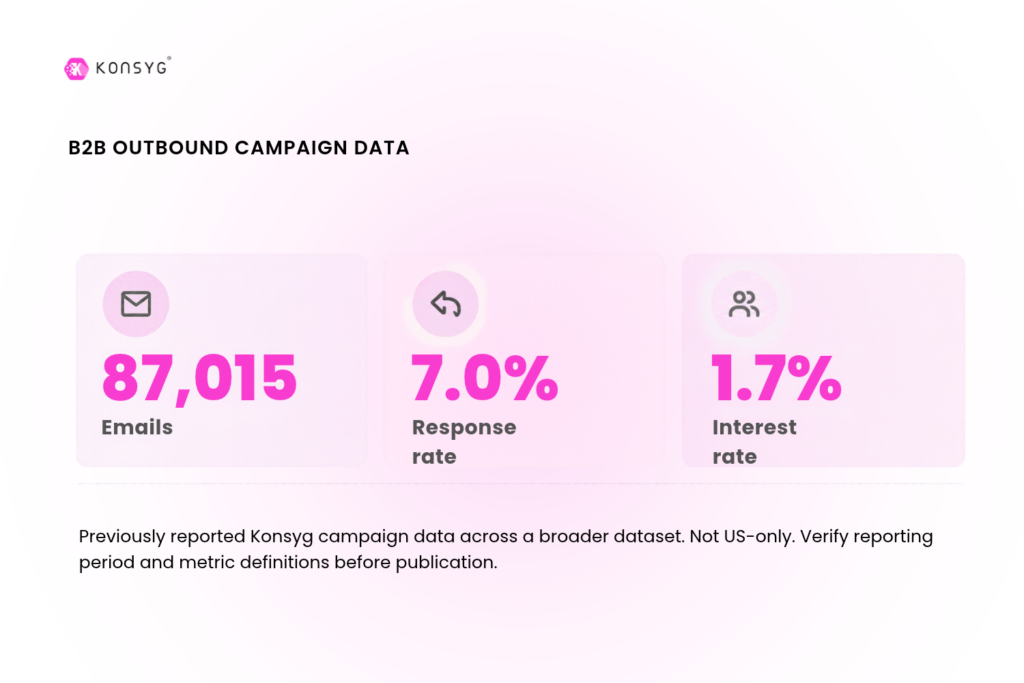
Konsyg’s previously reported outbound campaign dataset recorded 87,015 emails and 6,099 responses, representing an approximately 7.0% response rate.
The dataset also reported a 1.7% interest rate, highlighting an important distinction between receiving a response and generating genuine buyer interest.
For businesses evaluating a B2B cold email agency, this distinction matters. A negative reply, an unsubscribe request, and a prospect requesting a sales conversation should not be treated as equivalent outcomes.
The most useful reporting connects outreach activity with interested prospects, qualified meetings, and sales opportunities.
What Should Happen After the Report?
A good monthly review should lead to decisions.
If cybersecurity companies respond more often than other segments, the agency and client can investigate whether that audience deserves more attention.
If interested prospects aren’t progressing to meetings, they can review the follow-up process, qualification criteria, and sales handoffs.
If meetings are happening but few become opportunities, feedback from account executives can help identify what needs to change.
The report should end with agreed actions, clear ownership, and a plan for reviewing progress the following month.
What Happens After a Prospect Replies to Your Cold Email?
A prospect replies to your cold email: “This looks interesting. Can you send me more information?”
What happens next?
For a US B2B company, that response could be the beginning of a valuable sales conversation. But the outcome depends on how the agency handles it.
An experienced cold email agency should know when to provide more information, when to ask a follow-up question, and when to involve the client’s sales team.
Imagine a cybersecurity company reaching out to IT leaders in the United States.
An IT director responds, explaining that their team is reviewing security vendors ahead of an upcoming infrastructure project.
The agency now has useful context. Rather than immediately booking a meeting, the person managing replies can clarify what the prospect wants to evaluate, confirm whether the company fits the agreed target profile, and determine the appropriate next step.
If the prospect agrees to a discussion, the sales representative should receive the conversation history and relevant qualification details before the meeting.
This gives the sales team a better starting point than a calendar invitation with only a name and email address.
Why the Sales Handoff Matters
Cold email agencies and internal sales teams need to agree on what qualifies as a meeting worth pursuing.
That includes who should attend, the level of interest required, and what information must be recorded before the handoff.
A prospect may be interested in learning about a solution without being ready for a sales meeting. Others may have a specific project underway and want to speak with someone immediately.
Recognising those differences helps the agency recommend an appropriate next step and gives the sales team a clearer understanding of each opportunity.
Why Your B2B Sales Emails Get Ignored (And What Actually Works)
Getting a response starts with giving buyers a reason to care. In this video, Konsyg’s Bradford Gray shares what makes B2B sales emails worth reading and how businesses can approach outreach more effectively.
What Should US Companies Agree on Before Launching a Cold Email Campaign?
Before launching a B2B cold email campaign in the United States, both the agency and the client should agree on what success looks like.
A company targeting enterprise cybersecurity buyers may have very different expectations from a SaaS business reaching out to small and mid-sized companies.
The agency needs to understand those differences before developing prospect lists or writing the first email.
Five Things to Clarify Before Launch
- Target audience: Which industries, company sizes, locations, and decision-makers should the campaign prioritise?
- Campaign responsibilities: Who manages prospect research, email infrastructure, messaging approvals, replies, and follow-ups?
- Meeting qualification: What makes a prospect suitable for a sales conversation, and what information must accompany the handoff?
- Compliance and deliverability: How will the agency manage email authentication, opt-out requests, suppression lists, and applicable US outreach requirements?
- Reporting and accountability: Which metrics will be reviewed, how frequently will results be discussed, and who is responsible for making improvements?
These expectations should be documented before outreach begins.
They also give the sales team a reference point when reviewing campaign performance, discussing prospect feedback, or requesting changes.
The clearer both sides understand their responsibilities, the easier it is to evaluate the agency’s work once the campaign is underway.
Planning B2B Cold Email Outreach in the US?
The right campaign starts with a clear target audience, relevant messaging, reliable prospect data, and agreed qualification standards.
Konsyg supports businesses looking to strengthen B2B sales prospecting through cold email outreach and outsourced sales development.
When Does Hiring a B2B Cold Email Agency Make Sense?
For some US businesses, the challenge isn’t finding potential customers. It’s having enough time and resources to reach them consistently.
A growing SaaS company might have account executives focused on demonstrations and closing deals, leaving little capacity for prospect research and outbound follow-ups. A cybersecurity company may have a strong technical offering but need additional support reaching enterprise decision-makers.
In situations like these, a B2B cold email agency can help manage the work required to start and develop new sales conversations.
Outsourcing may be worth considering when:
- Your sales team spends more time prospecting than speaking with qualified buyers.
- You want to reach new US industries or territories but lack dedicated outbound resources.
- Your business needs structured prospect research, messaging, and follow-up management.
- Your existing cold email campaigns generate activity, but sales has limited visibility into prospect interest and meeting quality.
The decision also depends on your internal readiness. Even with an external agency managing outreach, your business needs a clear offer, an agreed target market, and someone available to handle qualified sales conversations.
How This Connects to Real B2B Sales Campaigns
Konsyg has supported outbound sales initiatives for businesses in industries such as cybersecurity and IT management, where reaching relevant decision-makers requires targeted research and an understanding of complex buying processes.
These engagements illustrate the importance of connecting prospecting activity with the sales conversations a client wants to generate.
For companies evaluating outsourced cold email, the useful question is whether an agency can explain how its research, outreach, and qualification processes will support their specific sales goals.
In-House vs Outsourced Cold Email: What Should US Businesses Consider?
Not every US business needs to outsource cold email. Some companies already have dedicated SDRs, reliable prospect data, and the resources to manage campaigns internally.
Others may benefit from an external agency that can handle research, campaign execution, and prospect engagement.
The right approach depends on your sales capacity, available expertise, and how much control your team wants over day-to-day outreach.
Which Approach Makes More Sense?
An in-house team may suit you if your business already has experienced SDRs, established outreach processes, and the capacity to manage campaigns consistently.
An outsourced cold email agency may help when you need more prospecting capacity, specialised execution support, or help entering new US markets.
Some businesses also use a hybrid approach, keeping sales strategy and closing responsibilities internally while outsourcing prospect research and initial outreach.
Whatever model you choose, the important consideration is whether your team can maintain consistent outreach while giving interested prospects the attention they need.
Frequently Asked Questions About B2B Cold Email Agencies
- What services should a B2B cold email agency provide?
A B2B cold email agency should provide ICP research, verified prospect data, email deliverability management, personalised outreach messaging, reply handling, and qualified meeting handoffs. US businesses should also expect regular reporting that connects campaign activity with buyer interest and sales outcomes.
- How do you measure the success of a cold email agency?
Measure success by targeting accuracy, response quality, positive buyer interest, qualified meetings, sales acceptance, and opportunities generated. Email volume and response rates help evaluate campaign activity, but they should be considered alongside the quality of conversations reaching the sales team.
- How long does it take for a cold email agency to generate results?
Timelines vary depending on the target market, offer, contact quality, sending infrastructure, and sales cycle. Initial campaign activity and responses may provide early feedback, while evaluating meeting quality and pipeline contribution generally requires a longer observation period. Businesses should agree on realistic milestones before launching.
- Is hiring a B2B cold email agency worth it for US companies?
It can be worthwhile for companies that need consistent outbound prospecting but lack dedicated resources to manage research, campaigns, and follow-ups internally. The value depends on the agency’s execution quality, the client’s market readiness, and whether the resulting conversations meet the sales team’s qualification requirements.
Final Thoughts: Choosing the Right B2B Cold Email Agency
A B2B cold email agency should deliver more than outbound activity. It should help your business reach relevant decision-makers, develop meaningful sales conversations, and create opportunities your sales team can pursue.
Before selecting an agency, evaluate its approach to prospect research, contact quality, deliverability, personalised messaging, reply management, and qualified meeting handoffs.
For US businesses investing in B2B lead generation, the right agency should also provide clear reporting and a collaborative process that connects outreach activity with sales objectives.
Looking for a B2B Cold Email Agency That Focuses on Qualified Meetings?
Konsyg supports B2B businesses with targeted prospect research, personalised cold email outreach, multichannel sales development, and appointment setting.
Whether you’re expanding into the US market or improving an existing outbound programme, let’s discuss how to reach the right buyers and create more relevant sales conversations.
Tell us about your target customers, sales challenges, and growth objectives.
Share This Post
Recent Posts
What We Offer
Get Your Quote