

Chicago has no shortage of companies for a SaaS sales team to target. The harder part is deciding which accounts are actually worth pursuing and giving the people inside those companies a reason to respond.
That matters in a market where SaaS continues to attract serious investment. According to World Business Chicago’s 2025 economic report, SaaS accounted for 27% of growth capital deals in the Chicago metropolitan area in 2025, up from 20% in 2021.
But a growing market does not automatically make B2B lead generation easier.
Buyers have more ways to research software without speaking to sales. Gartner found that 67% of B2B buyers now prefer an overall rep-free experience, while 45% used AI during a recent purchase. At the same time, buyers still turn to salespeople when they need context and help making a decision.
For SaaS companies selling in Chicago, simply adding more names to a prospecting list is not enough. The accounts need to make sense, the timing needs to make sense, and the outreach needs to give someone a genuine reason to reply.
The following B2B lead generation strategies focus on doing exactly that.
What B2B Lead Generation Strategies Work for Chicago SaaS Companies?
Effective B2B lead generation strategies for SaaS companies targeting Chicago include building a tighter ICP, prioritising accounts using relevant buying signals, mapping the buying group, using B2B cold calling alongside email and LinkedIn, multi-threading important accounts, qualifying prospects before demos and using sales expertise to support outbound conversations.
For companies that need additional sales capacity, B2B sales outsourcing can also provide an alternative to building the entire prospecting operation internally. The right mix depends on the SaaS product, target customer, deal size and sales cycle.
1. Build an ICP That Is Actually Useful to Sales
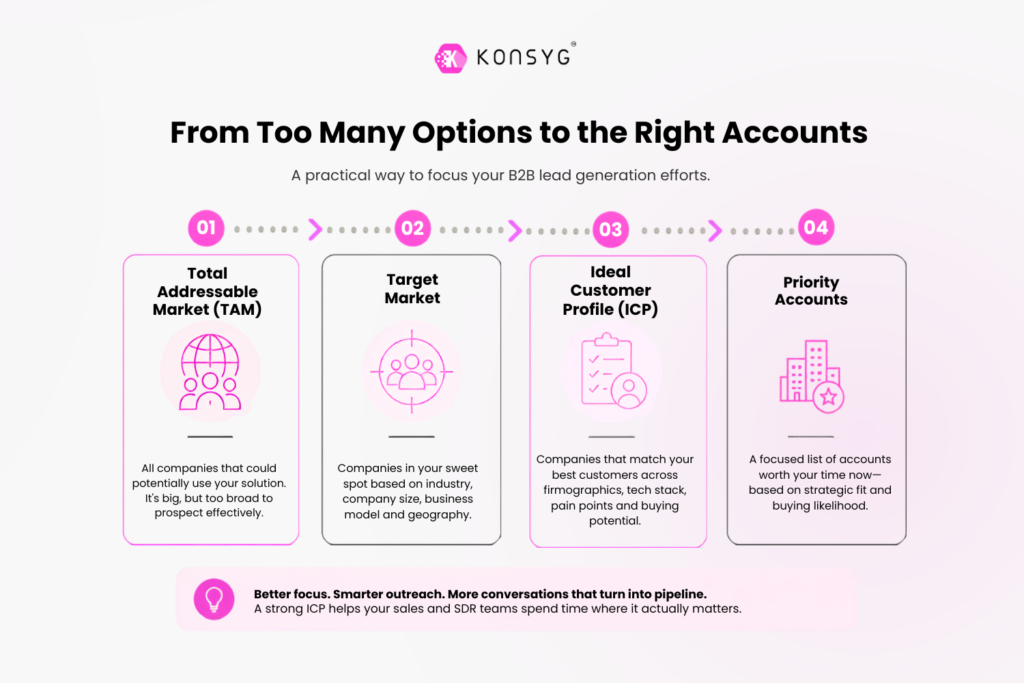
A large total addressable market can look impressive in a SaaS pitch deck. It is less helpful when an SDR has to decide who to call on Monday morning.
An ICP needs to narrow that market into companies with a realistic reason to buy. Company size, industry and location are useful starting points, but SaaS teams should also consider the problems their product solves, the technology a prospect already uses, how the business operates and whether there is a strong enough use case to justify outreach.
The same applies to Chicago. Being headquartered in the city does not automatically make a company a good prospect. A Chicago account should enter a B2B lead generation campaign because it matches the characteristics of a valuable customer, not simply because its address fits the geographic filter.
This distinction also helps SDRs do better research. Instead of working through thousands of loosely matched contacts, they can spend more time understanding accounts that have a credible reason to enter the sales pipeline.
2. Prioritise Accounts Using Real Buying Signals
A company fitting your ICP does not automatically mean it should be contacted today.
For SaaS teams, timing often matters just as much as fit. Signals such as a recent funding round, a leadership change, hiring activity, a new market expansion or a change in technology can give sales teams a reason to look more closely at an account.
Apollo also recommends combining multiple signals rather than treating one event as proof that a company is ready to buy.
That distinction matters. A funding announcement may suggest new budget, but it does not mean the company wants your software. A newly hired VP may be reviewing existing tools, but that still needs research before outreach begins.
The stronger approach is to use signals to prioritise accounts, then look for context. What changed? Why might that change matter to your product? Who inside the account is likely to care?
For Chicago SaaS companies running B2B lead generation campaigns, this can make prospecting more focused. Instead of contacting every account that fits the ICP at the same time, SDRs can focus on companies where there is a credible reason to start a conversation now.
A buying signal should open the research process, not replace it.
3. Map the SaaS Buying Group Before Outreach Starts
A SaaS purchase rarely depends on one person. Gartner reports that B2B buying groups can include 5 to 16 people across as many as four functions, which means targeting one decision-maker can leave much of the buying process untouched.
Depending on the product, the group might include an end user, technical evaluator, department head, finance, procurement and an executive sponsor. Each has a different reason to care about the purchase.
For B2B lead generation, this means researching the account before building the contact list. Identify who could use the product, who can influence the decision and who ultimately controls the budget. Konsyg’s North America B2B lead generation approach similarly includes stakeholder mapping across technical, financial and executive roles.
The goal is not to contact everyone. It is to understand who matters.
4. Use B2B Cold Calling to Start Real Conversations
Email is useful, but sometimes a five-minute conversation tells an SDR more than another sequence ever will.
A well-researched B2B cold calling campaign gives SaaS teams a direct way to reach decision-makers, understand whether a problem is relevant and find out who else should be involved. For example, a multi-channel outbound campaign can combine calling with account research, email and LinkedIn touchpoints rather than treating the phone as an isolated channel.
The call still needs a reason. “I wanted to introduce our software” gives a prospect very little to work with. A useful call starts with context and gets to the reason for the conversation quickly.
For Chicago SaaS teams, B2B cold calling works best as part of the wider outbound process, not as a race to make the most dials.
5. Write Cold Emails About Their Problem, Not Your Software
Many SaaS emails could come from almost any vendor.
“We help companies streamline operations.”
“Our platform improves efficiency.”
“Do you have 15 minutes this week?”
The problem is not necessarily cold email. It is giving the prospect nothing specific to respond to.
A better cold email outreach campaign connects the message to the account, the buyer’s role and a problem the software can actually solve. A strong cold email approach emphasises personalised, data-backed outreach rather than sending the same message across a large prospect list.
Generic: Here is what our software does.
Better: Here is why this might matter to your team right now.
Personalisation does not need to mean writing an essay about someone’s latest LinkedIn post. Relevance matters more.
6. Use LinkedIn to Research Before You Use It to Pitch
LinkedIn is useful for B2B lead generation, but not every connection request needs to become a sales pitch.
Before contacting an account, SDRs can use LinkedIn to understand the team structure, identify relevant stakeholders, spot role changes and see what the company or its leaders are talking about publicly.
That research can then improve outreach across LinkedIn, email and phone. For US outbound campaigns, the same multi-channel principle applies: combine LinkedIn with email and calling rather than relying on one channel to carry the campaign.
For SaaS sales teams, LinkedIn can therefore be just as valuable before the first message is sent as it is after a prospect accepts a connection.
| Stage | What the SaaS Team Does | What It Helps Avoid |
|---|---|---|
| Target | Build a focused ICP | Huge lists with poor-fit accounts |
| Prioritise | Look for relevant buying signals | Contacting every account at the same time |
| Map | Identify the buying group | Relying on one decision-maker |
| Research | Understand the account and buyer | Generic outreach |
| Reach | Use phone, email and LinkedIn | Depending on a single channel |
| Qualify | Confirm fit and reason to talk | Filling calendars with weak meetings |
Need More of the Right Accounts in Your Pipeline?
Konsyg builds and runs B2B lead generation campaigns around the accounts, buyers and channels that make sense for your market.
See How Konsyg Builds Pipeline
7. Multi-Thread the SaaS Accounts That Matter
One unanswered email should not automatically remove a good account from the pipeline.
If several people are involved in a SaaS purchase, B2B lead generation should reflect that. An SDR might begin with the person closest to the problem, then identify a technical stakeholder, department leader or economic buyer where relevant.
This does not mean sending the same message to six people at once. Each contact needs a reason for the conversation based on their role.
Multi-threading also works better when channels are combined. Email can introduce the problem, LinkedIn can provide context, and B2B cold calling can help establish whether there is enough interest to continue the conversation.
The account is the opportunity. One contact is only one route into it.
8. Qualify Interest Before Sending Every Prospect to a Demo
A positive reply feels like progress, but it does not automatically mean someone belongs on an account executive’s calendar.
Before moving a prospect into a demo or B2B appointment setting, SaaS teams should understand whether the company fits the ICP, whether the contact is relevant and what prompted their interest.
Qualification does not need to become an interrogation. A few useful questions can establish whether there is a real reason for the next conversation.
This changes the metric that matters. Instead of celebrating every meeting booked, sales teams can pay more attention to the meetings that are actually worth taking.
Watch Bradford Gray, Client Relations Director at Konsyg, talk about how building a sales engine is more important than just getting leads.
9. Give Prospects Something Useful Before Asking for Their Time
Outbound does not have to do all the work by itself.
A prospect who receives an email may visit the company website, look at the salesperson’s LinkedIn profile or search the brand before replying. Useful guides, videos, case studies and practical sales content can give that person another reason to keep looking.
For SaaS companies, the strongest content often helps buyers understand a problem or decision rather than simply describing product features.
This is where content and outbound should meet. The SDR starts the conversation, while useful expertise gives the prospect something worth investigating.
10. Know When B2B Sales Outsourcing Makes Sense
Not every SaaS company needs to build a larger internal SDR team.
B2B sales outsourcing can make sense when account executives are spending too much time prospecting, outbound activity is inconsistent, a company is entering a new market or building an internal prospecting operation would slow execution.
It should not be treated as an automatic replacement for an internal sales team. The decision depends on what the company already has, where the gaps are and how much control it wants to keep internally.
For SaaS companies targeting Chicago and the wider US market, the question is therefore less about whether outsourced or in-house sales is universally better. It is about which model can consistently put the right prospects in front of the people responsible for closing them.
Building a Stronger SaaS Pipeline in Chicago
Good B2B lead generation rarely comes down to one channel. The ICP, account research, messaging, outreach and qualification all need to work together before a prospect becomes a genuine sales opportunity.
Konsyg helps B2B companies manage that process through outbound sales execution. Campaigns can combine prospect research, B2B cold calling, email, LinkedIn outreach, qualification and B2B appointment setting, depending on the market and sales goals.
For SaaS companies targeting Chicago and the wider US market, this can provide additional outbound capacity without requiring account executives to spend a large part of their week building lists, chasing contacts and managing prospecting activity themselves.
For larger SaaS and enterprise accounts, this becomes even more important. Procurement, finance, security, technical teams and business stakeholders may all influence the buying process. A lead generation programme therefore needs to create account-level engagement rather than relying on a single contact to move the opportunity forward.
The focus should still be on quality. More contacts do not automatically create more pipeline, just as more meetings do not automatically create more opportunities. The aim is to identify the accounts worth pursuing, reach the people involved in the decision and give the sales team better conversations to work with.
Turn Your Target Accounts Into Sales Conversations
If your SaaS team needs more qualified conversations in Chicago and across the US, Konsyg can build and manage an outbound programme around your ICP, target accounts and sales goals.
Frequently Asked Questions About B2B Lead Generation for SaaS
What is B2B lead generation for SaaS companies?
B2B lead generation for SaaS is the process of identifying businesses that could benefit from a software product, finding the relevant people within those accounts and creating opportunities for sales conversations. It can involve account research, cold calling, email, LinkedIn, content, qualification and appointment setting.
What are the best B2B lead generation strategies for SaaS?
Effective B2B lead generation strategies for SaaS include developing a focused ICP, prioritising accounts using relevant buying signals, mapping buying groups, cold calling, personalised email outreach, LinkedIn research, multi-threading accounts and qualifying prospects before demos. The right combination depends on the product, target market, deal size and sales cycle.
Does B2B cold calling work for SaaS companies?
B2B cold calling can be useful for SaaS companies when it is based on relevant targeting and account research. A call gives SDRs an opportunity to understand whether the problem is relevant, identify the right stakeholder and establish whether there is a reason to continue the conversation. It generally works best alongside other outbound channels rather than in isolation.
How can SaaS companies generate qualified B2B leads?
Start by defining what a qualified account actually looks like. SaaS companies can then research matching businesses, prioritise relevant accounts, identify the people involved in the buying decision and use multiple channels to begin conversations. Qualification should happen before every interested prospect is treated as a sales opportunity.
Should SaaS companies outsource B2B lead generation?
It depends on the sales operation. B2B sales outsourcing can make sense when a company needs additional prospecting capacity, is entering a new market or does not want to build and manage a larger SDR operation internally. Companies with established internal prospecting teams may prefer to keep more of the process in-house.
How long does B2B lead generation take to produce results?
There is no reliable timeline that applies to every SaaS campaign. Results depend on factors such as the target market, deal size, sales cycle, data quality, outreach channels and how difficult the relevant decision-makers are to reach. Early responses should also be used to improve targeting and messaging rather than judging the entire campaign on its first few weeks.
Share This Post
Recent Posts
What We Offer
Get Your Quote