

According to a LinkedIn State of Sales report, 65% of high-performing sales organisations say their SDR teams are now expected to generate more pipeline with fewer resources than in previous years. This has forced CROs, VPs of Sales, and SDR managers to make tough decisions about where to focus their limited time and budget.
In this environment of doing more with less, one thing becomes crystal clear: every SDR pipeline development activity must produce a measurable revenue impact. Vanity metrics like raw dial counts or vague engagement figures are no longer enough; pipeline creation and B2B lead generation outcomes are what matter.
This is where strategic SDR pipeline development enters the picture. It is not just another sales buzzword it is a fundamental shift in how high-performing outbound teams operate.
In this comprehensive guide, we will explore:
- How SDR pipeline development differs from traditional sales development
- Practical strategies to implement a predictable, scalable pipeline-building framework
- Essential tools and metrics for sustainable success
Let’s dive in. 👇
What is SDR Pipeline Development?
SDR pipeline development is a structured, data-driven approach that transforms sales development into a consistent, revenue-focused engine.
It aligns SDR outreach, qualification processes, and B2B appointment setting activities directly with pipeline and revenue targets, working seamlessly alongside Account Executives and Sales Operations.
How does SDR Pipeline Development differ from traditional sales development?
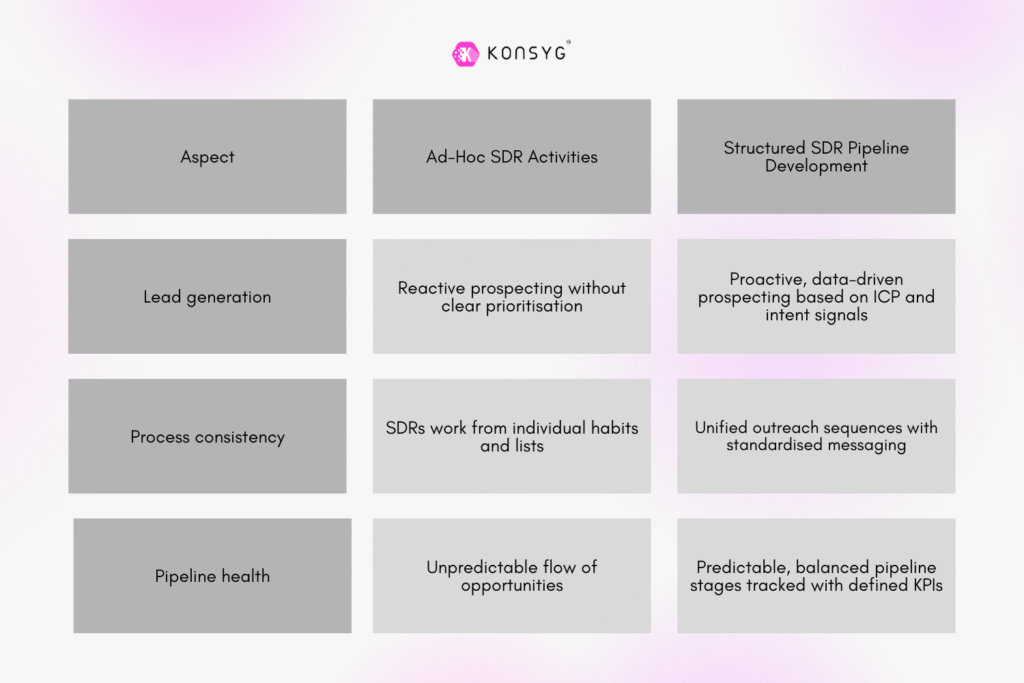
Traditional sales development often operates in isolation: SDRs generate lists, make calls, send emails, and pass leads to AEs without a full view of what drives conversion.
Once those leads are handed off, the SDR’s job is considered complete, resulting in a disconnected buyer journey and contributing to the classic sales handoff drop-off.
SDR pipeline development, by contrast, integrates outreach, qualification, and follow-up into a unified pipeline-building strategy.
Instead of focusing solely on top-of-funnel activity, SDR teams are accountable for revenue-linked pipeline metrics across the entire prospect journey. They work in lockstep with sales and RevOps, using B2B cold calling insights, intent data, and account-level intelligence to optimise every touchpoint for deal progression.
This means decisions – from list building to follow-up cadence – are made with clear pipeline and revenue goals in mind, not just activity volume targets.
Here’s how these approaches compare across key aspects:
What are the benefits of SDR Pipeline Development?
Let’s explore the key benefits that make the SDR pipeline development model an essential strategy for modern B2B sales teams.
Higher quality leads and conversion rates
SDR pipeline development replaces the traditional “spray and pray” approach with precision targeting and advanced qualification frameworks.
By leveraging intent data, account intelligence, and verified contact information, SDR teams can identify and prioritise prospects most likely to convert into high-value opportunities. This shift from quantity to quality ensures AEs spend more time on engaged, sales-ready leads rather than working through cold or unqualified lists.
Accelerated sales cycles
With a structured SDR pipeline development approach, prospects receive relevant outreach at precisely the right stage of their buying journey, making decisions faster and with greater confidence.
According to LinkedIn’s State of Sales report, B2B buyers spend just 17% of their purchasing time meeting with potential suppliers. Effective pipeline development ensures that every interaction within this window builds momentum towards closing the deal.
Enhanced ROI tracking and optimisation
SDR pipeline development provides complete visibility into how outbound activity translates into a qualified pipeline. Using CRM-integrated tracking, SDR leaders can analyse channel performance, test different outreach strategies, and double down on what works best.
This clarity allows sales leadership to defend headcount investment in SDR teams with proven B2B lead generation impact.
Stronger sales and marketing alignment
The traditional divide between SDRs, AEs, and marketing disappears when all teams share a common pipeline target and operate from a single source of truth.
Aligned teams see measurable results: research shows that revenue teams with tight alignment achieve 24% faster revenue growth and 27% faster profit growth.
Data-driven decision making
Instead of relying on gut feel or outdated playbooks, SDR pipeline development uses analytics, conversion tracking, and AI-driven insights to guide outreach, qualification, and follow-up.
This enables SDR managers to refine messaging, segment target lists more effectively, and improve overall B2B appointment setting efficiency.
Predictable pipeline creation
Perhaps most importantly, SDR pipeline development creates a repeatable, scalable system for generating opportunities month after month.
By tracking and optimising conversion rates at every stage from first touch to opportunity creation, sales organisations can forecast with greater accuracy and reduce end-of-quarter pipeline panic.
What are the key SDR Pipeline Development strategies?
Successfully implementing SDR pipeline development requires a systematic approach that aligns people, processes, and technology around measurable pipeline creation.
Setting pipeline-based goals
Gone are the days when SDR success was measured solely by the number of dials or emails sent. SDR pipeline development demands a shift to goals directly tied to qualified opportunity creation.
Start by working backwards from your organisation’s revenue targets to calculate the exact pipeline value SDRs need to generate each quarter.
Your pipeline-based goals should:
- Align with company-wide revenue objectives
- Be broken into monthly and weekly SDR targets
- Include both new business and expansion pipeline creation
- Define clear metrics for success, such as opportunity value and win rate
Creating aligned SDR and AE processes
The key to SDR pipeline development success lies in eliminating silos between SDRs and AEs. This means building joint processes that ensure smooth lead progression and consistent follow-up.
Best practices for alignment include:
- Establishing regular SDR–AE sync meetings
- Creating shared definitions for lead qualification stages
- Building joint account plans and outreach strategies
- Defining clear SLA-driven handoff protocols
- Involving SDRs in early deal-stage strategy discussions
Implementing data-driven prospecting
Pipeline-building campaigns must be fuelled by accurate, up-to-date data. This involves moving beyond static lead lists to leveraging B2B cold calling insights, behavioural intent data, and predictive analytics.
Key elements include:
- Using intent data to prioritise accounts in-market now
- Applying predictive scoring to identify high-likelihood converters
- Tailoring outreach sequences based on buyer stage and engagement history
- Continuously A/B testing messaging for improved conversion rates
Building a customer-centric outreach approach
SDR pipeline development is not just about filling the funnel, it is about progressing the proper accounts through to closed-won.
This means:
- Developing detailed Ideal Customer Profiles (ICPs)
- Mapping multi-stakeholder buying journeys
- Crafting stage-specific messaging and touchpoints
- Identifying cross-sell or upsell opportunities early
- Building relationships that support future advocacy
Developing continuous feedback loops
A strong feedback culture is critical for improving SDR effectiveness. SDRs, AEs, and marketing must share insights regularly on what is working and what needs refining.
Core feedback loops include:
- Weekly SDR–AE pipeline reviews
- Win/loss analysis to uncover messaging gaps
- Customer feedback integration into outreach scripts
- Sharing sales intelligence across the revenue team
- Regular review of B2B lead generation performance by channel
How to measure the success of SDR Pipeline Development?
Here are the essential metrics for validating your SDR pipeline development efforts:
Pipeline attribution
Pipeline attribution shows the direct impact of SDR activity on generating qualified opportunities.
Track metrics such as SDR-influenced pipeline value, SDR-sourced opportunities, multi-touch attribution across outreach channels, return on sales development investment (ROSDI), and cost per opportunity by channel.
They will help you identify which prospecting activities drive the most value.
Pipeline health metrics
Your pipeline health metrics are the best indicators of long-term sales success.
Focus on key indicators such as pipeline coverage ratio, average opportunity value, sales cycle length, pipeline velocity, and opportunity creation rate per SDR.
They will help you forecast accurately and spot potential bottlenecks early.
Conversion rates
Every stage of the B2B lead generation funnel has critical conversion points.
Monitor lead-to-opportunity rates, opportunity-to-demo progression, demo-to-proposal rates, proposal-to-win ratios, and stage-specific velocity.
They will help you fine-tune your B2B appointment setting process.
Account value over time
Look beyond the initial meeting booked to measure the long-term impact of pipeline efforts.
Track customer acquisition cost (CAC), customer lifetime value (CLV), CLV: CAC ratio, expansion pipeline from SDR-sourced accounts, and retention rates.
By keeping an eye on these numbers, you can optimise for sustainable, recurring revenue.
How to build an effective measurement system?
Set up your foundation
Start with a clean data infrastructure that ensures SDR activity and outcomes are tracked consistently across all channels.
Implement strong data governance policies and create unified account records so managers can see both high-level trends and individual SDR performance.
Choose your tools wisely
Your sales tech stack should serve as a single source of truth for SDR performance data.
Focus on seamless integration between your CRM, sales engagement platform, intent data tools, and analytics dashboards.
Design actionable reporting
Build dashboards that drive decisions, not just display activity numbers.
Tell a clear story of how SDR activity translates into pipeline growth using both executive overviews and detailed call, email, and meeting analytics.
Pro tip: Focus on what moves the needle.
Most sales organisations should initially focus on pipeline coverage, conversion rates, opportunity value, and CAC. As your SDR pipeline development matures, consider adding more advanced metrics, such as opportunity-to-revenue velocity.
What are the common SDR Pipeline Development challenges (and how to overcome them)?
Every sales transformation comes with obstacles.
Here are the most common challenges in SDR pipeline development and how to solve them.
Data quality and management
Poor prospect data can derail even the most substantial SDR efforts. Teams often face incomplete contact info, outdated decision-maker lists, and duplicate records.
The solution starts with establishing transparent data enrichment processes, regular list hygiene, and using a B2B data provider like Konsyg to ensure clean, up-to-date, and compliant contact records.
Team alignment issues
SDRs, AEs, and marketing often work in silos, chasing different goals.
Fix this by setting shared pipeline targets, running joint account planning sessions, and creating transparent lead handoff protocols.
Pipeline becomes everyone’s responsibility, not just the SDR team’s KPI.
Technology integration
Disconnected systems make it hard to track results and optimise outreach.
Solve this by auditing your sales stack, mapping critical integration points, and prioritising CRM–sales engagement platform–data provider syncs first.
Attribution complexity
Understanding which SDR activities contribute most to closed deals can be challenging in multi-touch B2B sales cycles.
Begin with a simple attribution model that SDRs can track consistently, then refine it over time. Focus on identifying high-impact activities rather than chasing perfect attribution.
Cultural resistance
Shifting to a structured, metrics-driven SDR pipeline development model can face resistance from teams used to working independently.
Overcome this by showcasing early wins, sharing pipeline success stories, and proving the link between SDR activity and closed revenue.
What role does customer and prospect data play in SDR Pipeline Development?
From buying signals to engagement history, every data point informs more effective prospecting.
Powers buying committee insights
B2B deals often involve 6–10 decision-makers; data helps SDRs identify and map them early.
By tracking who engages with outreach and content across a target account, SDRs can connect with multiple stakeholders and shorten sales cycles by up to 40%.
Unlocks revenue-driving intent signals
By monitoring account behaviour, such as website visits, content downloads, or increased activity on pricing pages, SDRs can identify when a prospect is transitioning into buying mode.
For example, if three stakeholders from the same company download a case study in one week, it signals a high-priority outreach opportunity.
Identifies expansion opportunities
For existing accounts, usage data and engagement trends can reveal upsell or cross-sell potential.
When an account’s product adoption reaches specific thresholds, SDRs can re-engage with targeted messaging, increasing conversion rates.
Drives intelligent lead scoring
Go beyond basic ICP matching by combining firmographic data, engagement history, and behavioural triggers to predict the likelihood of conversion with up to 90% accuracy.
For instance, if an account…
- Matches your ICP
- Has engaged with bottom-funnel content
- Shows multi-stakeholder activity
…it should be prioritised for immediate outreach.
Enables targeted account prioritisation
Not all accounts have equal potential. Using prospect data, SDR teams can focus on high-revenue potential accounts based on concrete buying signals.
These signals might include:
- Multiple decision-makers engaging with outreach
- Consistent opens and replies to SDR sequences
- Increased activity on product-focused content
These accounts should move to the top of your B2B appointment setting queue.
How to align SDR Pipeline Development with Sales and RevOps?
When SDR pipeline development operates in isolation, it becomes just another sales initiative. The real impact comes from deep alignment with account executives (AEs), marketing, and revenue operations teams.
Here’s how to make that alignment happen:
Creating unified goals
In many organisations, SDRs focus on booked meetings while AEs chase closed deals. This creates a gap from the very start. Establish shared pipeline targets and break them into metrics that matter to all teams.
Instead of only tracking meetings booked, align around pipeline velocity, opportunity creation rate, and win rates from SDR-sourced opportunities. This shared accountability shifts the relationship from transactional to truly collaborative.
Establishing shared processes
The handoff from SDR to AE should never feel like throwing a lead over the fence. Document clear processes for lead qualification, scoring, and routing.
Agree on what constitutes a sales-accepted lead (SAL), sales-qualified opportunity (SQO), and how each stage is validated.
Just as importantly, create SLAs for AE follow-up and feedback so SDRs understand which opportunities convert and why.
Implementing communication frameworks
Alignment should not depend on individual relationships. Create structured touchpoints like weekly SDR–AE syncs, monthly pipeline reviews, and quarterly planning sessions.
These are opportunities for AEs to share real-time insights on prospect objections, and for SDRs to preview new prospecting campaigns or messaging for feedback.
Building collaborative workflows
Go beyond booking meetings and integrate workflows across the entire prospecting journey. Have SDRs join AE calls to understand customer needs, and involve AEs in refining outreach sequences to address specific pain points.
Use a centralised B2B data source so everyone works from the same account intelligence. When SDRs, AEs, and RevOps see the same data, alignment becomes natural.
Measuring joint success
Individual KPIs still matter, but shared metrics create lasting alignment. Track metrics such as:
- SDR-influenced pipeline value and its conversion rates
- AE follow-up time on SDR-sourced leads
- Joint account penetration rates in target accounts
- Velocity of SDR-sourced opportunities through the sales cycle
What are the essential SDR Pipeline Development tools?
To execute SDR pipeline development effectively, you need the right tech stack.
Here are the vital tools that power high-performing SDR teams 👇
- Konsyg
A global B2B sales execution provider, Konsyg delivers end-to-end SDR services from targeted prospect list building to multi-channel outreach and appointment setting.
It enables SDR teams to:
- Build and refine target account lists with precise ICP matching
- Keep CRM data clean through real-time enrichment
- Execute multi-touch outbound sequences across phone, email, and LinkedIn
- Identify in-market buyers using intent and trigger-based signals
- Track performance and pipeline contribution in real time
Key features include:
- Diamond-level verified contact data
- Global market coverage with deep APAC and EMEA expertise
- Advanced prospect scoring models
- Integrated reporting and dashboard access for clients
- GDPR-compliant data handling and ISO-certified processes
- Apollo.io
Combines an extensive, verified B2B contact database with outbound email automation. Ideal for building prospect lists quickly, running A/B-tested email sequences, and tracking engagement metrics.
- ZoomInfo Engage
A data-driven sales engagement platform that helps SDRs prioritise outreach based on buyer intent, recent activity, and firmographic matching.
- LinkedIn Sales Navigator
An essential prospecting tool for identifying decision-makers, monitoring account activity, and sending personalised connection requests.
- Lemlist
An email outreach platform that allows SDRs to create highly personalised, image- and video-rich cold emails to increase reply rates.
- Leadfeeder
Website visitor identification software that shows which companies visit your site, even if they do not fill out a form, giving SDRs warm targets to reach out to.
- Crystal
A personality AI tool that analyses LinkedIn profiles and suggests tailored messaging approaches to improve cold outreach resonance.
- Chorus.ai
A conversation intelligence platform that records SDR–prospect calls, surfaces key objections, and highlights talk-to-listen ratios for performance coaching.
Start building a predictable pipeline today with Konsyg
What separates good SDR teams from great ones?
Often, it is the quality of the data and outreach strategy driving their daily activity.
With accurate, actionable prospect intelligence, every cold call becomes more relevant, every email more personalised, and every opportunity more predictable.
Want to see how a fully optimised SDR pipeline can transform your revenue potential?
Book a consultation with Konsyg today and join hundreds of companies turning SDR activity into a consistent, revenue-generating engine.
Share This Post
Recent Posts
What We Offer
Get Your Quote