

The Ultimate Guide to On-Demand Sales
The pressure on B2B sales leaders has never been more intense.
According to industry research, average sales budgets in many organisations have tightened, with leaders expected to deliver a more qualified pipeline while operating with fewer resources. This has forced revenue executives to make difficult decisions about where to deploy their shrinking budgets.
In this environment of doing more with less, one thing becomes crystal clear: every sales investment must show a clear, measurable impact on the bottom line. Activity metrics and vague pipeline projections will no longer suffice; predictable B2B sales results and revenue generation are what truly matter.
This is where on-demand sales come in. It is not just another outsourcing model; it is a fundamental shift in how modern revenue teams operate.
In this comprehensive guide, we will explore:
- How on-demand sales differ from traditional sales structures
- Practical strategies to implement on-demand SDR teams in your organisation
- Essential tools and metrics for success
What is on-demand sales?
On-demand sales is a strategic approach that transforms sales execution into a predictable and scalable sales pipeline engine.
It aligns all outreach and prospecting activity with measurable revenue outcomes and integrates them with marketing and revenue operations (RevOps).
How do on-demand sales differ from traditional sales?
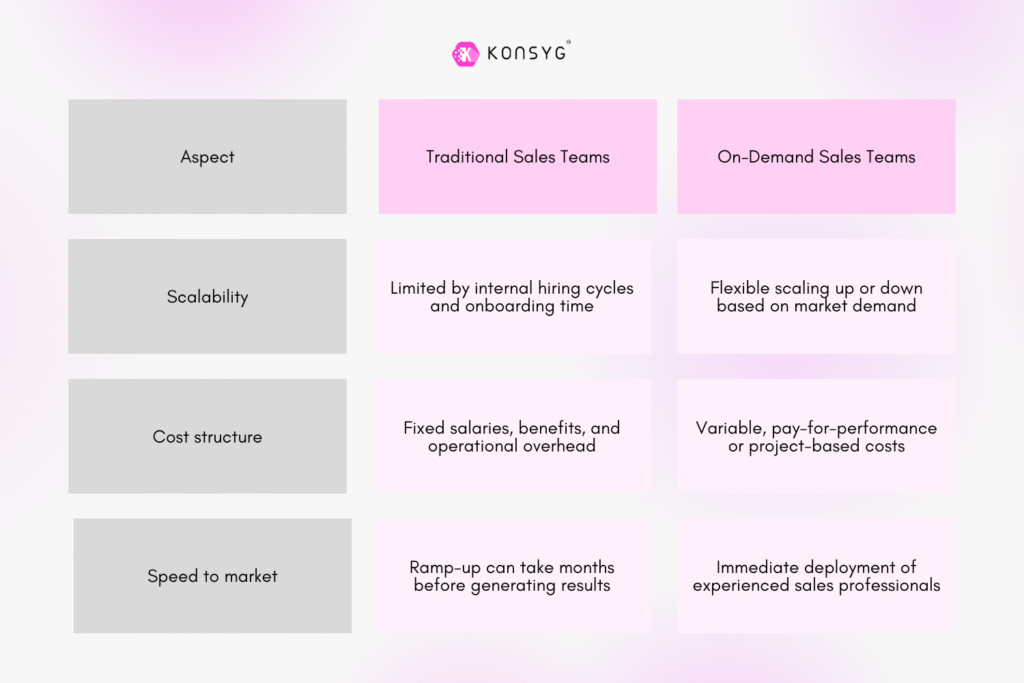
Traditional B2B sales teams operate in a relatively fixed structure: they recruit, onboard, and measure success mainly through activity counts such as calls or emails sent.
Once new hires are in place, the team’s cost remains fixed regardless of performance, creating inflexibility and slower adaptation to market changes.
On-demand sales, by contrast, transform this siloed and static approach into an integrated revenue generation system.
Instead of focusing only on headcount and activity volume, on-demand SDR and AE teams are accountable for revenue outcomes across the customer journey. They work in lockstep with marketing and RevOps, using data-driven sales insights to optimise every touchpoint for revenue impact. This means sales decisions, from campaign targeting to budget allocation, are made with clear revenue goals in mind, not just lead volume.
Here’s how these approaches compare across key aspects:
What are the benefits of on-demand sales?
Let’s explore the key advantages that make the on-demand sales model an essential strategy for B2B companies.
Higher quality leads and conversion rates
On-demand sales replaces the traditional “spray and pray” approach with precision targeting, dedicated outreach, and sophisticated qualification frameworks.
By using intent data, industry segmentation, and behavioural signals, on-demand teams identify and prioritise prospects most likely to convert. This shift from quantity to quality means sales reps spend more time advancing qualified B2B leads, rather than chasing unresponsive contacts. Providers like Konsyg apply proven playbooks in B2B lead generation and appointment setting services to deliver decision-maker conversations that convert consistently.
Accelerated sales cycles
With on-demand SDRs and AEs in place, prospects receive the right outreach at the right time, shortening the buying process and making it easier to reach a decision.
According to industry studies, B2B buyers spend only a small fraction of their evaluation window speaking with suppliers. On-demand sales ensure every touchpoint in that narrow window drives momentum, with tailored messaging, follow-up cadences, and timely insights that move deals forward faster.
Enhanced ROI tracking and optimisation
On-demand sales bring unprecedented clarity to sales’ contribution to the bottom line. Through shared CRM dashboards, opportunity attribution, and closed-loop reporting, teams can track exactly which outreach efforts are generating pipeline.
This visibility allows companies to optimise sales pipeline activities in real time, reallocating resources toward what’s working. Meanwhile, sales leaders can defend and expand budgets by showing clear revenue attribution from their on-demand teams.
Stronger sales and marketing alignment
The traditional divide between marketing and sales disappears when both operate from a shared playbook and revenue targets.
On-demand teams integrate directly with internal stakeholders, sharing data, lead definitions, and pipeline stages. This alignment delivers measurable results: aligned revenue teams generate a pipeline faster and close more deals compared to siloed departments.
Data-driven decision making
Instead of relying on guesswork or anecdotal reports, on-demand sales teams use advanced analytics, B2B sales engagement data, and AI-driven insights to guide campaign targeting, messaging, and cadence adjustments.
This empowers companies to make informed, agile decisions that continuously improve prospect engagement and conversion rates.
Predictable revenue generation
Perhaps most importantly, on-demand sales create a scalable, repeatable revenue engine.
By tracking and optimising sales pipeline velocity at every stage, companies can forecast revenue with greater accuracy and influence outcomes proactively.
What are the key on-demand sales strategies?
Successfully implementing on-demand sales requires a systematic approach that aligns people, processes, and technology around revenue generation.
Let’s explore the five core strategies that form the foundation of effective on-demand sales.
Setting revenue-based goals
Gone are the days of setting sales goals based solely on activity counts or generic lead quotas. On-demand sales require a fundamental shift in the goal-setting process.
Start by working backwards from your company’s revenue targets, breaking them into specific sales pipeline objectives that directly support business growth.
Your revenue-based goals should:
- Align with company-wide revenue targets
- Be divided into quarterly and monthly objectives
- Include both new customer acquisition and account expansion targets
- Define the key metrics for measuring progress, such as conversion rates, velocity, and cost per opportunity
Creating aligned sales and marketing processes
The key to on-demand sales success lies in breaking down the traditional silos between internal teams and outsourced sales partners. This means building integrated processes that cover the entire revenue journey.
Best practices for alignment include:
- Establishing a unified revenue team meeting cadence
- Creating shared definitions for lead and opportunity stages
- Developing joint account planning processes
- Implementing clear handoff protocols between on-demand SDRs and internal account executives
- Building collaborative content creation workflows that support sales conversations
Implementing data-driven campaigns
On-demand sales campaigns should be built on a foundation of robust data and analytics.
Move beyond basic demographic targeting to leverage buyer intent data, firmographics, behavioural triggers, and predictive analytics.
Key elements of data-driven campaigns include:
- Using B2B lead generation data to identify high-value accounts
- Leveraging predictive scoring to prioritise outreach sequences
- Creating dynamic messaging tracks based on prospect behaviour
- Optimising cadences based on conversion performance
- Testing and iterating continually to improve results
Building customer-centric approaches
On-demand sales is not just about acquiring new customers, it’s also about driving revenue from existing accounts.
This requires a deep understanding of customer needs, buying triggers, and decision-making processes.
Essential components include:
- Creating detailed ideal customer profiles and buyer personas
- Mapping comprehensive customer journeys across sales touchpoints
- Developing stage-specific outreach strategies for nurturing leads
- Identifying upsell and cross-sell opportunities within active accounts
- Building advocacy programs that turn satisfied customers into referral sources
Developing feedback loops
Continuous improvement in on-demand sales depends on robust feedback mechanisms between your internal team and your sales provider.
These loops ensure that insights from prospect interactions inform future strategy and execution.
Critical feedback loops include:
- Regular joint team syncs
- Win/loss analysis sessions to refine targeting and messaging
- Integrating customer and prospect feedback into outreach strategies
- Sharing sales intelligence across teams
- Reviewing campaign performance metrics in detail
How to measure the success of on-demand sales?
Here are the essential metrics for validating your on-demand sales efforts:
Revenue attribution
Revenue attribution reveals sales’ direct impact on revenue generation.
Track metrics like sales-influenced pipeline, SDR-sourced revenue, multi-touch attribution across channels, return on sales investment (ROSI), and cost per opportunity by channel.
These will help you understand which sales activities drive the most value.
Pipeline metrics
Your sales pipeline metrics indicate the health and predictability of your revenue engine.
Focus on key indicators like pipeline coverage ratios, average deal size, sales cycle length, pipeline velocity, and opportunity creation rate.
Monitoring these will help you forecast accurately and identify potential bottlenecks.
Conversion rates
Every stage of your B2B lead generation and sales funnel has critical conversion points.
Track metrics such as lead-to-SQL rates, SQL-to-Opportunity progression, Opportunity-to-Win rates, channel-specific conversions, and stage velocity.
These will help you refine your on-demand SDR process and optimise closing efficiency.
Customer lifetime value
Look beyond the initial win to measure long-term impact.
Track customer acquisition costs (CAC), customer lifetime value (CLV), the CLV: CAC ratio, expansion revenue rates, and retention performance.
By keeping these under review, you can ensure sustainable growth from your on-demand sales initiatives.
How to build an effective measurement system?
Set up your foundation.
Start with a solid sales data architecture that ensures consistent tracking across channels.
Implement clear data governance standards and create unified customer profiles, enabling both high-level reporting and detailed opportunity analysis.
Choose your tools wisely.
Your sales tech stack should create a single source of truth for revenue data.
Focus on seamless integrations between your CRM, sales engagement tools, and business intelligence platforms to ensure accuracy and accessibility.
Design actionable reporting
Create dashboards that drive decisions, not just display numbers.
Tell a clear story about your on-demand sales impact with both executive summaries and deep-dive analytics into SDR performance, appointment setting, and deal velocity.
💡 Pro tip: Focus on what moves the needle!
Most B2B companies starting with on-demand sales should focus first on pipeline influence, revenue attribution, conversion rates, and acquisition costs. As your sales outsourcing program matures, you can layer in more advanced analytics for forecasting and account expansion.
What are the common on-demand sales challenges (and how to overcome them)?
Every transformation in sales execution comes with its hurdles.
Here are the most common challenges in on-demand sales implementation, along with practical solutions to address them.
Data quality and management
Poor data quality undermines even the best B2B lead generation strategies. SDR teams often deal with duplicate records, incomplete contact information, and inconsistent data across systems.
The solution starts with establishing strict data governance policies, running regular CRM hygiene processes, and investing in data enrichment tools (like Konsyg’s integrated prospect intelligence) that keep your target account data accurate, up-to-date, and ready for outreach.
Team alignment issues
Sales, marketing, and outsourced SDR teams often operate in silos, with different goals and success metrics.
Break down these silos by setting shared revenue targets, holding regular joint pipeline reviews, and creating transparent handoff processes between SDRs and account executives.
Success comes from making revenue a shared responsibility instead of treating SDR output as a standalone metric.
Technology integration
Many organisations struggle with disconnected sales engagement tools, CRMs, and analytics platforms that slow down the on-demand SDR process.
Address this by auditing your tech stack, identifying integration gaps, and building a roadmap for a unified sales execution platform.
Focus on key integrations first, particularly between your CRM, sales engagement tool, and analytics dashboard so that SDR teams can work from a single source of truth.
Attribution complexity
Determining the actual impact of on-demand sales outsourcing on closed revenue can be tricky, especially when multiple touchpoints and channels are involved.
Begin with a clear, consistent attribution model that your team can execute, such as tracking SDR-sourced opportunities and pipeline influence. Then, refine it as your measurement maturity grows.
Cultural resistance
Shifting from a traditional, entirely in-house SDR model to outsourced sales support often meets resistance from teams used to old processes.
Combat this by sharing quick wins early, publishing internal success stories, and showing clear evidence of how on-demand sales accelerates pipeline creation. Make adoption a collaborative process instead of a forced change.
What role does customer data play in on-demand sales?
From buying signals to engagement patterns, every data point helps shape a more effective on-demand sales strategy.
Powers buying committee insights
Modern B2B deals often involve 6–10 decision-makers; customer data allows your SDRs to identify and map the full buying committee.
By tracking engagement across departments, SDRs can reach key stakeholders earlier, accelerating deal velocity by as much as 40%.
Unlocks revenue-driving intent signals
By monitoring prospect behaviour from website visits to case study downloads to demo requests, your team can spot buying intent before competitors.
For example, when engagement with a pricing page spikes or multiple contacts from the duplicate account download industry-specific content, your SDRs can prioritise outreach at the right moment.
Identifies expansion revenue opportunities
Usage data from existing accounts can signal when a client is ready for an upsell or cross-sell.
When utilisation exceeds 80% or specific service adoption milestones are reached, on-demand SDRs can proactively re-engage those accounts with tailored offers.
Drives intelligent lead scoring
Move beyond basic firmographic scoring by combining demographic fit with engagement history and behavioural signals.
This allows your B2B sales outsourcing team to predict which prospects are most likely to convert and focus efforts accordingly.
Enables targeted account prioritisation
Not every account has the same revenue potential. Customer data helps SDR teams identify high-value targets based on indicators like:
- Multiple departments are engaging with outreach
- Consistent responses to industry-specific messaging
- Ongoing interest in thought leadership content
These accounts become prime candidates for account-based marketing plays and deeper SDR follow-up.
How to align on-demand sales with internal teams
When on-demand sales operate in isolation, they are essentially just another outsourced service. The real impact comes when SDRs, account executives, marketing, and RevOps function as one revenue unit.
Here is how to build that alignment:
Creating unified goals
Traditional setups where in-house marketing focuses on MQLs and sales chase revenue targets create misalignment from day one. Start by establishing shared pipeline and revenue goals, then break them into metrics that matter to all stakeholders.
For example, instead of tracking only meetings booked, align around pipeline velocity, opportunity creation rate, and win rates. This shared accountability transforms the outsourced–in-house relationship from transactional to strategic.
Establishing shared processes
The handoff from outsourced SDR teams to in-house sales should never feel like throwing leads over a wall. Create documented processes for qualification, scoring, and routing.
Define exactly what constitutes a sales-ready lead for your business, and ensure both the on-demand team and your internal reps agree.
Most importantly, establish SLAs for lead follow-up and feedback loops to help SDRs understand which outreach efforts are driving real revenue.
Implementing communication frameworks
Consistent communication between internal and external teams cannot depend on chance. Schedule weekly SDR–AE syncs, monthly pipeline reviews, and quarterly planning sessions.
These touchpoints enable SDRs to share the messaging and tactics that resonate with prospects, while AEs can identify deal blockers and suggest adjustments to outreach.
Building collaborative workflows
Go beyond the basics of lead delivery to create integrated workflows. Have on-demand SDRs join sales calls to understand customer objections better. Involve internal teams in crafting outbound sequences so the messaging reflects actual buyer pain points.
Leverage shared data platforms to ensure both teams are working from the same account intelligence. When everyone has equal access to insights, alignment becomes the default.
Measuring joint success
Individual performance metrics still matter, but shared success indicators drive accurate alignment. Track:
- SDR-influenced pipeline and its conversion rates
- Internal sales adoption of SDR-sourced opportunities
- Penetration rates in high-priority accounts
- Velocity of outsourced deals through the pipeline
Essential on-demand sales tools
To execute B2B sales outsourcing effectively, you need a connected tech stack that supports prospecting, engagement, and measurement.
- Konsyg
A global leader in on-demand sales outsourcing, Konsyg delivers full-cycle outbound campaigns for B2B companies worldwide. The model combines experienced SDR teams with advanced sales technology to generate a predictable, high-quality pipeline.
Konsyg helps teams:
- Identify and target the proper accounts using firmographic and intent data
- Keep CRM data accurate through continuous enrichment
- Build targeted outbound sequences that match buying signals
- Align SDR outreach with in-house sales goals
- Track and optimise every stage of the pipeline for ROI
Key features include:
- Global SDR coverage with multi-language capability
- Proven outbound methodology optimised for complex B2B sales
- Integrated reporting on meetings booked, pipeline created, and deals won
- GDPR-compliant operations with secure data handling
- Flexible scaling based on campaign goals and timelines

What Konsyg’s clients say:
Konsyg kept up to their word. PikoHana’s reach was maximised when we outsourced them. The sales team in Konsyg carried out tasks diligently and ensured accountability for every milestone achieved.
Imagine having a perfectionist working for you on the sales team, and that’s the gist of outsourcing Konsyg. Konsyg was always there, taking up new instructions and working on them almost instantly, which made most of our tasks effortless.
For more information, explore Konsyg’s service packages or speak directly with our team to design your on-demand sales program.
- Salesforce
The gold-standard CRM for managing contacts, accounts, and opportunities across the revenue cycle. It provides a central hub for tracking SDR activity, AE follow-up, and deal progression, which isn essential for aligning outsourced SDR teams with internal sales.
- Clari
A unified revenue platform that brings together forecasting, pipeline analytics, and conversation intelligence. Perfect for on-demand sales programs, Clari gives leadership visibility into which SDR-sourced deals are most likely to close.
- Outreach
A leading sales engagement platform that helps SDRs execute personalised outbound sequences at scale. It tracks every touchpoint, making it easy to measure how B2B outbound sales efforts are performing.
- Chilli Piper
A meeting automation tool that instantly routes qualified leads to the right sales rep’s calendar. For outsourced SDR teams, this means zero delays between interest and connection, improving conversion rates.
- HubSpot Marketing Hub
While primarily a marketing automation platform, HubSpot integrates tightly with B2B sales outsourcing campaigns. It allows SDRs to leverage marketing-qualified leads and run coordinated nurture sequences.
- 6sense
An AI-powered account-based platform that identifies when target accounts are showing buying intent. When combined with on-demand sales teams, this data ensures outreach happens at the exact right time.
- LinkedIn Sales Navigator
A critical tool for research, prospecting, and social selling in B2B outbound sales. It helps SDRs identify decision-makers, track account activity, and personalise outreach for higher response rates.
Start building a predictable pipeline today with Konsyg
What separates a good outbound program from a great one?
Often, it comes down to the consistency and precision of the sales execution behind it.
With a skilled on-demand sales team, every outreach becomes more relevant, every touchpoint more strategic, and every opportunity forecast more reliable.
Want to see the impact a high-performance B2B sales outsourcing partner can have on your revenue growth?
Work with Konsyg and join companies worldwide that have turned their sales operations into a predictable, scalable growth engine.
Share This Post
Recent Posts
What We Offer
Get Your Quote