

Struggling to keep your sales pipeline full is more common than most teams admit.
Nearly 45% of B2B sales reps say that finding high-quality leads is their biggest challenge. Not closing. Not pricing. Just finding the right people to speak to.
That is where B2B lead generation starts to break down.
This guide is built to fix that. It covers what actually works in 2026, from proven strategies and channels to how teams are consistently building a pipeline without relying on guesswork.
If your goal is simple, more qualified leads and a pipeline you can depend on, this is where you start.

B2B lead generation: An overview
Let us start with the basics.
B2B lead generation is the process of turning potential business customers into paying clients. It involves identifying the right prospects, those with real purchase intent, engaging them through targeted marketing strategies, and guiding them towards conversion.
At its core, B2B lead generation sits between marketing and sales, connecting awareness to actual revenue.
Today, this process goes far beyond traditional methods. High-performing teams rely on lead generation tools, process automation, and data-driven targeting to build more efficient and predictable pipelines.
They also use lead magnets, personalised outreach, and structured campaigns to engage decision-makers at the right time.
When done well, B2B lead generation strategies do not just bring in leads. They bring in qualified leads that are more likely to convert, helping businesses build a consistent pipeline and long-term partnerships.
B2B vs B2C lead generation: What’s the difference?
At a glance, the process looks similar. Build awareness, capture interest, and convert leads.
In reality, B2B lead generation and B2C lead generation operate very differently.
The differences show up across every stage of the funnel, from target audience and buying cycles to decision-making processes and conversion timelines.
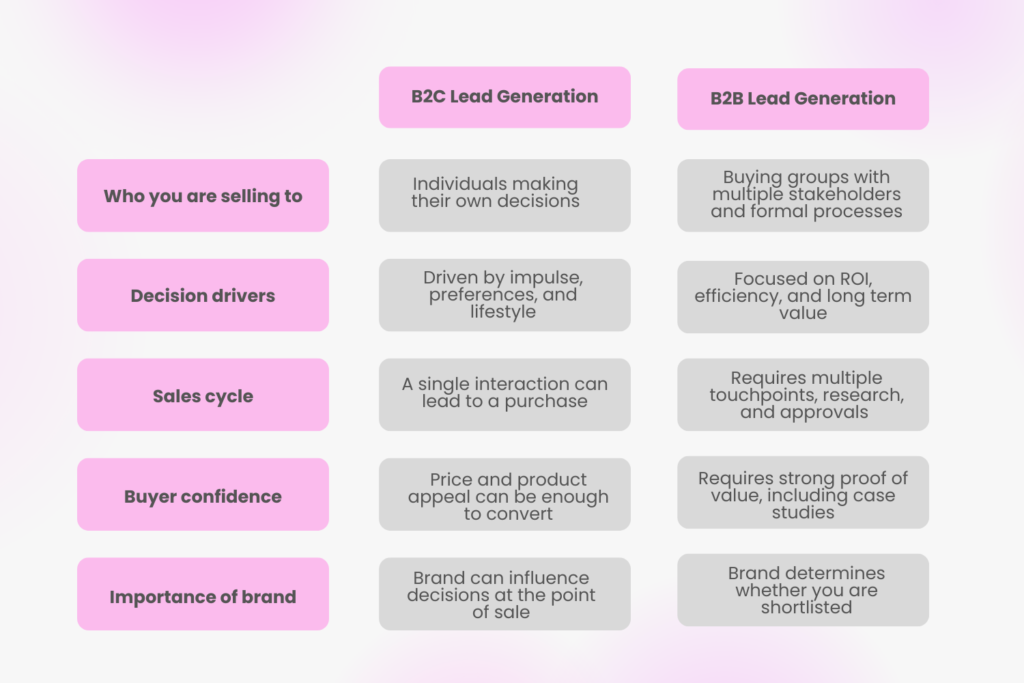
- You are selling to organisations, not individuals
In B2C lead generation, you are typically targeting individual consumers making a single decision.
In B2B lead generation, you are targeting organisations. This means navigating hierarchical buying teams and complex procurement processes. Your messaging needs to resonate with an entire decision-making unit (DMU), which often includes six or more stakeholders.
This is where many lead generation strategies fail. They focus on one persona instead of the full buying group.
- Emotions still matter, but logic leads
In B2C lead generation, decisions are largely driven by emotion. Impulse, preferences, and personal appeal play a major role.
In B2B lead generation, emotion still matters, but it comes later. Buyers first look for logic. They want to see clear ROI, efficiency gains, and measurable value.
Your messaging needs to lead with facts and outcomes, then reinforce trust through credibility and reassurance. This is what drives engagement with qualified leads.
- Sales cycles are longer and more complex
B2C purchases can happen instantly. A single interaction can lead directly to conversion.
In B2B lead generation, the B2B sales cycle is longer and more structured. It often involves research, multiple conversations, internal discussions, and formal approvals.
You are not pushing for a quick decision. You are helping a business justify an investment over time.
- Buyers need more convincing
In B2C, pricing and product appeal can be enough to convert.
In B2B lead generation, buyers expect more depth. They look for case studies, demos, and supporting content that help them build an internal case.
Your content does not just generate interest. It supports lead nurturing and helps prospects convince their team, their leadership, and finance stakeholders.
- Brand and authority matter more
In B2C, a brand can influence decisions at the point of sale.
In B2B lead generation, the brand often determines whether you are even considered. Buyers look for trust, authority, and credibility before engaging.
Budgets are larger, risks are higher, and decisions are more visible. A strong brand positions you as a safe and reliable choice.
This is why building authority early is critical for generating a consistent pipeline.

B2B lead generation tactics
There is no shortage of ways to approach B2B lead generation, but results depend on how well each tactic aligns with your audience, goals, and overall lead generation strategy.
As a leading B2B lead generation company, Konsyg has worked with global B2B teams to build a consistent pipeline through structured outbound and inbound execution. The fundamentals remain the same, but how you apply them determines performance.
Below are the core B2B lead generation tactics that consistently drive results.
- Email marketing
Email marketing focuses on building relationships over time through targeted campaigns. This includes newsletters, nurture sequences, and onboarding flows.
Success depends on segmentation, timing, and delivering consistent value rather than pushing promotions.
Best for:
- Nurturing early-stage and cold leads
- Driving repeat engagement with high-value content
- Staying visible across long B2B sales cycles
- Cold email
Cold email is a core part of outbound B2B lead generation. It involves reaching out to prospects who have not interacted with your brand.
It is widely used to engage decision-makers and generate meetings at scale. Strong targeting and high-quality data are essential.
Best for:
- Reaching specific accounts and roles
- Generating meetings through B2B appointment setting
- Personalised outreach with a clear value proposition
Read our Top 5 B2B Cold Email Strategies to Boost Reply Rates
- Social selling
Social selling uses platforms like LinkedIn to build relationships through content, engagement, and conversations.
It works best when sales and marketing are aligned, and their messaging is consistent.
Best for:
- Engaging hard-to-reach decision-makers
- Building trust before direct outreach
- Supporting outbound campaigns with softer touchpoints
Learn more about AI for B2B Lead Generation: The Ultimate Guide
- Content marketing
Content marketing focuses on creating valuable content that attracts and educates your target audience.
It plays a key role in inbound B2B lead generation by building authority before a prospect is ready to engage with sales.
Best for:
- Establishing expertise in your niche
- Supporting long-term lead generation efforts
- Guiding prospects through the decision-making process
- Search engine optimisation (SEO)
Search engine optimisation ensures your business appears when prospects actively search for solutions.
It is a long-term channel that compounds over time and consistently delivers high-intent leads.
Best for:
- Generating steady inbound traffic
- Capturing demand at the right moment
- Reducing reliance on paid channels
- Paid ads
Paid advertising includes platforms like Google Ads and LinkedIn Ads. It offers fast visibility and precise targeting.
It is especially useful for testing campaigns and accelerating demand generation.
Best for:
- Driving targeted traffic quickly
- Retargeting engaged prospects
- Supporting specific campaign objectives
- In-person networking
Despite digital growth, in-person networking remains important in many B2B lead generation strategies.
Events, conferences, and meetups allow for deeper relationship building.
Best for:
- Building trust in high-value sales environments
- Creating opportunities outside digital channels
- Referral marketing
Referral marketing leverages existing customers and partners to generate new leads.
It works well because it is built on trust.
Best for:
- Expanding through existing networks
- Accelerating growth in niche markets
- Encouraging customer advocacy
- Account-based engagement (ABE)
Account-based engagement (ABE) focuses on targeting high-value accounts with personalised outreach and tailored content.
It requires close alignment between sales and marketing but delivers strong results in complex environments.
Best for:
- Engaging multiple stakeholders within target accounts
- Improving conversion rates and deal size
- Building long-term, high-value relationships
A premium B2B outbound sales and ABM execution partner, Konsyg delivers a complete SDR-as-a-Service model for identifying, engaging, and converting high-value target accounts.
The most effective B2B lead generation strategies do not rely on a single channel.
They combine outbound and inbound tactics to create a consistent pipeline, engage qualified leads, and support long-term growth.
This is where execution becomes the differentiator. Knowing the tactics is one thing. Applying them with precision is what drives results.

Trends shaping B2B lead generation in 2026
B2B lead generation is changing fast. Buying behaviour today looks very different from even a year ago.
The most effective lead generation strategies are not based on outdated playbooks. They reflect how buyers actually research, evaluate, and make decisions now.
At Konsyg, a global B2B lead generation company, we see these shifts are visible across campaigns, industries, and markets. Below are the trends shaping how the pipeline is built in 2026.
- Buyers expect multi-channel engagement
B2B buyers no longer rely on a single channel.
They move across search engines, LinkedIn, email, websites, and peer recommendations, often within the same session. Relying on a single channel, such as email, limits reach and reduces engagement.
Multi-channel B2B lead generation campaigns consistently outperform single-channel efforts because they meet buyers where they already are.
What this means:
Your strategy needs to show up early, across multiple touchpoints, with consistent messaging. Visibility across channels is now essential for building a consistent pipeline.
- Buying groups are larger and more complex
Modern B2B buying decisions involve more stakeholders than ever before.
It is no longer about convincing one decision-maker. You are addressing a group with different priorities, concerns, and levels of influence.
This makes lead generation more complex and more strategic.
What this means:
Your messaging and content need to support internal discussions. Strong B2B lead generation strategies help your champion sell your solution internally, not just understand it.
- Self-service is now expected
Today’s buyers prefer to research independently before speaking to sales.
They expect access to pricing, product details, case studies, and comparisons without friction. If this information is not available, they move on.
Your website is no longer just a marketing asset. It plays a direct role in lead generation and conversion.
What this means:
Your content and website should enable self-education. This improves engagement with qualified leads and shortens the B2B sales cycle.
- Trust and brand authority drive decisions
In B2B lead generation, trust is not optional.
Buyers are choosing partners, not just products. They look for consistency, credibility, and proof of delivery before engaging.
Brand perception often determines whether you are shortlisted.
What this means:
Your lead generation strategy should build authority before asking for action. Content, messaging, and outreach all need to reinforce trust and credibility.
- AI is changing how buyers evaluate options
AI is reshaping how B2B buyers research and compare solutions.
Buyers now use AI tools to analyse messaging, compare vendors, and summarise insights before making decisions. This means your positioning is being evaluated in ways you do not directly control.
What this means:
Your messaging needs to be clear, structured, and easy to interpret. Strong B2B lead-generation content is not just written for humans but also for how AI systems process and present information.
Why is B2B lead generation essential for growth?
At a basic level, B2B lead generation keeps your pipeline active and revenue flowing.
Without a steady flow of qualified leads, even the strongest sales teams struggle to perform. No leads means no conversations. No conversations mean no deals.
But the importance of lead generation goes beyond just filling the pipeline.
When done properly, it becomes a core driver of long-term business growth.
A strong B2B lead generation strategy helps organisations:
- Expand reach beyond existing markets and competitors
- Build brand visibility and credibility over time
- Develop trust with prospects across the funnel
- Create long-term relationships with ideal customers
- Improve marketing strategy through better data and insights
- Align teams around a shared pipeline and revenue goal
Lead generation stops being a reactive activity and becomes a structured system for building a consistent pipeline.
In that sense, B2B lead generation is not just a function. It is the foundation of scalable growth.
Sales vs marketing: Who owns B2B lead generation?
Both.
B2B lead generation sits between sales and marketing, and it only works when both functions are aligned.
Marketing is typically responsible for generating interest. This includes running campaigns, creating content, and driving inbound traffic to build a lead pipeline.
Sales is responsible for converting that interest into revenue. This includes lead qualification, follow-ups, and closing deals.
However, the line between the two is no longer fixed.
Modern lead generation strategies require a coordinated approach where messaging, targeting, and timing are aligned across every touchpoint. Whether executed internally or through a B2B lead generation agency, consistency is critical.
Beyond sales and marketing, other teams also contribute.
- Business development expands opportunities through partnerships, new markets, and strategic initiatives.
- Customer success teams drive retention, upselling, and referral-based lead generation
Existing customers are often an overlooked source of high-quality leads. Strong customer experience leads to higher lifetime value (LTV) and more referrals.
Every interaction a prospect has with your business shapes their decision.
If sales, marketing, and customer-facing teams are not aligned, the experience breaks down. Messaging becomes inconsistent, follow-ups slow down, and opportunities are lost.
Effective B2B lead generation depends on seamless coordination. It is not just about generating leads, but about moving them through the funnel efficiently.
Types of B2B leads
In B2B lead generation, not all leads are the same.
Understanding the different types of B2B leads is critical for managing your pipeline effectively. Each type requires a different approach, from nurturing to conversion.
Marketing-qualified leads (MQLs)
A marketing-qualified lead (MQL) is a prospect who has shown interest through your marketing efforts but is not ready to buy.
This could include downloading content, subscribing to a newsletter, or engaging with your website.
These signals matter, but they typically sit at the top or middle of the funnel. You are on their radar, but not yet a priority.
Pushing MQLs directly to sales often leads to poor outcomes. Instead, they should be nurtured through lead nurturing campaigns that provide relevant insights and build trust over time.
Strong B2B lead generation strategies focus on moving MQLs gradually towards higher intent.
Sales-qualified leads (SQLs)
A sales-qualified lead (SQL) has moved from interest to active consideration.
They meet the criteria that indicate both fit and readiness. This could include requesting a demo, signing up for a trial, or engaging with outbound outreach.
SQLs represent high-value opportunities within your sales pipeline.
At this stage, timing and messaging are critical. The goal is not just to sell, but to position your offering as the right solution to a defined business problem.
Also read How to Nurture B2B Leads.
Product-qualified leads (PQLs)
A product-qualified lead (PQL) is highly relevant for SaaS and product-led businesses.
These leads have already interacted with your product, often through a free trial or freemium model. Their behaviour, such as repeated usage or feature exploration, signals strong buying intent.
PQLs already understand the product value. The focus now shifts to building a clear business case and driving conversion.
Explore expert services for b2b lead generation.
Cold leads vs warm leads
Another way to segment B2B leads is by engagement level.
Cold leads have had no prior interaction with your brand. They require structured, personalised outreach to initiate conversations. This is a core part of outbound B2B lead generation.
Warm leads have shown some level of engagement. This could include website visits, content interaction, or social engagement. They are not ready to convert yet, but they are more receptive.
Effective lead generation campaigns focus on moving warm leads towards SQL status through consistent engagement.
Want more info on cold calling? Read The Ultimate Guide to B2B Cold Calling.
A word on intent signals and behaviour tracking
In modern B2B lead generation, behaviour often matters more than stated intent.
Actions such as repeated visits to pricing pages, webinar sign-ups, or engagement with bottom-of-funnel content indicate rising interest.
Tracking these buyer intent signals allows teams to prioritise outreach, improve timing, and personalise communication.
This is where data becomes a competitive advantage. When captured and used correctly, it helps convert more qualified leads and build a more predictable pipeline.
Learn more about B2B Lead Research & Data Enrichment, and also watch the Top Mistakes Businesses Make in The B2B Sales Cycle!
What makes a high-quality B2B lead?
Not all B2B leads are equal.
You can generate thousands of contacts, but if they lack budget, authority, or real intent, they are not leads. They are distractions.
High-quality leads are different. These are the leads your sales team wants to engage. They convert faster, churn less, and contribute meaningful revenue.
In modern B2B lead generation, the ability to identify quality is what separates scalable growth from wasted effort.
Fit + intent = quality
At its core, lead quality comes down to two factors. Fit and intent.
Fit refers to how closely a prospect matches your ideal customer profile (ICP). This includes industry, company size, geography, and role. Even a warm lead is unlikely to convert if they do not align with your target audience.
Intent reflects timing. It shows whether the prospect is actively exploring a solution. This could include visiting pricing pages, engaging with bottom-of-funnel content, or responding to outreach.
Both are essential.
- Strong fit but no intent → requires lead nurturing
- High intent but poor fit → should be disqualified early
Effective B2B lead generation strategies rely on balancing both through structured lead scoring models.
Lead generation and buying committees
In B2B lead generation, decisions are rarely made by one person.
Most buying decisions involve a decision-making unit (DMU), often made up of six to ten stakeholders. Each brings different priorities, concerns, and levels of influence.
This changes how you define a high-quality lead.
It is not just about identifying one decision-maker. It is about understanding the entire buying group.
This includes:
- The internal champion
- The end user
- The decision-maker
- The gatekeeper
Ignoring any part of this group weakens your chances of conversion.
Strong lead generation strategies focus on building alignment across the full buying committee, not just winning over one contact.
Quality over quantity always wins
Chasing volume without qualification creates more problems than opportunities.
A large pipeline filled with unqualified leads leads to wasted effort, poor conversion rates, and misaligned sales activity.
In contrast, high-quality leads improve efficiency across the board.
They:
- Convert at higher rates
- Reduce time spent on unqualified prospects
- Improve sales performance and pipeline predictability
In B2B lead generation, quality is not a nice-to-have. It is the foundation.
When you prioritise fit, intent, and buying-group alignment, you build a pipeline that is not just active but effective.
And that is what drives consistent, scalable growth.
Lead generation vs demand generation
If you are responsible for pipeline growth, you are balancing two things. Lead generation and demand generation.
They are closely related, but they serve different purposes within a B2B lead generation strategy.
Confusing them or over-investing in one while ignoring the other often leads to poor results. Activity may increase, but the pipeline does not.
B2B lead generation: A recap
At its core, B2B lead generation is about turning anonymous visitors into known prospects.
These are individuals or companies that match your ideal customer profile (ICP) and have shown some level of interest in your offering.
In practice, this includes:
- Downloading content
- Responding to cold email outreach
- Booking a demo
- Engaging through B2B appointment setting
The goal is simple. Capture interest, start conversations, and move prospects closer to a sale.
The most effective lead generation strategies focus on attracting qualified leads, not just volume.
What is demand generation?
Demand generation focuses on creating awareness and interest before a prospect is ready to buy.
It is a long-term approach that builds familiarity, trust, and authority.
This includes:
- Publishing high-value, ungated content
- Running campaigns across social and video platforms
- Educating your audience before they actively search for solutions
The goal is not immediate conversion. It is to ensure your brand is recognised when demand eventually appears.
The key difference
The difference between demand generation and B2B lead generation is timing.
- Demand generation creates interest
- Lead generation captures and converts that interest
One builds attention. The other turns attention into a pipeline.
Why both matter
High-performing teams do not treat these as separate functions.
They combine demand generation and lead generation to create a system that simultaneously builds and captures demand.
When demand and lead generation are aligned, you see stronger engagement, better lead quality, and a more predictable pipeline.
The risk of getting it wrong
Focusing only on demand generation can create awareness, but no clear path to conversion.
Focusing solely on B2B lead generation without demand means you are reaching a cold market with little context or trust.
In both cases, you lose efficiency.
In some situations, you may even create demand that competitors can capture because your lead-generation strategy is not strong enough to convert it.
Demand generation builds interest. B2B lead generation converts it.
To build a consistent pipeline, you need both working together.
Read our blog B2B Lead Generation vs Demand Generation A Side-by-Side Comparison
The hidden risk of standalone demand generation
This is where many businesses get it wrong.
They invest heavily in demand generation through content, brand campaigns, paid ads, and SEO. Awareness increases. Prospects recognise the problem and start exploring solutions.
The market becomes active.
But without a clear B2B lead generation strategy to capture and convert that demand, the outcome is predictable.
Your competitors benefit.
They show up in search results alongside you. They retarget the same audience. Their sales teams reach out to accounts you have already warmed up.
You create the demand. They convert it.
Why this happens
Strong demand generation builds visibility, but it does not guarantee a pipeline.
Without structured lead generation, there is no system to convert interest into action.
This leads to:
- Missed opportunities from high-intent prospects
- Increased competition at the point of decision
- Lower return on marketing investment
So, which matters more: lead generation or demand generation?
You need both.
The difference lies in how you prioritise them based on your stage and goals.
- If you are entering a new market, demand generation helps build awareness and educate your audience
- If your brand is known but your pipeline is weak, B2B lead generation turns interest into revenue
- In competitive markets, timing matters. Your lead generation strategy must capture demand before competitors do
The real advantage comes from integration
The most effective approach is not choosing one over the other.
It is combining both into a single system.
Use demand generation to build awareness and attract attention. Use B2B lead generation to capture that attention and build a consistent pipeline.
Support this with lead nurturing and targeted outreach to stay engaged throughout the buying journey.
The biggest B2B lead generation challenges (and how to overcome them)
B2B lead generation is not just about tactics. It is about execution.
The right mix of processes, people, and tools is what creates a consistent pipeline. But for most businesses, getting this right is difficult.
Below are the most common lead generation challenges and how to fix them.
Challenge 1: You are generating leads, but not the right ones
If your pipeline is active but conversions are low, the issue is usually targeting.
You may be attracting leads, but not qualified leads.
What to do:
- Revisit your ideal customer profile (ICP) and refine targeting
- Align with sales on what defines a high-quality B2B lead
- Use firmographic and buyer intent signals to improve accuracy
Challenge 2: High funnel leakage between marketing and sales
Leads are coming in, but they are not converting into opportunities.
This often points to misalignment between sales and marketing.
What to do:
- Define clear lead scoring and qualification criteria
- Set structured follow-up processes
- Create regular feedback loops between teams
- Ensure both teams operate from the same CRM data
Challenge 3: It is hard to prove what is working
Attribution becomes complex in long B2B sales cycles.
Without clarity, it is difficult to optimise or justify spending.
What to do:
- Audit tracking systems, including UTMs and CRM integrations
- Move beyond last-touch attribution models
- Focus on metrics that matter: lead quality, pipeline contribution, and conversion rates
Challenge 4: Leads are not followed up on quickly enough
Speed matters.
Delays in responding to high-intent leads often result in lost opportunities.
What to do:
- Set up alerts for key actions like demo requests
- Use live chat or automation to improve response time
- Review internal processes and resourcing
Challenge 5: Too many channels, not enough focus
Multi-channel B2B lead-generation strategies perform better, but spreading efforts too thin reduces their effectiveness.
What to do:
- Focus on channels that already drive results
- Prioritise high-conversion channels before expanding
- Keep messaging consistent across all touchpoints
Challenge 6: Leads stall before conversion
Generating leads is only half the process. Moving them forward is where many teams struggle.
This usually indicates gaps in lead nurturing or sales enablement.
What to do:
- Map content to each stage of the buyer journey
- Build structured lead nurturing sequences
- Equip sales teams with relevant materials to handle objections
Challenge 7: Brand and messaging are limiting performance
Even strong campaigns struggle if your positioning is unclear or lacks credibility.
In B2B lead generation, trust plays a major role in conversion.
What to do:
- Review your website and messaging from a buyer’s perspective
- Strengthen your value proposition with clear proof points
- Improve positioning to differentiate from competitors
Why solving these challenges matters
Most B2B lead generation strategies do not fail because of a lack of activity.
They fail due to execution gaps.
Fixing these bottlenecks leads to better lead quality, higher conversion rates, and a more predictable pipeline.

What can we expect from the future of B2B lead generation?
B2B lead generation is evolving, but the fundamentals are not going anywhere.
What is changing is the environment around them.
Buying journeys are less linear. Decision-making units (DMUs) are larger. Expectations are higher. And competition is stronger.
The future will favour companies that not only generate leads but do so with greater precision, clarity, and consistency.
- AI and automation will enhance, not replace, human strategy
AI is becoming central to modern lead generation strategies, but it is not a replacement for human thinking.
The best results come from combining automation with strategic execution.
Expect to see:
- AI-assisted outreach built on real buyer intent data
- More accurate lead qualification models
- Faster campaign testing and optimisation
The advantage will come from how well teams use AI, not whether they use it.
Read more about AI for B2B Lead Generation: The Ultimate Guide
- Lead generation and demand generation will continue to merge
The gap between demand generation and B2B lead generation is shrinking.
Businesses are moving towards integrated systems where content, outreach, and conversion work together.
In practice, this means:
- Shared metrics across sales and marketing
- Content designed for the full funnel
- Stronger alignment between awareness and conversion
Fewer handovers lead to faster movement through the pipeline.
- Buying journeys will become more complex
The traditional funnel is becoming less predictable.
B2B buyers move across channels, pause conversations, and often complete most of their research before speaking to sales.
To stay relevant, B2B lead generation strategies must:
- Be present across multiple channels
- Offer strong self-service experiences
- Deliver the right message at the right time
Consistency across touchpoints will define performance.
- Content and brand will carry more influence
Generic outreach is losing effectiveness.
Buyers are choosing companies that demonstrate value through content, positioning, and credibility.
This means:
- Creating content that informs and challenges
- Building a clear and differentiated brand
- Establishing authority within your category
In B2B lead generation, trust is becoming a primary driver of conversion.
- Data privacy and compliance will shape execution
Regulations and buyer expectations are tightening.
How you collect, store, and use data will directly impact your ability to generate leads.
This requires:
- Moving away from low-quality, mass outreach
- Investing in accurate and compliant data
- Aligning lead generation processes with data regulations
Compliance is no longer just a requirement. It is part of building trust.
The future of B2B lead generation is not about more activity. It is about better execution.
More precise targeting. Stronger messaging. Better alignment across teams.
Businesses that adapt to these shifts will build a consistent pipeline and stay competitive.
Those that do not will struggle to convert demand into revenue.
See how Konsyg uses the best b2b lead generation strategies to make your campaign shine.

Expert Q&A: B2B lead generation insights
William Gilchrist, Founder of Konsyg, shares practical insights on B2B lead generation, covering lead nurturing, qualification, and building a consistent pipeline.
Q: Why is lead nurturing one of the biggest challenges in B2B lead generation?
Lead nurturing is challenging because B2B buying journeys are not linear.
Most teams either rely on fixed email sequences or push sales conversations too early. Both approaches miss how buyers actually move through the funnel.
Effective lead nurturing depends on:
- Relevant content at each stage
- Well-timed sales involvement
- Clear understanding of buyer intent
The challenge is not complexity. It is consistency.
Strong B2B lead generation strategies treat nurturing as an ongoing process aligned with how buyers make decisions.
Q: I have the tools, but my lead qualification process still needs work. What should I improve?
Tools help, but clarity drives results.
Start by aligning sales and marketing on what defines a qualified lead.
This should include:
- Firmographic data, such as company size and role
- Behavioural signals such as engagement and site activity
Then, build a structured lead-scoring model that combines both.
Most importantly, scoring should trigger action. Without a clear follow-up process, even strong B2B lead generation efforts lose momentum.
Q: What are the best B2B lead generation tactics for small businesses?
Small teams win through focus, not scale.
The most effective lead generation tactics include:
- Cold email for direct outreach
- Content marketing for inbound visibility
- Referral marketing to leverage trust
- LinkedIn outreach for targeted engagement
With a clear ideal customer profile (ICP) and consistent execution, these channels can generate a strong pipeline without heavy investment.
Q: How can businesses stand out in competitive markets?
Most businesses sound the same.
Standing out comes from clarity and relevance.
To improve B2B lead generation performance:
- Focus on a specific problem your audience recognises
- Use proof early, including case studies and results
- Personalise messaging instead of generalising
- Build a consistent and recognisable brand
In competitive markets, precision beats volume.
Q: Should I focus on inbound or outbound lead generation?
It depends on your goals.
- Need pipeline quickly → Outbound B2B lead generation
- Building long-term trust → Inbound lead generation
- Want predictability → Combine both
The most effective B2B lead generation strategies integrate inbound and outbound to balance short-term pipeline with long-term growth.
Q: What are the most cost-effective B2B lead generation tactics?
Cost-effective means return, not just low spend.
High-performing tactics include:
- Targeted cold email for direct access to decision-makers
- Organic LinkedIn content for visibility and trust
- SEO-driven content for long-term inbound leads
- Referral programmes for warm, high-quality leads
- Lead magnets to capture intent
Execution determines results. Even low-cost tactics fail without structure.
Give your lead generation the boost it deserves
Whether you are focusing on inbound, outbound, or a combination of both, the most effective B2B lead generation strategies are built on three fundamentals:
- A clear understanding of your audience
- Strong alignment between sales and marketing
- A structured process for turning interest into action
At the end of the day, the tactics, tools, and channels you choose only matter if they work together to convert prospects into paying customers.
Ready to see what that looks like in practice? Book a demo with Konsyg and discover how to turn your lead generation into real revenue.
Share This Post
Recent Posts
What We Offer
Get Your Quote