

According to a recent Gartner report, average marketing budgets have fallen to 7.7% of overall company revenue, down from 9.1% in 2023. This means CMOs are making sharper, more strategic decisions on where to invest.
In this climate of doing more with less, one reality is apparent: every marketing action must directly influence pipeline and closed deals. High-volume lead generation without context or precision is no longer enough; measurable business impact is the priority.
This is where Account-Based Marketing (ABM) takes centre stage. It is not another campaign tactic it is a strategic shift in how B2B marketing and sales teams work together to win, grow, and retain high-value accounts.
In this comprehensive guide, we will explore:
- How ABM differs from traditional lead generation
- Practical strategies to implement ABM successfully in your organisation
- Essential tools and metrics for ABM success
Let’s dive in. 👇
What is Account-Based Marketing?
Account-Based Marketing is a highly targeted growth strategy that focuses resources on a defined set of accounts and tailors personalised campaigns to engage each one.
Instead of trying to attract as many leads as possible, ABM zeroes in on the accounts with the highest revenue potential, ensuring marketing and sales efforts are concentrated where they will have the greatest return.
How does ABM differ from traditional marketing?
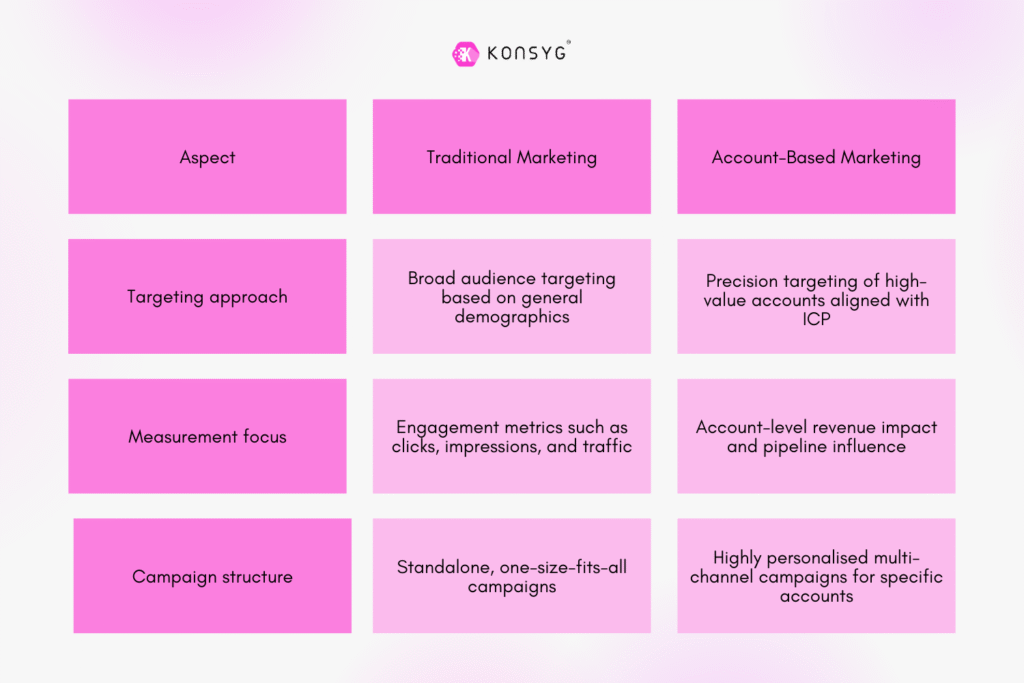
Traditional B2B marketing casts a wide net, generating campaigns to attract large audiences, scoring leads, and passing them to sales. Success is often measured in lead volume and early-stage engagement metrics.
ABM flips this approach. It starts by identifying and prioritising the proper accounts first, then creating bespoke strategies for engaging all relevant decision-makers within those accounts. Marketing and sales operate as one team, aligning messaging, outreach, and timing to guide each account through the buying journey.
This means ABM decisions from account selection to campaign design are made with a singular focus: building stronger relationships with high-value targets and converting them into long-term customers.
Here’s how the two approaches compare across key aspects:
What are the benefits of account-based marketing?
Let’s explore the key benefits that make the ABM model an essential strategy for B2B companies.
Higher quality opportunities and win rates
ABM replaces broad, untargeted campaigns with laser-focused outreach to high-value accounts.
By leveraging intent data, firmographic insights, and personalised messaging, marketing and sales teams can engage the right decision-makers at the right time. This targeted approach consistently produces higher-quality opportunities and increases close rates compared to traditional lead generation.
Shorter, more efficient sales cycles
In ABM, every touchpoint is tailored to the account’s unique needs, which builds trust faster and reduces time spent educating prospects.
Research from Forrester shows that companies using ABM see sales cycles shorten by as much as 20% because the buying committee is engaged early with highly relevant content and solutions.
Improved ROI and resource efficiency
ABM makes ROI tracking straightforward by focusing resources on a clearly defined list of accounts.
With fewer wasted impressions and more precise targeting, marketing budgets stretch further while still delivering measurable revenue impact. Companies practising ABM often report significantly higher marketing ROI compared to non-targeted approaches.
Stronger sales and marketing alignment
The traditional disconnect between sales and marketing disappears when both teams co-own account plans, pipeline goals, and engagement strategies.
ABM thrives on this collaboration, with joint planning sessions, shared metrics, and unified outreach that ensures the entire buying committee receives a consistent and coordinated message.
Data-driven personalisation
Rather than generic campaigns, ABM uses real-time data and buyer insights to create tailored experiences for each account.
By analysing engagement patterns, technology stacks, and trigger events, marketers can deliver the right message at the right stage of the buying journey, improving both engagement and conversion.
Predictable, scalable revenue growth
At its core, ABM is about building a repeatable revenue engine from your highest-value accounts.
By tracking account engagement, deal progression, and expansion opportunities, companies can forecast revenue more accurately and scale their most effective ABM plays across new target accounts.
What are the key account-based marketing strategies?
Successfully implementing ABM requires a systematic approach that aligns people, processes, and technology around a shared focus on target accounts.
Let’s explore the five core strategies that form the foundation of effective account-based marketing.
Setting account-based goals
Gone are the days of setting marketing goals purely around lead volume or MQL counts. ABM requires a shift towards measurable account outcomes.
Start by working backwards from your company’s revenue targets, mapping them to specific account engagement and pipeline objectives.
Your account-based goals should:
- Align with company-wide revenue targets.
- Be divided into quarterly and monthly account objectives.
- Include both new account acquisition and existing account expansion.
- Define key metrics such as account penetration and deal velocity.
Creating aligned sales and marketing processes
The success of ABM relies on deep alignment between sales and marketing. This means creating integrated processes that support account engagement from first touch to closed deal and beyond.
Best practices for alignment include:
- Establishing a joint account selection process.
- Creating shared definitions for engagement stages.
- Developing joint account plans and target lists.
- Implementing clear outreach and follow-up protocols.
- Building collaborative account nurture workflows.
Implementing data-driven campaigns
ABM campaigns must be built on precise, actionable data.
This means moving beyond broad segmentation to leverage firmographic insights, buyer intent signals, and predictive analytics.
Key elements of data-driven ABM campaigns include:
- Using intent data to identify in-market accounts.
- Leveraging predictive scoring to prioritise accounts.
- Creating personalised content paths for different stakeholders.
- Optimising campaigns based on account-level engagement metrics.
- Testing and iterating based on conversion performance.
Building customer-centric approaches
ABM is not just about winning new accounts; it’s about maximising lifetime value across the customer base.
This requires a deep understanding of the whole buying committee and each stage of the account journey.
Essential components include:
- Creating detailed account profiles and maps.
- Mapping multi-stakeholder buyer journeys.
- Developing stage-specific content for each persona.
- Identifying upsell and cross-sell opportunities.
- Building account advocacy and referral programs.
Developing feedback loops
ABM thrives on continual refinement, which means building robust feedback loops between all revenue teams.
These ensure that real-world account insights inform every aspect of the strategy.
Critical feedback loops include:
- Regular joint account reviews.
- Win/loss analysis sessions at the account level.
- Customer feedback integration into account plans.
- Sharing sales intelligence on account priorities.
- Reviewing campaign results by account segment.
How to measure the success of account-based marketing?
Here are the essential metrics for validating your ABM efforts:
Account engagement attribution
Account engagement attribution reveals marketing’s direct impact on target account progression and revenue generation.
Track metrics like marketing-influenced pipeline within target accounts, account-sourced revenue, multi-touch attribution at the account level, return on account-based investment (ROAI), and cost per engaged account.
They will help you understand which activities drive the most value within your high-priority segments.
Pipeline metrics
Your account-based pipeline metrics indicate the health of your ABM engine.
Focus on key indicators like target account coverage ratios, average deal size within ABM accounts, sales cycle length for ABM opportunities, pipeline velocity, and opportunity creation rate from named accounts.
They will help you forecast accurately and identify potential bottlenecks in your ABM funnel.
Conversion rates
Every stage of your ABM funnel has critical conversion points.
Monitor engaged account-to-opportunity rates, opportunity-to-win rates for ABM deals, stakeholder engagement depth, and stage velocity within target accounts.
They will help you optimise your account journeys and ensure resources are focused on the highest-probability opportunities.
Account lifetime value
Look beyond the initial deal to measure long-term account impact.
To do this, track account acquisition costs (AAC), account lifetime value (ALV), ALV: AAC ratio, expansion revenue rates within target accounts, and account retention over time.
By keeping eyes on them, you can optimise for sustainable, long-term account growth.
How do you build an effective ABM measurement system?
Set up your foundation
Start with a solid account data architecture that ensures consistent tracking across all touchpoints and stakeholders.
Implement clear account data governance standards and create unified account profiles that enable both high-level insights and detailed stakeholder analysis.
Choose your tools wisely
Your ABM tech stack should create a single source of truth for account engagement and revenue impact.
Focus on seamless integrations between your CRM, account-based marketing platform, and analytics tools to unify account-level reporting.
Design actionable reporting
Create dashboards that drive decisions, not just display numbers.
Focus on telling a clear story about ABM’s revenue impact through account-level executive summaries, engagement heatmaps, and detailed campaign analytics.
Pro tip: Focus on what moves the needle!
Start by measuring what matters most to your ABM objectives, such as account engagement penetration, pipeline influence, and opportunity conversion rates. As your ABM program matures, you can layer in more sophisticated metrics.
What are the common account-based marketing challenges (and how to overcome them)?
Every transformation comes with its hurdles.
Here are the most common challenges in ABM implementation, along with practical solutions to address them.
Data quality and management
Poor account data quality undermines even the best ABM strategies. Teams often struggle with duplicate account records, incomplete firmographic details, and inconsistent stakeholder data across systems.
The solution starts with establishing clear account data governance policies, implementing regular data cleaning processes, and investing in account data enrichment tools that maintain accurate, up-to-date information for your named accounts.
Cross-team alignment issues
Marketing, sales, and customer success teams often work in silos, pursuing different objectives.
Break down these silos by establishing shared account engagement metrics, implementing regular joint planning sessions, and creating transparent handoff processes between marketing and sales for ABM-qualified accounts.
Success comes from making revenue from target accounts a shared responsibility rather than a departmental KPI.
Technology integration
Many organisations struggle with disconnected tools that prevent a unified view of account engagement.
Address this by auditing your ABM tech stack, identifying critical integration points, and building a roadmap for connecting your CRM, account-based marketing platform, sales engagement tools, and analytics systems.
Focus on core integrations first, particularly those that unify engagement data at the account level.
Attribution complexity
Determining ABM’s actual impact on revenue can be difficult, especially with long, multi-stakeholder buying cycles.
Start with a simple account-level attribution model that tracks the influence of marketing and sales activities on opportunity creation and pipeline progression. As your ABM program matures, you can adopt multi-touch attribution models that capture a more complete view of account journeys.
Cultural resistance
Shifting from volume-based lead generation to a focused account-based approach often faces resistance from teams accustomed to traditional metrics.
Overcome this by celebrating early wins with target accounts, sharing engagement insights with leadership, and providing clear evidence of ABM’s revenue impact. Empower your team through training and collaboration rather than forcing adoption.
What role does account data play in ABM success?
From engagement patterns to firmographic details, intent signals to stakeholder mapping, every account data point helps shape a more precise ABM strategy.
Let’s explore how each type of data drives specific ABM outcomes:
Powers buying committee insights
Enterprise B2B deals typically involve 6–10 decision-makers. Account data helps you map this buying committee, identify influencers, and tailor outreach to each role.
By tracking content engagement and participation across departments, you can connect with stakeholders early, accelerating deal velocity by up to 40%.
Unlocks account-level intent signals
You can spot buying signals before competitors by analysing account activity across multiple channels, from website visits and content downloads to event attendance.
For example, if multiple contacts from a target account engage with pricing or product comparison content within the same week, it signals readiness for direct outreach.
Identifies expansion opportunities
Usage and adoption data reveal patterns that predict upsell or cross-sell opportunities within existing accounts with up to 85% accuracy.
When you see indicators like growing product adoption, increased seat utilisation, or consistent engagement with advanced features, you can proactively initiate expansion conversations.
Drives intelligent account scoring
Move beyond basic firmographics to predictive account scoring models.
By combining firmographic data with engagement trends and intent signals, you can prioritise accounts with the highest likelihood to convert. For example, an account that matches your ICP, shows sustained high-value engagement, and involves multiple stakeholders should be fast-tracked for sales action.
Enables targeted account prioritisation
Not all named accounts offer equal potential. Account data helps you focus on those with the most significant revenue opportunity.
Prioritisation signals might include:
- Multiple departments are engaging with ABM content.
- Rising adoption rates of your solutions.
- Strong engagement with bottom-of-funnel campaigns.
These become your highest-value targets for personalised ABM plays and advocacy programs.
Creating Cross-Team Alignment for ABM Success
When account-based marketing runs in isolation, it becomes just another campaign. The real power comes from deep collaboration between marketing, sales, and customer success teams.
Creating unified account goals
Instead of marketing chasing MQLs while sales focuses on closed deals, start by agreeing on shared account-level targets. These should cover pipeline growth, opportunity creation, and account expansion metrics that matter to all teams. Shared accountability turns ABM into a joint mission rather than separate initiatives.
Establishing shared processes
ABM requires clarity at every stage of the account journey. Create documented workflows for account selection, tiering, and engagement. Define exactly what qualifies a target account, what triggers outreach, and how insights flow between teams. Clear SLAs for follow-up and regular feedback loops keep momentum high.
Implementing communication frameworks
Do not rely on ad-hoc updates. Schedule structured syncs such as weekly account reviews, monthly pipeline check-ins, and quarterly planning sessions. These are the spaces where sales shares frontline insights, marketing previews campaigns, and customer success flags expansion opportunities.
Building collaborative workflows
Go beyond handoffs and create accurate joint execution. Invite sales to content brainstorming to ensure materials address real buying objections. Have marketing join key account calls to hear pain points directly. Share ABM platform data so all teams work from the same insights.
Measuring joint success
Individual metrics still matter, but ABM success depends on shared KPIs. Track measures like:
- Engagement lift in target accounts.
- Pipeline value and velocity from ABM accounts.
- Multi-contact penetration within accounts.
- Expansion revenue from existing ABM targets.
What are the Essential Tools for Account-Based Marketing?
To execute account-based marketing effectively, you need a tech stack that enables precise targeting, personalised engagement, and measurable impact.
Here are the essential tools that power modern ABM teams 👇
- Konsyg
A premium B2B outbound sales and ABM execution partner, Konsyg delivers a complete SDR-as-a-Service model for identifying, engaging, and converting high-value target accounts.
The platform and service team fuel your entire ABM engine by helping marketing and sales teams work from the same account lists, qualify opportunities faster, and execute personalised outreach at scale.
As the foundation for ABM strategies, Konsyg helps teams:
- Build highly targeted account lists based on ICP criteria.
- Engage key stakeholders across multiple channels.
- Execute coordinated outbound campaigns that align with ABM goals.
- Provide real-time feedback loops to refine targeting.
- Track ABM engagement metrics from first touch to closed deal.
Key features include:
- Dedicated SDR teams specialising in account-based outreach.
- Multi-channel sequencing (email, calls, LinkedIn).
- Data-driven account prioritisation.
- Pipeline acceleration strategies for in-market accounts.
- Complete transparency through detailed performance reporting.
- Demandbase
An AI-powered ABM platform that provides account identification, intent signals, and personalised engagement.
It integrates deeply with CRM and marketing automation systems to ensure sales and marketing work from the same account intelligence.
- 6sense
A leading AI-driven intent data platform that uncovers anonymous buying signals and predicts which accounts are ready to engage.
6sense helps ABM teams focus resources on accounts showing the highest likelihood to purchase.
- RollWorks
A comprehensive ABM platform that helps marketing teams identify target accounts, engage them across channels, and measure results.
RollWorks offers advanced account scoring, display advertising, and sales insights to improve ABM performance.
- Terminus
A multi-channel ABM platform enabling engagement through targeted display ads, chat experiences, and email signatures.
Terminus is extreme for scaling personalised outreach to decision-makers across a defined account list.
- LinkedIn Sales Navigator
A powerful prospecting tool for engaging decision-makers directly.
Sales Navigator allows ABM teams to track account changes, connect with multiple stakeholders, and tailor messaging based on real-time updates.
Start winning high-value accounts today with Konsyg
What makes the difference between good and great account-based marketing?
Often, it comes down to the precision and consistency of your execution.
With targeted, data-driven outreach from Konsyg’s dedicated SDR teams, every interaction is personalised, every decision-maker is engaged at the right time, and every campaign is designed to move key accounts closer to a closed deal.
Want to see the impact expert ABM execution can have on your pipeline?
Book a strategy call with Konsyg today and join leading B2B companies turning their account lists into predictable revenue engines.
Share This Post
Recent Posts
What We Offer
Get Your Quote