
Primary challenge
High competition for buyer attention
Earning relevance and credibility
Market fragmentation

Outbound sales is not slowing down.
It is getting harder to do well.
Across the US, UK and Europe, sales teams have access to more data, AI, automation and prospecting tools than ever before. Reaching thousands of potential buyers is easier. Turning that activity into qualified conversations is not.
This is changing how B2B lead generation works in 2026.
The advantage is shifting away from teams that simply generate the most activity. Stronger outbound programmes are becoming more precise about the accounts they target, the channels they use, the timing of outreach and what happens once a prospect responds.
The market also matters.
The US remains a large and highly competitive outbound environment. The UK requires a more deliberate approach to relevance and buyer engagement. Europe adds another layer of complexity, with different languages, business cultures, regulations and prospecting behaviours across individual markets.
The result is clear: no single outbound playbook works equally well across all three regions.
This report examines the state of B2B outbound sales across the US, UK and Europe in 2026, including how calling, email, LinkedIn, targeting, AI and conversation quality are influencing pipeline performance.
Outbound is moving from activity to precision: More tools have made prospecting easier to scale, but scale alone does not guarantee qualified pipeline. The focus is increasingly on better ICP selection, accurate data, relevant messaging and stronger conversion after the first interaction.
Cold calling remains a core outbound channel: Industry research for 2026 places the average cold-call success rate at 2.7%, while individual high-performing sales organisations report considerably stronger results when they apply better data, targeting, and execution.
AI is changing prospecting faster than it is replacing conversations: AI is increasingly being used for research, account prioritisation and preparation. The human conversation remains critical once a prospect engages.
Multi-channel execution is becoming standard: Cold calling, cold email outreach and LinkedIn lead generation increasingly work as parts of the same outbound motion rather than separate strategies.
Regional differences are becoming impossible to ignore: The US, UK and Europe show different prospecting environments. Buyer behaviour, competition, regulation and local expectations influence how outreach performs and how sales teams should execute.
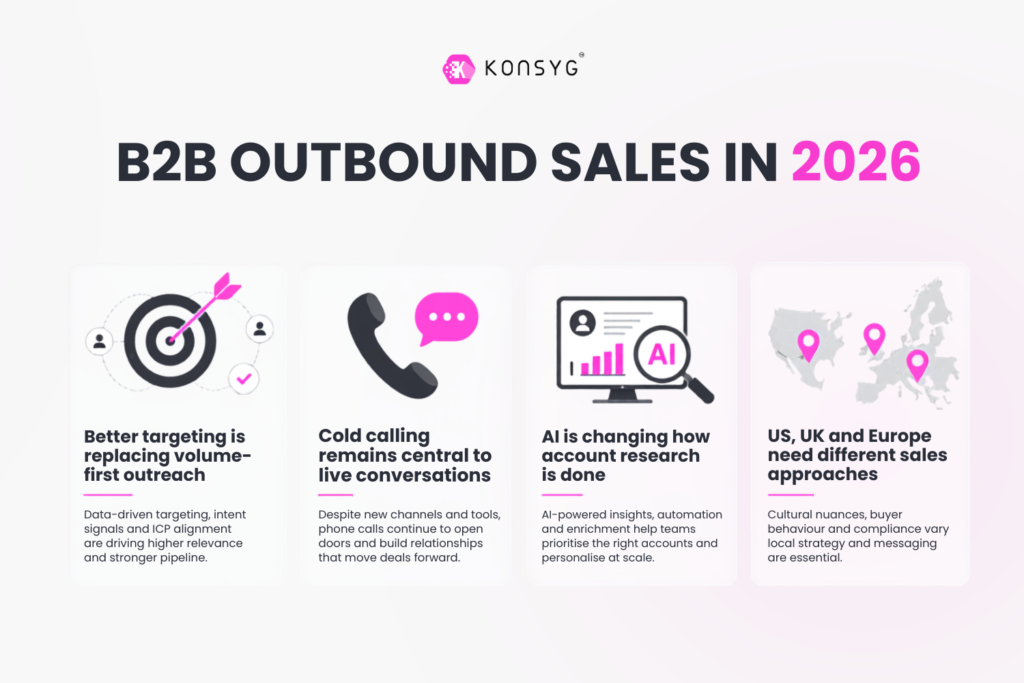
For years, outbound sales followed a relatively simple equation.
More prospects → more touches → more conversations → more opportunities.
Technology made the first two parts of that equation much easier.
AI can accelerate research. Prospecting platforms can identify thousands of contacts. Sequencing tools can automate follow-ups. Sales teams can execute significantly more outreach without increasing headcount at the same rate.
But buyer attention has not scaled with sales technology.
That creates the central challenge facing outbound teams in 2026.
The ability to send more messages is no longer a meaningful competitive advantage when every competitor can do the same.
What matters is whether the right buyer receives a relevant message at the right moment and whether the sales team can turn that interaction into a genuine business conversation.
Konsyg’s existing research into outbound performance points to the same distinction: generating more leads does not automatically create more pipeline. Conversion depends on targeting, qualification, and what happens after engagement.
This means modern B2B outbound sales is moving away from: Volume → automation → activity and towards: Targeting → relevance → conversation → qualification → pipeline
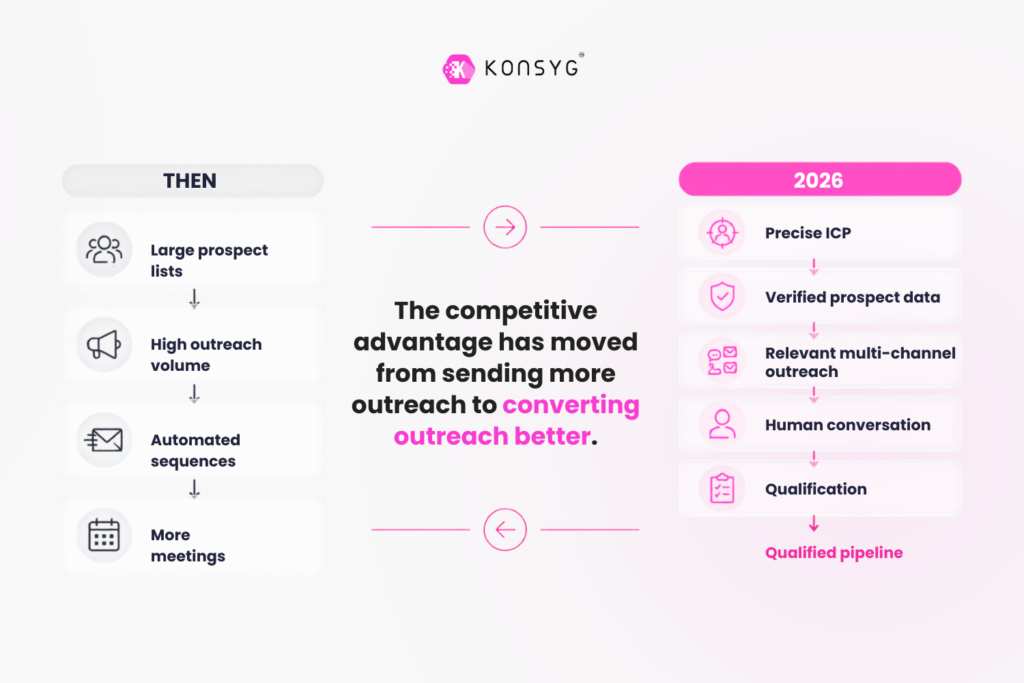
Global outbound strategies often begin with one playbook and expand it across markets.
That approach is becoming less effective.
A campaign targeting a CTO in New York operates in a different environment from one targeting a technology leader in London, Berlin or Stockholm.
The buyer may have the same job title.
The way that buyer evaluates outreach may not be the same.
The US combines a huge addressable B2B market with intense competition for buyer attention.
The UK is a mature sales market where generic prospecting increasingly struggles to earn engagement.
Europe cannot realistically be treated as one homogeneous outbound market. Language, culture, regulation and buying behaviour can change considerably between countries.
For teams building global outbound sales programmes, localisation therefore extends beyond translating an email.
It affects account selection, messaging, channel mix, calling approach, cadence, and how value is communicated.
This report examines the state of B2B outbound sales across the US, UK and Europe, combining Konsyg’s experience running outbound programmes with external sales research and benchmark data published during 2025 and 2026.
The analysis focuses on how modern outbound activity translates into conversations, meetings and qualified pipeline across different markets.
Rather than relying on a single global benchmark, the report compares regional patterns across calling, email, multi-channel outreach and sales execution to understand where performance differs and why.
This analysis aims to identify the factors shaping repeatable outbound pipeline creation in 2026.
Insights in this report are based on a combination of Konsyg outbound experience and independently published industry research.
Call data: Connection rates, call success rates, attempts required to reach prospects and regional calling performance.
Email performance: Deliverability, reply behaviour, engagement and regional differences in cold email performance.
Multi-channel performance: How calls, email and LinkedIn contribute to prospect engagement across modern outbound cadences.
Meeting and pipeline outcomes: How initial engagement progresses into meetings, qualification and pipeline.
Buyer and sales-leader research: Survey findings on channel preferences, AI adoption, prospecting behaviour and changes in outbound execution.
Regional data: Research comparing outbound performance and buyer behaviour across the US, UK and European markets.
External sources used throughout the report are identified alongside the relevant statistics and graphics rather than being presented as Konsyg campaign data.
The report draws on three categories of evidence:
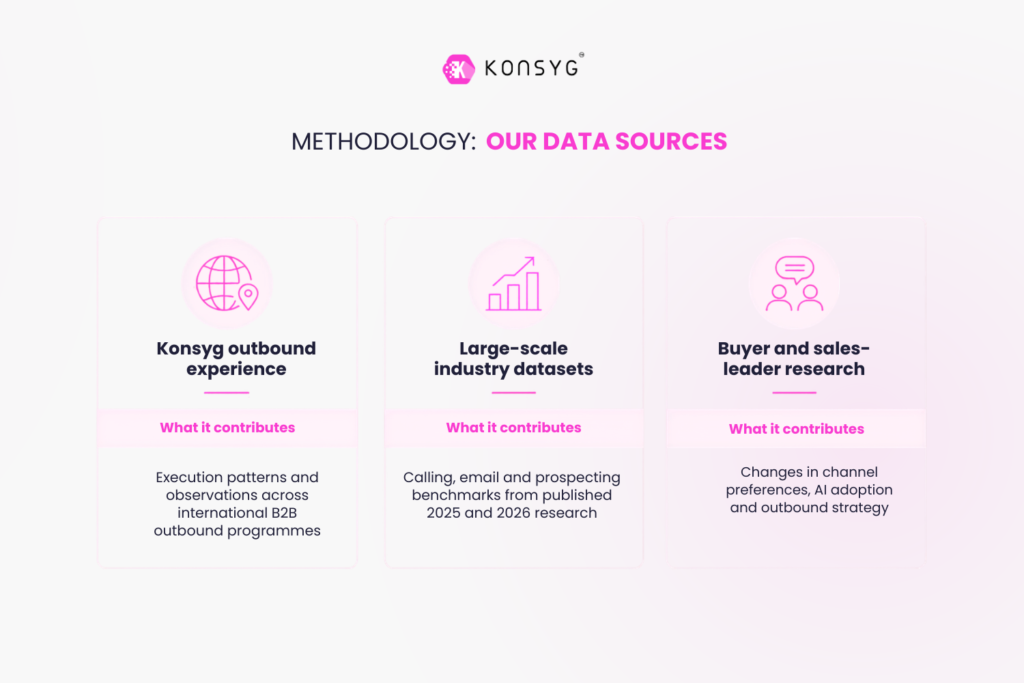
The report uses a consistent set of outbound performance indicators throughout to make regional comparisons clearer.
Call data
Call performance is assessed using call volume, connection rates, success rates, attempts required to reach prospects and meeting conversion, where the source data makes these metrics available.
Email data
Email analysis focuses primarily on deliverability, reply rates and engagement. Open rates are treated cautiously because privacy protections and automated email activity can make them less reliable as indicators of buyer intent.
Multi-channel execution
The report examines the role of phone, email and LinkedIn within the wider outbound motion, including how channels support one another rather than evaluating each solely in isolation.
Meeting and pipeline data
Where available, meeting generation, qualification and progression into pipeline are used to distinguish engagement from meaningful sales outcomes.
Regional performance
Benchmarks are compared across the US, UK and Europe to identify differences in prospect accessibility, buyer behaviour, market saturation and outbound execution.
We reviewed external datasets according to the methodology published by each source.
Where sources use different definitions of metrics such as connection rate, answer rate, reply rate or success rate, those terms are retained rather than treated as interchangeable.
Regional statistics are also interpreted within the context of their individual datasets.
A performance figure reported by one sales organisation, for example, is identified as that organisation’s result rather than presented as a universal benchmark for the entire market.
This distinction matters when comparing outbound performance across the US, UK, and Europe.
This report identifies directional patterns rather than establishing a universal outbound benchmark.
Results can vary significantly by industry, ICP, company size, prospect seniority, deal value, sales cycle, data quality, and sales team maturity.
Europe also contains multiple distinct markets. A single European benchmark cannot fully represent differences between markets such as Germany, France, the Netherlands or the Nordics.
External studies use different datasets and methodologies, so figures from separate sources should not automatically be compared as if they came from the same experiment.
Where relevant, these limitations are identified alongside individual findings.
This report should be used as a benchmark for understanding how outbound sales is changing, rather than as a fixed formula for campaign performance.
Each section examines a different part of the outbound environment across the US, UK and Europe, from prospecting and channel performance to regional execution and pipeline conversion.
The objective is to help sales teams understand what is changing, where regional differences matter and which outbound practices are producing stronger results in 2026.
In 2026, the biggest outbound challenge is not access to prospects.
It is earning their attention.
Sales teams have more tools to identify accounts, find decision-makers and automate outreach. But the same technology is available to almost every competitor targeting those buyers.
This has changed outbound economics.
More activity can still create more opportunities, but only when the underlying targeting is strong. When account selection, contact data or messaging is weak, scaling outreach simply scales the inefficiency.
The strongest B2B lead generation programmes are therefore becoming more selective about who enters the outbound process in the first place.
The shift is from reaching more prospects to reaching more of the right prospects.
Cold calling provides one of the clearest examples.
Cognism’s State of Cold Calling 2026 reports an industry cold-call success rate of 2.7%, up from 2.3% previously.
But its own sales organisation reported a considerably higher 11.3% success rate.
The difference should not be interpreted as a universal benchmark. It does, however, demonstrate how far performance can move beyond industry averages when targeting, data quality, timing and execution improve.
For sales teams, this changes the role of cold calling.
The objective is not simply to maximise dials.
It is to increase the probability that each dial reaches someone who fits the ICP and has a credible reason to engage.
The move toward more precise outbound is visible across all three regions, but the reason changes by market.
In the US, the challenge is competition.
North America is one of the most heavily prospected B2B markets. Buyers have extensive exposure to sales outreach, making generic messaging easier to ignore. Konsyg’s US outbound model therefore emphasises specific buyer personas, direct value propositions, and coordinated email, LinkedIn, and phone activity.
In the UK, relevance and credibility matter most. UK outbound needs to give buyers a clear reason to talk, rather than relying on activity alone.
Across Europe, precision becomes even more complicated. Europe is not one outbound market. Country, language, buyer expectations, regulatory requirements and decision culture all influence execution.
The principle is the same across all three:
More outreach cannot compensate indefinitely for weak targeting.
How you achieve precision, however, needs to reflect the market.
The same principle applies to channel selection.
Modern outbound increasingly combines cold email outreach, phone and LinkedIn rather than relying on one channel.
But adding channels does not automatically improve performance.
The purpose of multi-channel execution is to create multiple relevant opportunities for a buyer to engage.
Email can introduce context.
LinkedIn can reinforce familiarity.
Phone creates the opportunity for a direct conversation.
Follow-up maintains momentum.
When you coordinate those activities, each channel supports the others.
When they are not, multi-channel outbound simply becomes more noise.
Volume is becoming easier to create
AI, prospecting platforms, and sequencing tools let sales teams execute more outbound activity with fewer manual steps.
That makes volume less of a competitive advantage.
Targeting determines the value of that activity
Accurate account selection and verified prospect data increase the probability that calls, emails and LinkedIn outreach reach buyers who can realistically become opportunities.
Cold calling still creates direct access to buyers
The phone remains important because it creates something automated outreach cannot guarantee: a live conversation.
The performance gap between average and stronger calling programmes also shows why execution quality matters more than dial volume alone.
Regional differences influence how precision works
US outbound requires differentiation in a highly competitive environment.
UK outbound increasingly rewards relevance and credibility.
European outbound requires greater localisation across individual markets.
Multi-channel execution works when the channels have different jobs
The objective is not to contact the buyer everywhere.
It is to create a coordinated sequence in which each interaction adds context and moves the prospect closer to a meaningful conversation.
Outbound performance starts before you send the first call or email.
Large prospect lists can create activity quickly, but they also increase the risk of contacting accounts with limited fit, weak buying signals or no clear reason to engage.
In 2026, stronger B2B lead generation starts with a more defined ICP and tighter account selection.
Sales teams should prioritise:
The objective is not to create the largest possible database.
It is to increase the proportion of prospects that can realistically become pipeline.
Knowing who fits the ICP is only the first step.
Timing determines whether the conversation is relevant now.
Changes in leadership, hiring, funding, expansion, technology adoption and other company-level signals can provide stronger reasons for outreach than static prospect lists alone.
This is particularly important in competitive markets such as the US, where buyers may already receive significant volumes of sales outreach.
Instead of immediately increasing call or email volume when performance slows, teams should first examine who they are targeting and why those accounts should engage now.
Multi-channel outbound should not mean repeating the same pitch across email, LinkedIn and phone.
Each channel should move the prospect forward in a different way.
Cold email outreach can establish context and communicate relevance.
LinkedIn can create familiarity and provide another point of engagement.
Cold calling creates the opportunity for direct conversation and immediate qualification.
Follow-up connects those interactions and maintains momentum.
Konsyg’s own SDR pipeline model similarly combines account research, targeted email, social outreach and direct prospect engagement rather than treating channels as isolated activities.
Calls made, emails sent, and LinkedIn touches show how much work is happening.
They do not show whether that work is creating revenue opportunities.
Teams should increasingly connect outbound activity to metrics such as:
Prospect → Conversation → Meeting → Qualified Opportunity → Pipeline
This makes it easier to identify where performance is actually breaking down.
A campaign with high activity and low conversation rates may have a targeting or data problem.
A campaign generating conversations but few meetings may have a messaging or qualification problem.
A campaign generating meetings but limited pipeline may have a discovery or handover problem.
The objective of SDR pipeline development is therefore not simply to increase the top of the funnel. It is to create a repeatable path from prospecting to qualified opportunities. Konsyg’s current SDR model similarly places ICP definition, stakeholder mapping, outreach, qualification and measurement within the same pipeline process.
International expansion should not begin by copying the existing campaign into a new geography.
Before entering the US, UK or another European market, teams should review:
The underlying product may remain the same.
The reason a prospect engages with it can change considerably.
Konsyg’s global outbound approach similarly combines centralised sales execution with regional market knowledge and localised strategies rather than treating every geography identically.
The teams that adapt early can learn what works before committing significant resources to scale.
The teams that scale first and localise later risk amplifying the wrong approach.
Getting a prospect to respond is only the first conversion.
The next challenge is turning that engagement into a qualified opportunity.
Across outbound programmes, activity metrics become less useful. A campaign can generate calls, replies and meetings without creating enough pipeline to justify the activity behind them.
The difference increasingly comes down to conversation quality.
Strong B2B lead generation gets the right buyer into the conversation. Strong discovery determines whether that conversation progresses.
This makes the first live interaction particularly important.
Sales teams need to understand the prospect’s current situation, identify whether there is a genuine business problem and establish whether solving that problem has enough value to justify a next step.
The objective is not to deliver the perfect pitch.
It is to establish whether there is a reason for the sales process to continue.
Konsyg’s analysis of outbound programmes found that meetings with a balanced talk share of approximately 45–55% consistently produced stronger engagement and progression.
This matters because qualification depends on information.
When the seller dominates the conversation, there is less opportunity to understand the buyer’s current situation, priorities, constraints and decision process.
A more balanced conversation gives the prospect enough space to explain the problem in their own terms.
It also gives the salesperson better information to determine whether the opportunity should progress.
The same pattern appears in questioning.
Konsyg campaign analysis found stronger engagement in conversations where AEs asked approximately 35–45 relevant questions per hour.
The objective is not to hit a question quota.
It is to create enough dialogue to understand:
This turns discovery from a presentation into an exchange.
It also improves the quality of information SDRs pass into the wider sales pipeline.
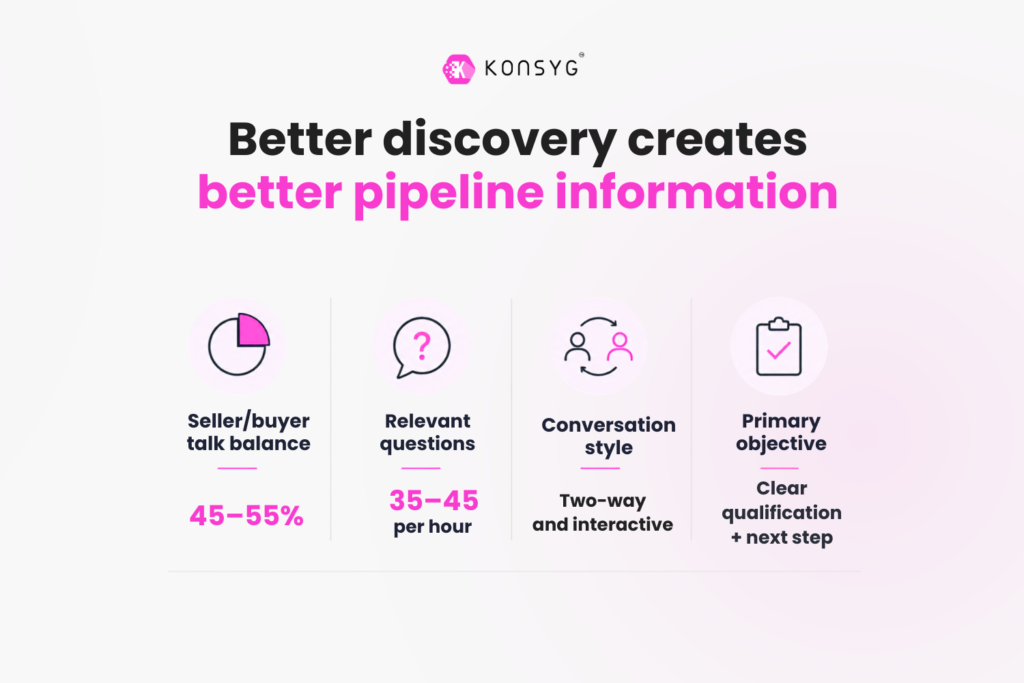
Structure helps sales teams maintain consistency.
Scripts can have the opposite effect when followed too rigidly.
Strong discovery gives the salesperson a framework for understanding the opportunity while leaving enough flexibility to respond to what the buyer actually says.
High-performing conversations generally establish five things:
Business context: What is happening inside the company?
Problem: What is preventing the buyer from reaching the desired outcome?
Impact: What does that problem cost in revenue, time, resources or missed opportunity?
Decision: Who is involved and what needs to happen before the organisation can move forward?
Next step: Is there enough alignment to continue the conversation?
This is particularly important in SDR pipeline development because the quality of early discovery influences everything that follows.
A weak first conversation creates a weak handover.
A strong one gives the next salesperson context.
Meetings are not the final outbound metric
Booking a meeting proves that outreach generated interest.
It does not prove that the prospect represents qualified pipeline.
Balanced conversations create more information
When buyers have enough space to participate, sales teams gain a clearer understanding of problems, priorities and buying intent.
Questions improve qualification when they have a purpose
Effective discovery is not about asking as many questions as possible. It is about uncovering enough commercial context to decide whether the opportunity should progress.
Structure improves consistency
A repeatable discovery framework helps sales teams qualify opportunities consistently without forcing every buyer through the same conversation.
The handover matters
Information discovered during early outbound conversations should carry into the next stage. Losing that context forces buyers to repeat themselves and makes progression harder.
The principles behind strong outbound remain consistent across markets.
The execution does not.
This is one of the most important distinctions for B2B sales teams in 2026.
Companies frequently expand outbound by taking a campaign that works in one geography and applying the same ICP, messaging, cadence and channel strategy elsewhere.
That approach ignores how much the selling environment changes between the US, UK and Europe.
Market size changes.
Buyer expectations change.
Competition changes.
Regulation changes.
Even the effectiveness of individual channels can change.
As a result, global outbound sales increasingly requires a common strategy with market-specific execution.
The US remains an attractive market for outbound because of its size and concentration of B2B buyers.
Scale is also what makes it difficult.
American buyers operate in an environment with significant prospecting activity across email, phone and LinkedIn. This makes it relatively easy for generic outreach to disappear among competing messages.
The US opportunity is large enough to support significant B2B outbound sales activity.
But scale needs precision.
The strongest approach is to narrow the ICP, identify specific buying contexts and give prospects a clear reason to engage rather than assuming market size will compensate for broad targeting.
The UK presents a different outbound environment.
It is a mature B2B market with significant exposure to sales outreach, but simply increasing activity does not necessarily increase engagement.
Relevance becomes particularly important.
Prospects need to quickly understand why the conversation relates to their business, rather than receiving a broad pitch built around the seller’s product.
For teams running UK outbound sales, this places greater emphasis on company research, clear positioning and credibility early in the conversation.
Regulation also influences execution.
B2B teams operating in the UK need to consider both UK GDPR and the Privacy and Electronic Communications Regulations (PECR) when designing direct marketing activity.
The rules vary by communication method and the type of organisation being contacted. This makes compliance part of campaign design, not something to consider only after outreach has started.
Europe creates the most obvious problem with a single-playbook approach.
It is not one homogeneous outbound market.
A campaign targeting prospects in Germany may need to operate differently from one targeting France, the Netherlands or the Nordics.
Language is only one part of the difference.
Buyer expectations, communication styles, procurement processes, regulations and attitudes towards unsolicited outreach can also vary between markets.
This makes European outbound sales particularly dependent on localisation.
The question is not simply whether an email should be translated.
Sales teams need to determine whether the value proposition, proof points, buyer personas, channel mix and cadence make sense for the specific market.
GDPR provides a common regulatory framework across the European Economic Area, but national laws and interpretations can add further requirements around electronic direct marketing.
Market research therefore needs to happen before scaling campaigns.
Cognism’s own 2026 sales data shows how widely calling performance can differ by geography.
Its sales organisation reported cold-call success rates of approximately:
Europe: 16%
US: 11%
UK: 7%
These numbers should not be treated as universal cold-calling benchmarks for each region.
They reflect Cognism’s own sales activity.
But they demonstrate why regional performance should be measured separately rather than hidden inside one global average.
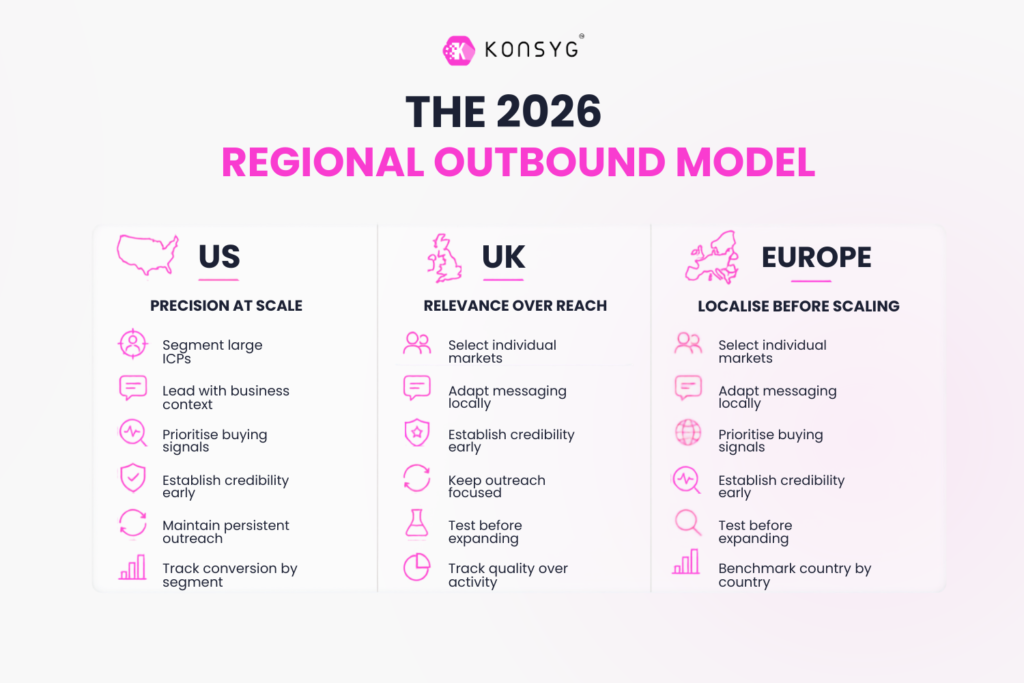
The US rewards precision at scale
The market provides enormous opportunity, but competition for buyer attention means broad prospecting can generate significant activity without proportional pipeline.
The UK rewards relevance
Clear business context, credibility, and well-researched outreach matter more than simply increasing the number of touches.
Europe rewards localisation
A single European campaign can overlook substantial differences between individual countries. Strong execution starts by defining which European market the team is actually targeting.
Regional benchmarks need context
A 7% result in one market and a 16% result in another cannot automatically be attributed to geography alone.
ICP, industry mix, contact data, team execution and methodology also influence performance.
Regional benchmarks should guide investigation, not replace it.
The global playbook needs local execution
Core principles such as accurate targeting, strong discovery and clear qualification remain consistent.
How those principles are applied should change by market.
Regional benchmarks are useful only when they change how teams execute.
Differences between the US, UK, and Europe do not mean sales organisations need three completely separate outbound systems.
They mean the same system needs enough flexibility to respond to different markets.
ICP definition, verified data, structured outreach and qualification remain important everywhere.
What changes is how those principles are applied.
The size of the US market makes volume tempting.
A broad ICP can still produce thousands of potential accounts, which makes it easy to interpret a large prospect database as a large sales opportunity.
They are not the same thing.
In a competitive outbound environment, every additional account added to a campaign must remain relevant enough to justify the effort required to reach it.
This makes segmentation increasingly important for US outbound sales.
Rather than treating one large ICP as a single audience, teams can segment accounts by characteristics such as industry, company size, business problem, buying trigger, and buyer role.
Messaging can then become more specific without forcing sales teams to manually personalise every interaction.
The objective is precision at scale.
Not precision instead of scale.
In the UK, increasing activity without improving relevance creates diminishing returns.
Prospects need to understand quickly:
Why this company?
Why this problem?
Why now?
This changes the role of research.
Account research should not simply provide a personalised opening sentence. It should give the salesperson a commercially relevant reason for contacting the prospect.
For UK outbound sales, credibility also becomes important early in the interaction.
Relevant customer examples, industry knowledge, measurable outcomes and a clear understanding of the buyer’s environment can strengthen the reason to continue the conversation.
The objective is not longer messaging.
It is stronger context.
The biggest mistake teams can make with European outbound is treating Europe as the ICP.
It is a region, not a buyer segment.
Sales teams need to decide which European markets have the strongest commercial fit before building outreach.
That means evaluating factors such as:
Only then should you scale European outbound sales.
This is particularly important for companies entering Europe for the first time.
Launching simultaneously across several countries can create more data, but it can also make it difficult to understand why a campaign is succeeding or failing.
A more focused market test creates clearer information.
Outbound teams often report global averages.
That can hide the information sales leaders actually need.
Imagine that one global campaign produces a 10% connection rate.
That number appears straightforward.
But the underlying performance could look like this:
US: 7%
UK: 8%
European Market A: 15%
A global average would conceal the fact that one market is significantly outperforming another.
The numbers above are illustrative, but the principle is important.
Regional reporting should separate performance by geography before teams decide where to increase investment.
The same should apply to:
The most useful regional comparison is not simply whether one market generates more replies than another.
Teams should benchmark the entire progression from first touch to pipeline.
This prevents teams from declaring one geography successful simply because it generates more activity.
The market producing fewer meetings may still create stronger pipeline if those meetings convert at a higher rate.
That is the benchmark that matters.
No single channel wins B2B outbound.
The strongest programmes increasingly use channels together.
Phone, email and LinkedIn each solve a different problem in the outbound process.
The mistake is expecting one of them to do everything.
A prospect who ignores an email may answer a call.
Someone who does not answer the phone may recognise the salesperson after seeing them on LinkedIn.
A prospect who has already spoken with an SDR may use email to share information or coordinate the next step.
This is why modern B2B lead generation increasingly depends on coordinated channel execution rather than isolated campaigns.
Phone remains distinctive because it creates immediate interaction.
There is no open-rate proxy.
No click to interpret.
No automated engagement to separate from genuine buyer behaviour.
The prospect answers, or they do not.
When they do, cold calling lets the salesperson understand objections, ask questions, test relevance, and qualify interest in real time.
That makes phone calls particularly valuable when the objective is learning.
A short conversation can reveal more about an account than several automated touches.
Calling also becomes more valuable as digital prospecting becomes easier to automate.
The more crowded automated channels become, the more commercially useful a genuine conversation can be.
Email plays a different role.
It gives the prospect time to understand the proposition without engaging immediately.
Strong cold email outreach can establish why the salesperson is reaching out, connect the proposition to a relevant business problem and create context for another interaction.
Email is also important after the initial conversation.
Follow-up can:
This makes email useful across multiple stages of the outbound process.
The problem begins when sales teams treat email automation as a reason to maximise volume.
More sends do not automatically produce more meaningful replies.
LinkedIn sits between direct outreach and professional visibility.
A prospect may see the salesperson’s profile before replying to an email.
They may recognise the company name after receiving a connection request.
They may engage with content without being ready to enter a sales conversation.
That makes LinkedIn a valuable supporting channel.
The objective is not necessarily to convert every interaction directly into a meeting.
It is to reduce the distance between an unknown salesperson and a recognisable professional contact.
When LinkedIn is combined with phone and email, that familiarity can strengthen subsequent outreach.
Adding another channel does not automatically make an outbound programme multi-channel.
Coordination does.
A strong cadence should create a logical progression rather than repeat the same sales message in three places.
Phone remains critical for live engagement
Calls provide immediate feedback and allow sales teams to qualify interest directly.
Email works best when it creates context
Email remains valuable before and after conversations, but automation should support relevance rather than replace it.
LinkedIn strengthens familiarity
Social engagement can make follow-up outreach feel less unfamiliar and give prospects another way to evaluate the salesperson and company.
More channels do not automatically create better outbound
A three-channel campaign with disconnected messaging can still perform worse than a focused two-channel campaign.
The sequence should reflect the market
US teams may need greater persistence across channels.
UK campaigns may benefit from stronger contextual preparation.
European campaigns may require different channel mixes between individual countries.
The best channel strategy is therefore not the one with the most touches.
It is the one that creates the clearest path from first contact to qualified conversation.
The strongest outbound teams are not necessarily doing more.
They are getting better at deciding where to focus activity and how it should convert into pipeline.
High-performing teams define the ICP, verify contact data and identify relevant business signals before increasing activity.
This keeps B2B lead generation focused from the start.
US, UK and European buyers should not automatically receive identical campaigns.
Strong teams maintain a consistent sales strategy while adjusting messaging, cadence and channel execution according to the market.
AI is increasingly useful for account research, prioritisation and sales preparation.
But automation does not remove the need for human judgement once the conversation begins.
Meetings are an important outbound milestone.
Qualified opportunities are more important.
High-performing teams examine how effectively conversations progress into pipeline rather than judging success only by activity or meetings booked.
Better data can identify the prospect.
Automation can create the touchpoint.
But discovery, questioning, listening, and qualification still determine whether that prospect becomes an opportunity.
Prioritise precision over raw volume.
Build tighter target lists and use stronger buying signals before scaling activity.
Treat phone, email and LinkedIn as one system.
Use cold calling for conversation, cold email outreach for context and LinkedIn for familiarity and reinforcement.
Localise international campaigns.
Adapt execution across the US, UK and Europe instead of applying one global cadence everywhere.
Improve discovery.
Coach sales teams to understand the problem, commercial impact, stakeholders and next steps rather than rushing into the pitch.
Measure the full conversion path.
Prospect → Conversation → Meeting → Qualified Opportunity → Pipeline
This is where outbound performance becomes visible.
B2B outbound sales in 2026 is not defined by who can generate the most activity.
Technology has made activity easier to create.
The advantage now comes from targeting the right accounts, reaching them through the right channels and converting engagement into qualified pipeline.
Across the US, UK and Europe, the fundamentals remain consistent. Accurate data, relevant messaging, direct conversations and strong qualification drive performance.
But execution needs to reflect the market.
The US requires precision at scale.
The UK rewards relevance and credibility.
Europe requires localisation and market-by-market execution.
Outbound still works.
The standard for doing it well is simply higher.
Precision beats volume:
More prospects do not automatically create more pipeline. Better targeting improves the value of every outbound touch.
Keep conversations central:
Technology can support prospecting, but human interaction remains critical for discovery and qualification.
Build a coordinated channel mix:
Phone, email and LinkedIn should support one another rather than operate as separate campaigns.
Measure conversion:
Track how outreach progresses from first contact into qualified opportunities and pipeline.
Think regionally:
US, UK and European outbound programmes should share a strategy without assuming identical execution.
Use AI where it improves the salesperson:
Research, prioritisation and preparation can become faster without removing human judgement from the sales conversation.
Konsyg helps B2B companies build and execute outbound sales programmes across global markets, from demand and lead generation and prospecting to SDR execution and pipeline development.
Whether you’re entering the US, expanding across the UK, targeting specific European markets or improving an existing outbound programme, the objective remains the same:
Turn outbound activity into qualified pipeline.
Share This Post
Recent Reports
Learn More