

According to a Gartner report, average marketing budgets have fallen to 7.7% of overall company revenue, down from 9.1% in 2023. Sales teams are being asked to deliver more pipeline and closed deals with fewer resources, smaller budgets, and shorter timelines.
In this environment of doing more with less, one thing becomes crystal clear: every sales investment must deliver measurable, predictable results. Vanity metrics and unqualified leads will not cut it anymore; sales leaders need a reliable, scalable pipeline.
This is where outsourced SDR teams come in. Far from being just another cost-cutting tactic, outsourcing your SDR function is a strategic move that helps companies accelerate lead generation, improve conversion rates, and drive consistent revenue without the overhead of in-house hiring.
In this comprehensive guide, we will explore:
- How outsourced SDR teams differ from traditional in-house sales development.
- Practical strategies for integrating SDR outsourcing into your go-to-market plan.
- Key tools, metrics, and processes that make outsourced SDR programs successful.
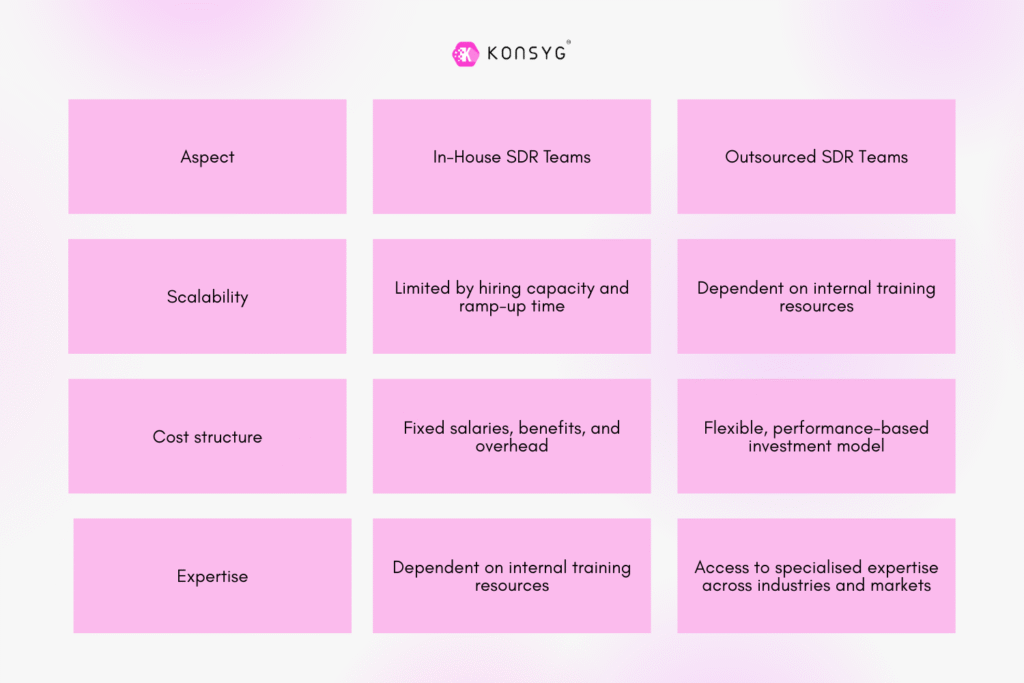
What are the benefits of outsourced SDR teams?
Let’s explore the key benefits that make outsourced SDR models an essential strategy for companies focused on B2B sales and B2B lead generation.
Higher quality leads and conversion rates
Outsourced SDR teams replace the traditional “spray and pray” approach with precision targeting, proven outreach frameworks, and advanced qualification methods.
By leveraging intent data, market research, and industry-specific messaging, they identify and prioritise prospects most likely to convert. This focus on quality over quantity ensures your B2B appointment setting efforts connect your sales team with decision-makers who are already in-market, reducing wasted effort on unqualified leads.
Accelerated sales cycles
With outsourced SDRs, prospects receive the right outreach at the right time, making buying decisions faster and smoother.
Experienced SDR teams know how to engage decision-makers early, address objections upfront, and deliver tailored value propositions. This shortens time-to-meeting and accelerates the path from B2B cold calling to qualified opportunities in your pipeline.
Enhanced ROI tracking and optimisation
Outsourced SDR providers deliver clear visibility into the pipeline they generate, often with performance metrics tied directly to booked meetings, qualified opportunities, and revenue influence.
This level of accountability enables you to double down on what works, adapt campaigns in real time, and scale without the overhead of building and managing a team internally.
More substantial sales alignment and focus
With outsourced SDR teams handling top-of-funnel prospecting, your in-house sales team can focus on closing deals instead of chasing leads.
This division of labour increases productivity and ensures that your sales reps are working only on qualified, sales-ready opportunities, improving both win rates and morale.
Access to specialised expertise
Instead of relying solely on in-house experience, outsourced SDR teams bring cross-industry knowledge, tested B2B lead generation playbooks, and access to the latest sales engagement tools.
They know how to adjust messaging for different markets, navigate complex buying committees, and adapt strategies to suit your specific sales goals.
Predictable and scalable pipeline growth
Perhaps most importantly, outsourced SDR teams create a consistent, scalable flow of qualified opportunities through repeatable outreach processes.
By tracking activity metrics, conversion rates, and opportunity velocity, they make pipeline growth more predictable, giving your sales team a steady stream of well-qualified prospects to close.
Core strategies for building success with outsourced SDR teams
Successfully implementing an outsourced SDR model requires a systematic approach that aligns people, processes, and technology around B2B lead generation and predictable pipeline growth.
Setting revenue-based SDR goals
Gone are the days of measuring SDR success by dials made or emails sent alone. With outsourced teams, success metrics must tie directly to revenue outcomes.
Work backwards from your company’s sales targets and break them down into SDR objectives, such as:
- Qualified opportunities created per month.
- Meeting-to-opportunity conversion rates.
- Contribution to B2B appointment setting targets.
- Pipeline value influenced.
Align these goals with your overall sales strategy to ensure every SDR activity moves the revenue needle.
Creating aligned workflows between SDRs and sales
The handoff from SDR to sales should be frictionless. This involves establishing shared definitions for what constitutes an opportunity, implementing consistent follow-up processes, and ensuring feedback loops are in place.
Best practices for alignment include:
- Joint SDR-sales pipeline reviews.
- Agreed definitions for lead stages (MQL, SQL, opportunity).
- SLAs for follow-up on booked meetings.
- Structured feedback on lead quality from account executives.
Implementing data-driven prospecting campaigns
The best outsourced SDR teams run outreach campaigns grounded in data, not guesswork.
This involves:
- Leveraging intent signals and firmographic targeting.
- Using B2B cold calling alongside multichannel sequences.
- Prioritising accounts with higher engagement potential.
- Tracking campaign performance and refining outreach based on results.
When SDRs focus on the accounts most likely to convert, you get faster results and higher ROI.
Building customer-centric outreach
Outreach must speak directly to a prospect’s needs, pain points, and goals. Outsourced SDR teams should map detailed ideal customer profiles (ICPs) and tailor messaging accordingly.
This means:
- Personalising every touchpoint based on industry, role, and trigger events.
- Creating messaging that reflects where the buyer is in their journey.
- Aligning SDR conversations with your company’s broader B2B sales narrative.
Developing feedback loops for continuous improvement
Outsourced SDR programs are most effective when there’s constant refinement based on data and frontline insights.
This requires:
- Weekly performance reviews with your provider.
- Analysis of conversion data from booked meetings to closed deals.
- Sharing market and prospect feedback with marketing and product teams.
- Updating messaging, targeting, and workflows based on results.
How to measure the success of outsourced SDR teams
Tracking the proper performance metrics is critical to maximising the ROI of your outsourced SDR program. The goal is not just activity volume but measurable pipeline contribution and revenue impact.
Opportunity creation metrics
Your outsourced SDR team’s primary purpose is to generate qualified opportunities.
Key metrics to track include:
- Number of sales-qualified opportunities created.
- B2B appointment setting conversion rates from meetings booked.
- Average opportunity value.
- Opportunity-to-close win rates.
These indicators reveal the direct contribution SDRs are making to your B2B sales pipeline.
Pipeline velocity
The health of your sales funnel depends on how quickly deals move from first contact to close.
Measure:
- Pipeline coverage ratios (pipeline value vs. revenue targets).
- Average days from SDR outreach to opportunity creation.
- Sales cycle length from SDR engagement to closed-won.
Faster velocity means your SDR team is engaging the right prospects at the right time.
Outreach performance
Not all outreach channels are equal. Analysing performance by channel helps you double down on what works.
Track:
- B2B cold calling connect-to-meeting conversion rates.
- Email open, reply, and meeting-booked rates.
- LinkedIn engagement and response rates.
- Multi-touch sequence conversion percentages.
This allows you to refine your SDR playbook for maximum efficiency.
Customer acquisition costs (CAC)
Understanding the total cost of acquiring a customer through your outsourced SDR team is essential for long-term profitability.
Calculate CAC by including:
- SDR program fees.
- Technology costs (dialers, sequencing tools, data platforms).
- Any shared marketing spend that fuels SDR outreach.
Compare CAC against customer lifetime value (CLV) to ensure healthy unit economics.
Feedback-based improvement
Beyond numbers, qualitative feedback is vital. Track insights from account executives on lead quality, fit, and readiness to buy.
Regular reviews of these insights allow you to refine targeting criteria, messaging, and outreach sequences for even better results.
Pro tip: In the early months of working with an outsourced SDR partner, prioritise metrics like opportunity creation rate, meeting-to-opportunity conversion, and pipeline velocity. As the program matures, expand tracking to include CAC and CLV for a complete revenue impact view.
What are the common outsourced SDR challenges (and how to overcome them)?
Every SDR program, whether in-house or outsourced, faces hurdles that can limit performance. The difference between success and failure lies in identifying these challenges early and having a clear plan to solve them.
Data quality and management
An outsourced SDR team is only as effective as the data it works from. Poor data, such as outdated contacts, incorrect firmographics, or missing decision-maker details, slows outreach and reduces conversion rates.
The solution involves implementing strict data governance, scheduling regular CRM clean-ups, and utilising premium B2B data sources like Konsyg. Accurate, enriched, and compliant data means SDRs spend more time connecting with qualified prospects and less time chasing dead ends.
Targeting and alignment issues
If your outsourced SDR team and internal sales or marketing teams are not aligned on the ideal customer profile (ICP), outreach will lack precision.
Avoid this by running joint ICP workshops, setting clear qualification criteria, and sharing account lists in real time. An aligned strategy ensures that B2B cold calling, B2B appointment setting, and email campaigns all target the duplicate high-value accounts.
Technology integration gaps
Disconnected systems between your CRM, sales engagement tools, and marketing automation lead to lost data and wasted effort.
Audit your tech stack early, integrate the outsourced SDR team’s tools with your CRM, and ensure reporting flows seamlessly. Platforms like Salesloft or Outreach, when combined with your CRM, help track every touchpoint from the initial call to the closed deal.
Measuring SDR impact
One of the biggest mistakes companies make is only tracking activity metrics (calls made, emails sent) without tying them to revenue outcomes.
Shift the focus to metrics like meetings booked, opportunity creation rate, pipeline velocity, and win rate from SDR-sourced opportunities. These KPIs give you an accurate picture of your outsourced SDR team’s ROI.
Cultural and messaging alignment
Even an experienced outsourced SDR team needs to speak your brand’s language. Without this, messaging can feel generic or disconnected from your positioning.
Run onboarding sessions on tone, value propositions, and competitive differentiators. Have SDRs shadow your account executives to understand real buyer objections, ensuring they sound like an extension of your internal team.
The role of data in outsourced SDR success
From identifying high-intent prospects to timing outreach perfectly, data is the lifeblood of an outsourced SDR program.
Mapping the buying committee
In complex B2B sales, there can be 6–10 decision-makers. Data reveals who they are and how they interact with your brand. By tracking engagement patterns across departments, your SDRs can multi-thread accounts and speed up deal cycles.
Capturing intent signals
Intent data shows you when a prospect is ready to talk. Whether it is multiple visits to your pricing page or repeated downloads of bottom-funnel content, these triggers allow SDRs to strike while interest is high, often improving connect-to-meeting rates by 30%+.
Spotting upsell and expansion opportunities
Usage and adoption data can reveal when an existing customer is primed for a cross-sell or upsell conversation. Outsourced SDRs equipped with this insight can warm up expansion opportunities for account managers.
Driving intelligent lead scoring
Predictive scoring models combining firmographics, engagement, and intent help outsourced SDRs prioritise accounts most likely to convert. This means more efficient outreach and higher ROI on B2B lead generation programs.
Prioritising high-value accounts
Not every prospect in your TAM is worth equal effort. Data lets you rank accounts based on buying readiness, potential deal size, and engagement depth. This allows your outsourced SDR team to focus its energy on areas that will generate the most pipeline.
Maximising SDR Impact Across the Sales Cycle
Outsourced SDR teams should not just be treated as an external lead-generation resource. When integrated strategically, they can accelerate every stage of the sales cycle from prospecting to opportunity creation while keeping your internal team focused on closing deals.
Setting shared performance targets
Move beyond generic activity quotas and align SDR KPIs with core revenue goals. Instead of tracking only calls or emails, consider measuring metrics such as meetings booked with ICP accounts, pipeline value generated, and conversion rates from first touch to SQL. These targets ensure SDR activity directly fuels revenue growth.
Embedding SDRs into your sales process
Your outsourced SDR team should work from the same playbooks, data sets, and messaging frameworks as your in-house team. Provide clear definitions for what qualifies as an SQL and ensure lead handover protocols are consistent to avoid drop-offs.
Enabling real-time communication
Weekly pipeline reviews, deal strategy sessions, and quick feedback loops are essential. Use these touchpoints for SDRs to share insights on objections, competitor mentions, and buyer behaviours, giving marketing and sales the intelligence to refine campaigns mid-flight.
Collaborating on content and outreach
Outsourced SDRs can provide valuable frontline feedback to shape sales messaging. Involve them in developing outreach sequences, call scripts, and content offers to ensure everything resonates with live market conversations.
Tracking joint success metrics
To see the real impact, monitor SDR-influenced pipeline value, opportunity-to-close velocity, and percentage of high-value accounts reached. By tying SDR output to tangible sales outcomes, you ensure they remain a high-ROI part of your revenue engine.
What are the essential outsourced SDR tools?
To execute outsourced SDR campaigns effectively, you need the right tech stack to enable speed, accuracy, and consistent pipeline generation.
Here are the essential tools that power high-performing outsourced SDR teams 👇
- Konsyg
A global outsourced sales partner, Konsyg delivers full-cycle SDR execution with precision targeting, multichannel outreach, and real-time reporting.
As the foundation for outsourced SDR strategies, Konsyg helps clients:
- Build highly qualified prospect lists for faster market entry.
- Execute personalised outreach across phone, email, and LinkedIn.
- Track pipeline movement in real time through transparent reporting.
- Adapt campaigns quickly based on market feedback.
Key features include:
- Multilingual SDR teams covering global markets.
- Real-time performance dashboards.
- Proven SDR playbooks tailored to each client’s ICP.
- Experience across SaaS, B2B tech, and enterprise sales.
What Konsyg’s clients say:
“The SDR team became an extension of our sales department. Within weeks, they were booking meetings with decision-makers we could not reach on our own.”
“We scaled the pipeline without scaling the internal headcount. The ROI has been clear from the start.”
- Apollo.io
A leading sales intelligence and engagement platform that equips SDR teams with verified contact data, email sequencing, and real-time prospect insights.
It helps outsourced SDRs combine precision targeting with automated outreach to increase meeting booking rates.
- Outreach.io
A sales engagement platform designed to orchestrate personalised, multichannel touchpoints at scale.
For outsourced SDR teams, it ensures consistent follow-up and maximises conversion rates by keeping prospects engaged throughout the buying cycle.
- ZoomInfo
A B2B database and intelligence platform that supports outsourced SDRs with firmographic data, intent signals, and contact verification to target the proper accounts at the right time.
- LinkedIn Sales Navigator
A must-have for account-based prospecting, enabling SDRs to find and engage decision-makers with precision filters, shared connections, and real-time activity alerts.
- Gong
A conversation intelligence platform that records, transcribes, and analyses SDR calls to identify patterns, objections, and improvement opportunities.
- Calendly
An automated meeting scheduling tool that eliminates back-and-forth emails and speeds up the handoff from SDR to Account Executive.
- HubSpot Sales Hub
A CRM and sales engagement tool that supports pipeline tracking, email automation, and deal forecasting for outsourced SDR teams working across multiple clients.
Start building a predictable pipeline today with outsourced SDR expertise
What makes the difference between an SDR team that books a few meetings and one that fills your pipeline month after month?
Often, it comes down to the systems and tools that power their outreach.
With the right tech stack and experienced outsourced SDRs, every prospecting touchpoint becomes more targeted, every follow-up more timely, and every pipeline forecast more reliable.
Want to see how a fully equipped outsourced SDR team can transform your sales performance?
Book a discovery session with Konsyg today and start building your predictable pipeline.
Share This Post
Recent Posts
What We Offer
Get Your Quote