

Spending $10,000 a month on B2B lead generation sounds significant until you try to answer a much harder question: what should that investment actually produce?
A monthly report might show 18 meetings booked, hundreds of accounts contacted and thousands of outbound touches. Those numbers prove that activity happened. They don’t prove the activity created enough sales pipeline to justify the spend.
For a business investing $10,000 every month, the calculation needs to go further.
How many of those meetings fit the ICP? How many became qualified opportunities? What was the potential contract value of those opportunities? And, eventually, how much became revenue?
No universal rule says $10,000 in B2B lead generation should produce $100,000, $300,000, or $500,000 in pipeline. A company selling $8,000 contracts will have completely different economics from one selling $80,000 contracts.
The useful benchmark comes from working backwards from your own numbers: average contract value, meeting-to-opportunity rate, win rate and revenue target.
That is what we are going to calculate.
Start With Revenue Economics, Not Meeting Volume
One of the easiest ways to misjudge B2B lead generation is to start with a meeting target.
A business decides it needs 20 meetings a month. The agency agrees. Outreach begins, meetings appear on the calendar, and everyone has a number to report.
But 20 meetings tells you very little about pipeline.
The better approach is to start with the revenue you need and work backwards.
Say your monthly new revenue target is $60,000, your average contract value is $30,000, and your sales team closes 20% of qualified opportunities.
Your required pipeline would be:
Required pipeline = Revenue target ÷ Opportunity win rate
$60,000 ÷ 20% = $300,000
At a $30,000 average contract value, you need approximately 10 qualified opportunities to create that pipeline.
Now assume 40% of qualified meetings progress into genuine sales opportunities.
10 opportunities ÷ 40% = 25 qualified meetings
This changes the conversation completely.
Instead of telling a B2B lead generation agency, “We need 25 meetings”, you can say:
“We need $300,000 in qualified pipeline. Based on our current conversion rates, that requires approximately 10 opportunities and 25 qualified meetings.”
Now every number has a reason.
It also makes underperformance easier to diagnose. If 25 meetings generate only three genuine opportunities, simply demanding another 25 meetings next month may not fix anything.
The problem could be the ICP, qualification criteria, messaging, prospect seniority or the type of companies entering the funnel.
Meeting volume is useful. But without knowing how those meetings progress towards pipeline, it is an incomplete measure of B2B lead generation performance.
| Metric | Example |
|---|---|
| Monthly new revenue target | $60,000 |
| Average contract value | $30,000 |
| Opportunity win rate | 20% |
| Required pipeline Key Metric | $300,000 |
| Required qualified opportunities | 10 |
| Meeting-to-opportunity rate | 40% |
| Required qualified meetings Key Metric | 25 |
What Should $10K a Month in B2B Lead Generation Actually Produce?
No fixed amount of pipeline should a $10,000 monthly B2B lead generation investment generate.
A 5x or 10x pipeline target might sound like a useful benchmark, but it can be misleading when separated from the business economics.
Consider two companies investing the same $10,000 a month.
Company A sells a service with an average contract value of $10,000. Company B sells contracts worth an average of $75,000.
If both campaigns create six qualified opportunities, Company A has generated $60,000 in potential pipeline, while Company B has generated $450,000.
The agency spend is identical. The number of opportunities is identical. The pipeline value is not.
This is why the question should not be: “How many dollars of pipeline should every $10,000 generate?”
It should be: “How many qualified opportunities does our $10,000 need to create for the economics of this campaign to work?”
That number depends on four factors:
Average contract value. Higher-value contracts increase the potential pipeline attached to each qualified opportunity.
Meeting-to-opportunity conversion. A large number of meetings means little if very few are accepted as genuine sales opportunities.
Opportunity win rate. Pipeline only has value when there is a realistic probability of converting it into revenue.
Sales cycle. A campaign targeting six-month enterprise deals cannot reasonably be judged against closed revenue after 30 days.
For example, suppose a company spends $10,000 per month on B2B lead generation and creates eight qualified opportunities with an average contract value of $25,000.
That represents: 8 × $25,000 = $200,000 in qualified pipeline
If the company’s historical opportunity win rate is 20%, the expected revenue value of that pipeline is approximately: $200,000 × 20% = $40,000
That does not guarantee $40,000 in revenue. Individual deals will be won, lost, delayed or reduced in value. But it gives the business a much more useful basis for evaluating its $10,000 investment.
The target should therefore be built around qualified pipeline and its probability of becoming revenue, not an arbitrary promise about how many meetings an agency can put on the calendar.
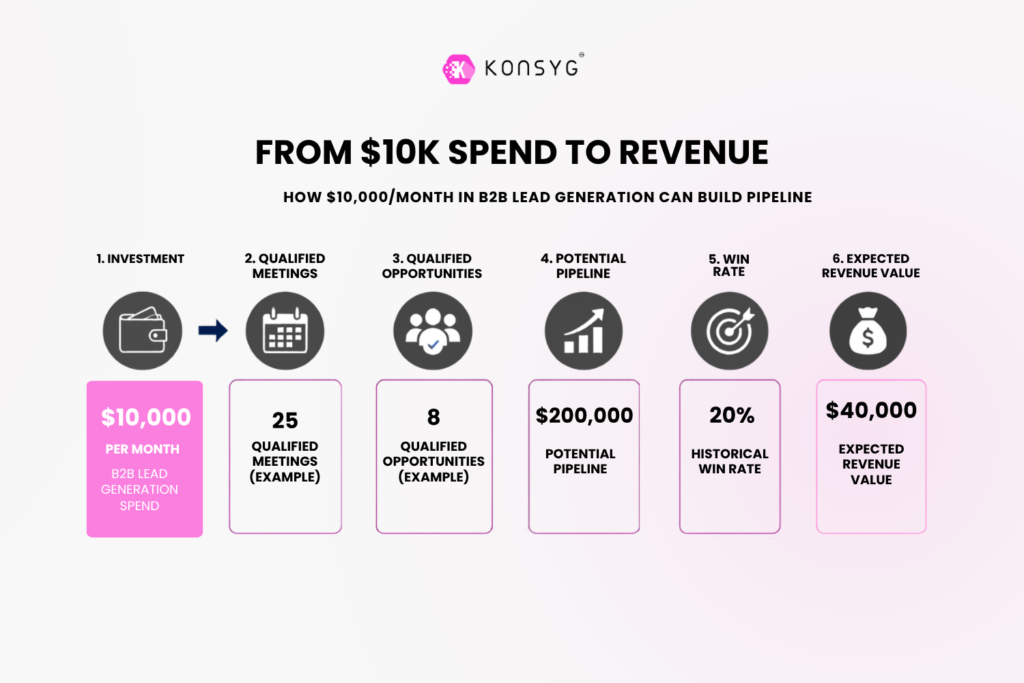
Example only. Actual performance depends on contract value, market, conversion rates and sales cycle.
Meeting Volume Can Hide Weak Pipeline
A high meeting count can make a B2B lead generation campaign look stronger than it really is.
If an agency books 25 meetings in a month, that number can sound impressive on its own. But the commercial value depends on what happens next.
Consider two campaigns.
Agency A books 25 meetings. Eight become qualified opportunities. One closes.
Agency B books 12 meetings. Eight become qualified opportunities. Three close.
Agency A generated more than twice as many meetings, but both campaigns created the same number of genuine opportunities. Agency B also produced three times as many customers.
That is why meeting volume should never be the final measure of performance.
The more useful question is how efficiently meetings move through the sales process.
A strong B2B lead generation programme should be able to show:
how many meetings matched the agreed ICP, how many were accepted as qualified opportunities, how much pipeline those opportunities represented, and how many eventually progressed to revenue.
If those numbers are weak, booking more meetings can simply make the problem larger.
For example, if only 20% of booked meetings become qualified opportunities, increasing meeting volume from 20 to 40 may create more activity without fixing the real issue.
The problem could be poor targeting, loose qualification criteria, weak prospect seniority or a mismatch between the offer and the market being contacted.
This is where lead generation reporting needs to move beyond calendar activity.
A meeting is a useful milestone. A qualified opportunity is a commercial outcome.
Is Your B2B Lead Generation Agency Actually Performing?
Once meetings start coming in, the next challenge is deciding whether your B2B lead generation agency is actually performing well.
Cost per meeting is useful, but it should not be the number that decides whether a campaign is working.
Suppose you spend $10,000 a month and receive 20 meetings. Your cost per meeting is $500. If only four of those meetings become qualified opportunities, however, you are effectively spending $2,500 per qualified opportunity.
Now consider another campaign that generates only 12 meetings from the same $10,000 investment. Seven become qualified opportunities.
The cost per meeting is higher at $833, but the cost per qualified opportunity falls to approximately $1,429.
The second campaign produces fewer meetings, yet creates qualified opportunities at roughly 43% lower cost.
This is where agency performance becomes easier to judge. Look beyond the calendar and follow what happens to each meeting.
A healthy campaign should show a reasonable progression from:
Target account → Conversation → Qualified meeting → Sales opportunity → Pipeline → Revenue
If large numbers of meetings consistently disappear between the meeting and opportunity stages, there is usually something worth investigating.
It could be poor ICP selection. Meetings may be happening with companies that were never realistic buyers.
It could be qualification. A prospect agreeing to a conversation does not necessarily mean there is a business need, budget or credible sales opportunity.
It could also be the offer. The right people may be taking meetings but finding too little reason to move forward.
Another important factor is time.
A B2B lead generation programme selling enterprise contracts with a six-month sales cycle should not be judged against closed revenue after its first 30 days.
Assess early performance through leading indicators such as ICP fit, conversations, qualified meetings, and opportunities created. Revenue becomes more meaningful as those opportunities have enough time to progress.
The goal is not to find one perfect metric.
It is to see whether each stage produces enough quality to move prospects toward revenue.
If your agency can report meetings but cannot show what happens after them, you do not yet have enough information to decide whether that $10,000 is working.
When the B2B Lead Generation Maths Does Not Work
Sometimes the numbers reveal that a B2B lead generation campaign is underperforming. Other times, they reveal that the original expectations were unrealistic.
Consider a company with an average contract value of $8,000.
If it needs $80,000 in new revenue and closes 20% of qualified opportunities, it needs approximately $400,000 in pipeline. At an $8,000 average contract value, that represents 50 qualified opportunities.
If 40% of meetings become opportunities, the campaign would need around 125 qualified meetings to support that revenue target.
Expecting a $10,000 monthly programme to consistently deliver that volume within a narrow target market may simply not be realistic.
That is why you should run the calculation before increasing outreach.
If the numbers do not work, there are several places to investigate.
The ICP may be too narrow to support the required volume.
The average contract value may be too low relative to the cost of acquiring opportunities.
The meeting-to-opportunity rate may be weak, creating a qualification problem rather than a volume problem.
The win rate may be too low, meaning generating more pipeline alone will not close the revenue gap.
Or the sales target itself may require considerably more outbound capacity than the current investment can support.
This is also why comparing one B2B lead generation programme with another can be misleading. A campaign selling $100,000 enterprise contracts to 500 carefully selected accounts operates under completely different economics from one selling $10,000 contracts into a market of 50,000 potential buyers.
The objective is not to force the numbers until the ROI looks attractive.
B2B lead generation is only one part of the sales equation.
Explore the wider outbound process, from prospecting to sales execution, in Konsyg’s Let’s Talk Sales.
What Should US Companies Expect From a $10K Lead Generation Budget?
For US B2B companies, a $10,000 monthly lead generation budget should not be judged against a universal meeting guarantee. The economics depend on average contract value, the complexity of the buying committee, sales cycle length and how frequently qualified conversations become genuine sales opportunities.
A SaaS company targeting $75,000 enterprise contracts, for example, can justify very different acquisition economics from a professional services company selling $10,000 engagements. The more useful question is whether the programme creates enough qualified pipeline to support the company’s revenue target.
This becomes particularly important when targeting larger US accounts. Enterprise opportunities may involve finance, procurement, technology, operations and executive stakeholders rather than a single decision maker. The outbound programme therefore needs to generate engagement within the right accounts while maintaining enough opportunity value to justify the acquisition cost.
For companies entering or expanding across the United States, ICP precision matters just as much as outreach volume. A campaign targeting enterprise technology buyers in New York may require a different account strategy, messaging approach and sales cadence from one targeting mid market companies across a broader national territory.
How Much Pipeline Should Your $10K Actually Generate?
No single pipeline number applies to every $10,000 monthly B2B lead generation programme.
The better benchmark comes from your own sales economics.
Start with four numbers:
Revenue target
Average contract value
Meeting-to-opportunity rate
Opportunity win rate
Then work backwards.
If your revenue target is $100,000 and your opportunity win rate is 20%, you need approximately $500,000 in qualified pipeline.
If your average contract value is $25,000, that pipeline requires 20 qualified opportunities.
If 40% of qualified meetings become opportunities, you need approximately 50 qualified meetings to support the target.
Now compare those requirements with what your $10,000 monthly investment is actually producing.
If the agency is consistently creating enough qualified opportunities and pipeline to support the revenue target, the programme may be working even if the raw meeting number looks lower than expected.
If meeting volume looks impressive but very little reaches the opportunity stage, the economics tell a different story.
That is ultimately how a B2B lead generation agency should be evaluated.
Not by how busy the calendar looks.
By whether the right conversations are turning into enough qualified pipeline to make the investment commercially worthwhile.
Find Out What Your B2B Lead Generation Spend Should Be Producing
If you are investing in outbound but cannot clearly connect meetings to qualified pipeline, Konsyg can help you examine the numbers behind the programme.
Bring your current monthly spend, average contract value and conversion rates. We can work backwards from your revenue target to identify how many opportunities your B2B lead generation programme needs to create and where the current funnel may be losing value.
[Book a B2B Pipeline Review]
Frequently Asked Questions
How much should a B2B lead generation agency cost?
The cost of a B2B lead generation agency depends on campaign scope, target market, sales complexity, outreach channels and the resources required to run the programme. Instead of evaluating the monthly fee alone, compare the investment with qualified opportunities, pipeline created and eventual revenue.
How much pipeline should B2B lead generation generate?
There is no universal pipeline target. Calculate the amount your business needs by dividing the revenue target by your opportunity win rate. For example, a company targeting $100,000 in new revenue with a 20% win rate would need approximately $500,000 in qualified pipeline.
How many meetings should a B2B lead generation agency book?
The right meeting target depends on how frequently meetings become qualified opportunities. If you need 10 opportunities and 40% of qualified meetings progress to the opportunity stage, you would need approximately 25 qualified meetings. Meeting quality matters more than setting an arbitrary volume target.
What is a good cost per qualified opportunity?
A good cost per qualified opportunity depends on average contract value, win rate and customer economics. A $2,000 opportunity acquisition cost may be attractive for a company selling $50,000 contracts but difficult to justify for a business selling $5,000 contracts. Cost per opportunity should therefore be evaluated against its realistic revenue potential.
How do you measure B2B lead generation ROI?
Start by tracking the complete progression from outbound activity to qualified meetings, sales opportunities, pipeline and closed revenue. Over a suitable sales cycle, compare the revenue attributable to the programme with the total cost of generating it. For longer sales cycles, qualified pipeline and opportunity progression can provide useful leading indicators before enough deals have closed to calculate meaningful revenue ROI.
Share This Post
Recent Posts
What We Offer
Get Your Quote