

Cold outreach has never been easy.
And if you are working in B2B outbound sales in Europe, you do not need another report or webinar to tell you that buyer behaviour has shifted again.
Prospects are more selective. Budgets are tighter. Procurement gets involved earlier than ever.
And attention?
It is fragmented, filtered, and heavily protected.
Most teams respond to this by doing more. More emails. More sequences. More automation.
But that is exactly where things start to break.
There is a growing belief that cold email is dead. That inboxes are too saturated, and buyers are no longer engaging with B2B cold email campaigns.
Konsyg believes that is the wrong conclusion.
Cold email strategy is not failing because the channel stopped working. It is failing because execution has not kept pace with European buyer expectations.
What we are seeing across outbound sales in Europe tells a different story.
Teams that adapt continue to generate a consistent pipeline. Response rates improve when B2B lead generation targeting is tighter. Conversations increase when outreach is grounded in a real business context rather than surface-level personalised outreach.
The gap is not between companies that use cold email for B2B lead generation and those that do not.
The gap is between teams that treat outbound as volume and those that treat it as precision.
Top-performing teams are not sending more emails. They are sending fewer, but with sharper intent.
They reach out at the right moment in a company’s growth cycle. They open conversations with relevance, not templates. And they treat email as one part of a broader outbound sales strategy, not a standalone tactic.
That is where most teams fall short.
If your goal in 2026 is simple: generate more qualified conversations from B2B cold email, then the approach needs to change.
Below are three shifts that consistently set average cold email strategies apart from those of high-performing teams across Europe.
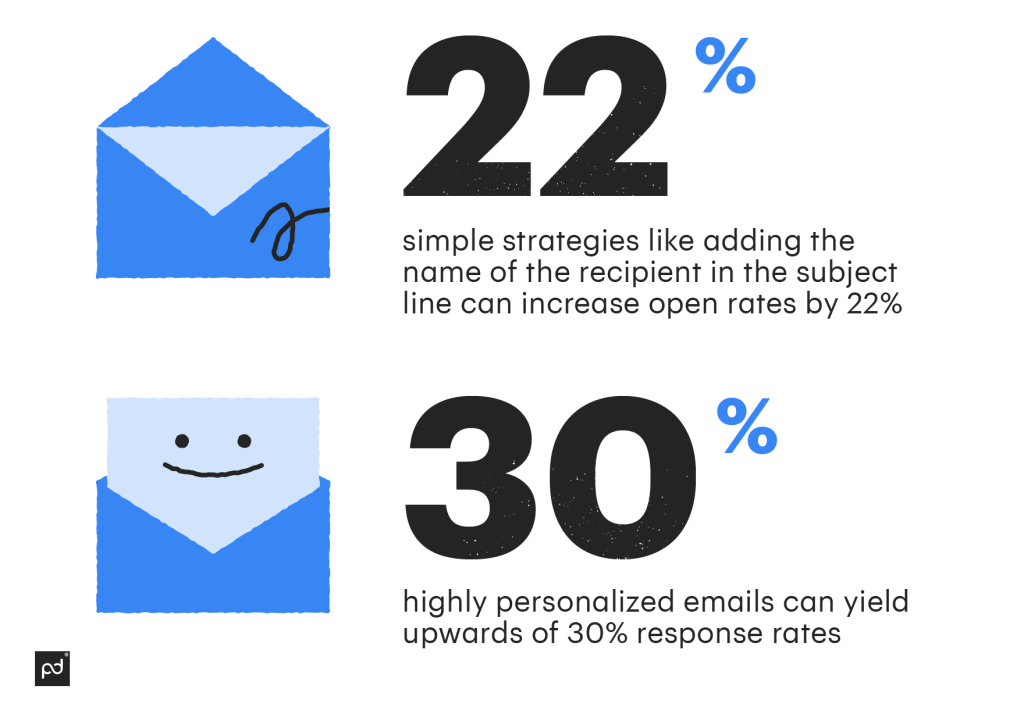
Prioritise High-Intent Prospects Over High-Volume Cold Email
If there is one shift redefining B2B cold email in Europe, it is this:
The days of sending more emails to get more meetings are over.
Top-performing teams are not winning because they increase volume.
They are winning because they focus on the right accounts and filter out the rest early.
Across outbound sales in Europe, a clear pattern has emerged.
When teams tighten their ideal customer profile, improve data quality, and prioritise prospects showing genuine buying signals, reply rates and meeting conversions increase significantly.
Not marginally. Significantly.
Most teams still assume that success in cold email strategy comes from persistence. More sequences. More follow-ups. More automation.
When your outreach is directed at prospects who already show relevance, the conversation starts with momentum instead of resistance.
Instead of targeting broad lists, high-performing teams focus on prospects who:
- Match a clearly defined B2B ICP
- Hold decision-making authority
- Are you facing a relevant business problem
- Sit within an active buying window
- Can take action without heavy internal friction
This changes how B2B lead generation in Europe actually works.
Fewer emails are sent, but each one is more likely to receive a response. Outreach becomes more deliberate. Qualification happens earlier in the process.
Another shift shaping this across Europe is direct access.
Reaching the right inbox, rather than relying on generic or outdated data, has become critical. Strong data hygiene, accurate contact mapping, and better account prioritisation reduce friction at the very first touchpoint.
When this is executed well, your outbound list becomes smaller but far more effective.
The result is simple.
High intent consistently outperforms high volume.
Teams that move away from generic cold email campaigns and focus on timing, relevance, and precision are seeing the greatest improvements in the number of qualified meetings across European markets.
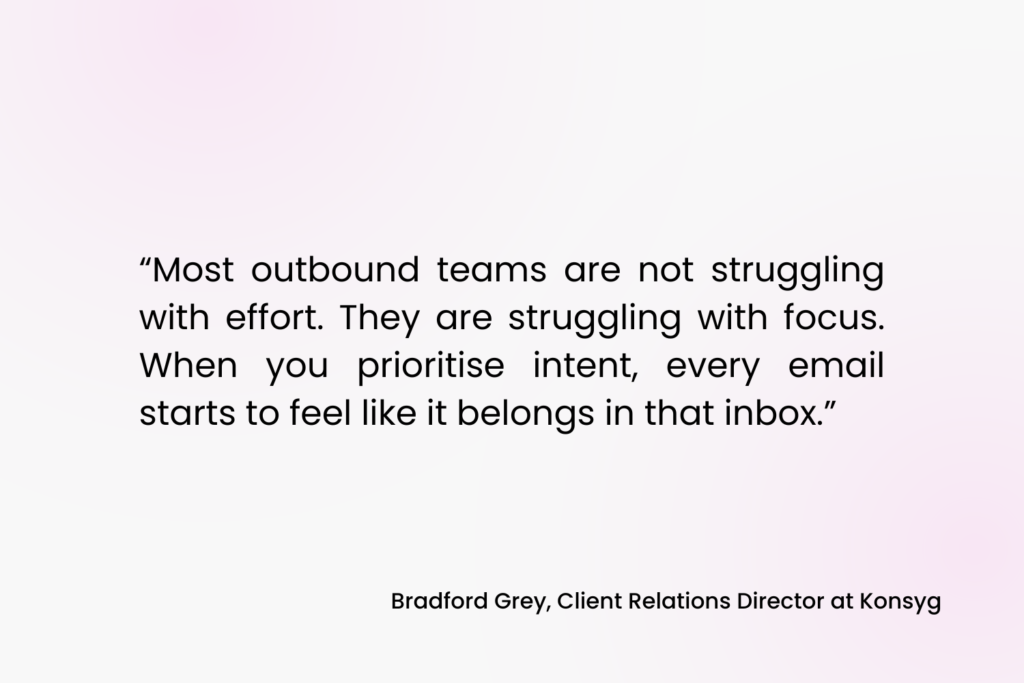
As Bradford Grey, Client Relations Director at Konsyg, puts it:
Timing Your Cold Email for When Buyers Are Most Likely to Engage
You can have the strongest messaging, the most relevant targeting, and a well-structured cold email strategy, but if your email lands at the wrong time, it gets ignored.
Timing is one of the most overlooked levers in B2B cold email, especially across Europe.
Most teams focus on what to say.
Far fewer think about when it should be seen.
Across outbound sales in Europe, a clear pattern is emerging.
Emails that arrive when prospects are actively working, reviewing priorities, or clearing their inbox are far more likely to generate replies.
Not because the message is better.
But because the timing allows it to be noticed.
There are two consistent engagement windows that high-performing teams optimise for:
Late morning, when inboxes are being actively reviewed and priorities are being set.
Mid-afternoon, when buyers return to focused work after internal meetings and are more open to evaluating new inputs.
When outreach aligns with these windows, teams consistently see:
- Higher reply rates
- More meaningful responses
- Fewer follow ups required to get engagement
- Stronger conversion into qualified conversations
On the other hand, poorly timed emails tend to disappear.
Early mornings are crowded with internal communication. Lunchtime is ignored. Late afternoons often get lost as buyers shift focus away from new inputs.
In European markets, this becomes even more important due to regional differences.
An email sent at the right time in London will not perform the same way in Berlin or Stockholm if timing is not adjusted. High-performing teams adapt their cold email campaigns to match the working patterns of each region, not their own internal schedules.
This is where many outbound teams lose momentum.
They optimise messaging, but ignore visibility.
The takeaway is simple.
If your goal is to improve results from B2B cold email, optimise when your message is seen, not just what it says.
Because even the most relevant outreach will fail if it arrives at the wrong moment.
Lead with Problems, Not Pitching in Cold Email
If there is one universal truth about modern B2B buyers in Europe, it is this:
They have no patience for a cold email that reads like a pitch.
The fastest way to get ignored in B2B cold email is to lead with what you do, your features, or a generic introduction.
Top-performing teams are doing the opposite.
They are opening with relevance, clarity, and context. And they are getting to the point faster than ever.
This shift is not accidental.
While many assume shorter attention spans mean less engagement, Konsyg thinks the opposite is happening. Buyers are not engaging less. They are filtering faster.
That means your email does not need to be longer.
It needs to be sharper.
And sharper starts with one thing.
The problem.
High-performing cold email campaigns are built around the buyer’s world, not the sender’s offer.
Instead of leading with a pitch, they:
- Highlight a challenge specific to the prospect’s role or industry
- Reference a situation the company is likely experiencing
- Show clear awareness of the prospect’s context
- Give a reason to continue reading within the first few lines
- Guide the conversation without forcing it
This changes how your email is received.
A problem-led opening signals that the message is relevant before the reader even processes who you are.
It removes friction.
It builds immediate context.
And most importantly, it earns attention.
Across outbound sales in Europe, this has become a defining difference.
Generic introductions get ignored. Feature-heavy emails get archived.
But emails that reflect a real problem the buyer recognises are far more likely to generate replies.
This also shortens the path to a conversation.
Instead of spending multiple touchpoints trying to establish relevance, it is established immediately.
And when a prospect feels understood early, they are far more open to exploring whether a conversation is worth their time.
The takeaway is simple.
Prospects do not respond to pitches.
They respond to relevance.
If your goal is to improve results from B2B cold email, focus your opening lines on a problem your prospect already recognises, rather than on introducing your company or listing your capabilities.
Because in 2026, relevance is what earns the reply.
Why Most Cold Email Strategies Still Fail in Europe
If there is one consistent pattern across B2B cold email in Europe, it is this: most teams have not meaningfully changed how they approach outbound.
They are still increasing volume, expanding lists, and relying on sequences to compensate for weak targeting.
The assumption is simple. More activity should lead to more results.
But that is not what is happening.
Teams booking the most meetings today are not sending more emails. They are being far more deliberate in how they execute.
They focus on a narrower set of accounts, align messaging with real business context, and pay closer attention to when their emails are actually seen.
This shift is not theoretical.
Across European markets, the divide is becoming clearer. Some teams continue to struggle with low reply rates and an inconsistent pipeline, while others are generating steady conversations from fewer, more targeted emails.
The difference comes down to execution.
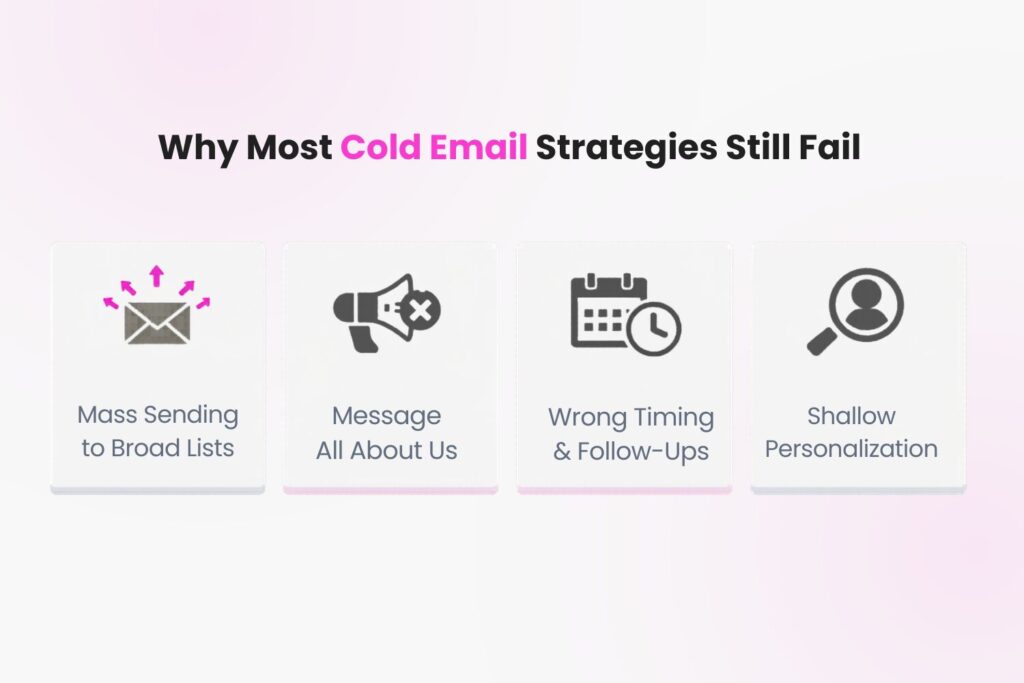
Cold email tends to fail when built around effort rather than precision. It often looks like sending campaigns to loosely defined audiences, leading with company information instead of buyer relevance, and relying on longer sequences to create engagement that was never there to begin with.
Timing is treated as a secondary factor, and personalisation is reduced to surface-level references that buyers have learned to ignore.
The result is predictable.
Emails are delivered but not read. Messages are opened but not considered. And follow-ups add volume without improving outcomes.
This is why so many cold email campaigns underperform.
Not because the channel no longer works, but because the way it is being used has not kept pace with how buyers evaluate information.
When targeting lacks intent, outreach reaches inboxes unlikely to engage. When messaging lacks relevance, attention is lost almost immediately. And when timing is off, even strong emails fail to land.
If your goal is to improve performance from B2B cold email, the focus should not be on increasing output.
It should be on correcting execution.
Because in 2026, results are not driven by how much you send, but by how precisely you send it.
Treat Cold Email as Part of a Multi-Touch Strategy, Not a One-Email Outcome
One of the biggest shifts shaping B2B cold email in Europe right now is this:
A single email is no longer expected to do all the work.
The teams generating the most qualified meetings are not trying to force a response from the first touch. They are using that first email to create awareness, establish relevance, and set up a follow-up that feels more natural and far easier to convert.
Because buying behaviour has changed.
Decision-making is slower, more distributed, and often delayed. Even when your email reaches the right person, with the right message, at the right company, the timing may still not align.
That does not mean the opportunity is lost.
It means the opportunity is not immediate.
Teams that treat cold email campaigns as part of a broader, multi-touch approach consistently outperform those relying on a single interaction. Instead of pushing for a reply instantly, they:
- Use the first email to introduce a relevant problem or idea
- Follow up with context based on the same narrative, not a reset
- Layer outreach across channels where appropriate
- Build familiarity over multiple touches so recognition increases
- Re-engage with purpose, not repetition
This creates a very different experience for the buyer.
Instead of receiving disconnected emails that feel automated, they encounter a sequence that builds context over time. Each interaction feels related, intentional, and easier to engage with.
And that changes how responses happen.
When a prospect has already seen your name, recognised your message, and connected it to a relevant problem, the next touchpoint carries far less friction.
You are no longer just another sender in their inbox.
You are someone they recognise.
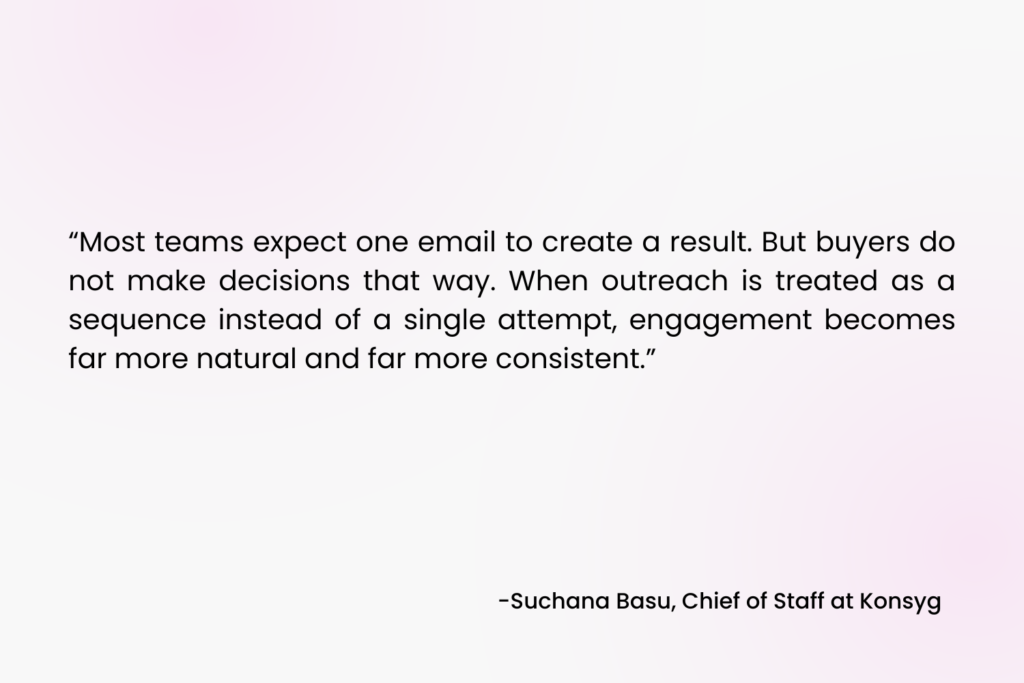
As Suchana Basu, Chief of Staff at Konsyg, puts it:
This is where many outbound strategies still fall short.
They treat cold email as a one-off attempt instead of a structured progression.
But the teams seeing consistent results understand something different.
Cold email is not about getting an immediate reply.
It is about opening a door, building familiarity, and returning at the right moment with context that makes the conversation easier to continue.
That is how B2B cold email works in 2026.
How to Drive More Results from Cold Email in 2026
Cold email is changing, and so are the teams succeeding with it.
The teams generating a consistent pipeline today are not relying on volume, guesswork, or templates that worked five years ago.
They are adapting to how buyers actually behave across Europe. More selective. More informed. Far less tolerant of irrelevant outreach.
That does not make B2B cold email harder.
It makes it sharper.
Focus on the three shifts above, and the difference becomes clear:
They prioritise high-intent prospects over volume.
They lead with problems instead of pitching.
They send emails when buyers are actually likely to engage.
When these come together, outreach becomes more precise, conversations become more relevant, and results become more predictable.
Cold email is not broken.
But the way most teams use it is.
What works now is more focused, more contextual, and far more aligned with how buyers evaluate information.
And when you lean into that, cold email does not just generate meetings.
It builds conversations that turn into a real pipeline.
That is the difference.
Share This Post
Recent Posts
What We Offer
Get Your Quote