

B2B Lead Generation: Meaning, Strategy, Examples, and How to Get Started in the UK
Learn how B2B lead generation can strengthen your pipeline and take practical steps to build a high-performing lead generation strategy.
Learn how B2B lead generation can strengthen your pipeline and take practical steps to build a high-performing lead generation strategy in England.
What Is a B2B Lead Generation Campaign
A B2B lead generation campaign is a structured marketing and sales initiative designed to attract qualified business prospects and move them into your sales funnel.
In B2B markets, the goal is not just visibility. It is to:
- Generate qualified B2B sales leads
- Build sustained interest among decision makers
- Convert prospects into revenue-generating clients
Unlike basic lead-capture tactics, modern B2B lead generation integrates marketing and sales functions into a unified system.
In the UK market, this typically includes:
- Search engine-driven inbound lead generation
- LinkedIn-based prospecting
- Outbound email campaigns
- B2B cold calling
- Marketing automation and CRM workflows
- Account-based outreach
Today, lead generation is not limited to cold outreach. It is a data-driven process supported by automation tools, audience segmentation, and targeted messaging.
Strong campaigns align marketing content with sales outreach, ensuring prospects move smoothly from awareness to conversation.
When executed correctly, a B2B lead generation campaign does more than create interest. It builds a predictable pipeline and supports long-term revenue growth.
Does Lead Generation Make Money for UK Businesses? Benefits of Generating Leads
A good B2B lead generation system can make it easier for your business to grow. You can gain market exposure, attract aligned prospects, and guide them toward a purchase while freeing up time and energy to build the next growth stage of your business. Other benefits include growing your social media following and email subscriber list, gathering more customer reviews, collecting valuable data about potential customers, running your business more efficiently, and increasing your revenue.
To hear practical insights about B2B lead generation and modern sales strategy straight from an industry leader, watch the video below featuring William Gilchrist, Founder and CEO of Konsyg. His perspectives reflect real-world B2B sales execution and pipeline-building tactics that generate revenue through demand creation and targeted outreach.
Watch the full video here.
Types of B2B Leads and Why Classification Matters
Before building a strong B2B lead generation strategy, it is critical to understand what a lead actually represents and how different lead types behave inside your sales funnel.
Not all leads are equal. In the UK market, where buying committees and longer sales cycles are common, understanding lead temperature directly impacts conversion rates.
Cold Leads: Cold leads are companies or decision makers who match your ideal customer profile, but have not yet engaged with your brand.
They fit your target industry, company size, or job role criteria, yet there has been no interaction.
These leads are typically reached through:
Outbound lead generation
B2B cold calling
- Cold email campaigns
- Account-based outreach
Cold leads require education and trust-building before moving forward.
Warm Leads: Aware of your brand and have shown early-stage engagement.
In B2B markets, this may include:
- Visiting your website multiple times
- Downloading gated resources
- Engaging with LinkedIn content
- Subscribing to your email updates
- Attending a webinar
Warm leads sit in the middle of your lead generation process. They are interested but not yet ready for a sales conversation.
This is where structured nurturing and follow-up matter.
Hot Leads: High-intent leads.
They may:
- Request a demo
- Book a strategy call
- Respond directly to sales outreach
- Ask pricing or implementation questions
In B2B lead generation, speed matters at this stage. Delayed responses reduce close rates, especially in competitive UK sectors.
Hot leads should move quickly into structured qualification and proposal discussions.
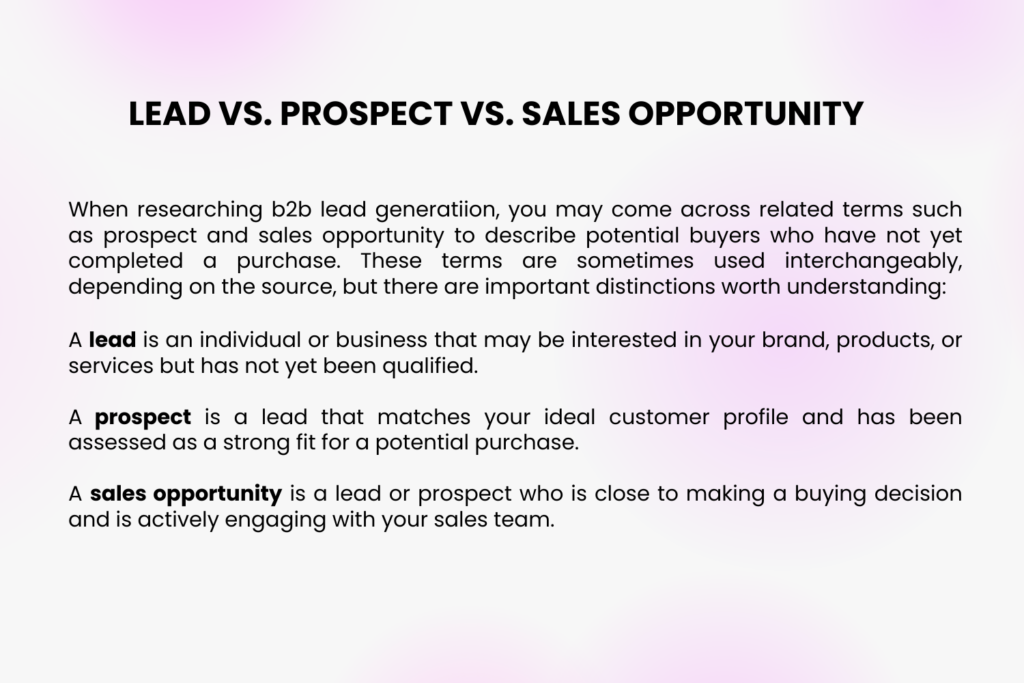
Qualified Leads
One important goal of B2B lead generation is to qualify leads, ensuring they are the right fit for your business and its products and services. Use these four types to evaluate qualified leads in your business:
An information-qualified lead is at the stage of researching solutions to a problem and may share information about themselves with your business, such as by filling out a contact form.
A marketing-qualified lead is highly likely to become a customer based on their activity and engagement with your business, such as downloading resources, visiting specific site pages, and interacting with social content.
A sales-qualified lead is someone who is ready to move from engagement into the sales process.
A product-qualified lead is someone who has used a product or benefited from a service, such as through a free trial, and is now showing signs of being ready to make a purchase.
Lead Generation Process
Here is an example of online B2B lead generation and the customer journey it initiates.
A potential customer discovers your business through a marketing channel such as social media or a digital advertisement.
Next, the potential customer shows interest in your business by responding to a call to action, such as clicking a sign-up button or visiting a landing page that offers a free resource in exchange for an email address.
Then, the potential customer enters their email address in a form, receives the free resource, and opts in to future marketing communications from your business.
Once the potential customer opts in, you begin a nurture sequence of valuable content designed to guide them toward making a purchase.
How to Generate Leads for Your Business
Now that you understand how lead generation works and the different types of leads a business may encounter, use the strategies below to attract new potential customers and generate leads for your business.
- Identify Your Business Objectives
Review your business plan and reflect on the following questions to clarify your objectives:
- What do you want your business to look like in the next quarter, six months, and year?
- What specific changes need to happen to support that growth?
- What current or new offers do you want to sell?
- How many sales do you need to reach your revenue goals?
- How many leads do you need to convert into customers?
Did you know?
The average cost per lead varies by industry. Between 2023 and 2024, attorneys and legal professionals spent an average of $144.03 per lead, while automotive service and parts businesses paid an average of $27.94 per lead.
- Create an Ideal Customer Profile
To generate leads effectively and guide them toward a purchase, you need clarity about your ideal customer.
Whether you serve individual consumers or other businesses, think of your ideal customer profile as a representation of the customers you are best equipped to serve.
Consider these questions:
- What types of consumers or businesses most need your products or services?
- What are their demographics, such as age and geographic location for consumers, or industry, company size, and annual revenue for businesses?
- What are their psychographics, including values, goals, challenges, and decision-making priorities?
Based on your answers, outline the problem your ideal customer experiences, what outcome they want instead, and how your product or service addresses that need.
- Investigate Lead Generation Strategies in Your Industry
Lead generation strategies vary by industry, buyer behaviour, and product complexity.
For example, generating real estate leads requires a steady stream of new prospects because property purchases are infrequent. Strategies may include social media outreach, local networking, referrals, and print advertising.
Below are common lead generation strategies businesses use to turn prospects into customers.
Go Offline
Offline lead generation can still be effective, particularly in B2B environments.
- Attend networking events to meet potential customers, discuss their needs, and exchange contact information.
- Sponsor events to position your brand in front of relevant audiences.
- Ask satisfied customers for referrals to strengthen credibility through social proof.
- Advertise through billboards, flyers, direct mail, or print publications to capture attention outside digital channels.
Host Events
Hosting events can support both online and local lead generation efforts.
- Offer free or low-cost workshops, webinars, or conferences to educate your audience and introduce paid services.
- Organise performances, gatherings, or industry meetups to build awareness and encourage future engagement.
- You can collect attendee contact information through event registration platforms or video conferencing tools.
Build a Social Media Following
Share content such as tutorial videos, blog posts, visuals, infographics, or polls to engage followers.
As your audience grows, generate leads by:
- Inviting followers to send direct messages or contact you by email
- Sharing links to your website or landing pages
- Promoting downloadable resources
- Hosting contests or giveaways
- Encouraging shares and reposts
- Creating community groups around relevant topics
- Participating in online forums and professional groups
Turn Your Website into a Lead Generation Asset
Optimise your website to convert visitors into leads.
- Publish valuable, search-friendly content that addresses customer challenges and goals.
- Offer gated resources such as ebooks, reports, video tutorials, quizzes, or free trials in exchange for email subscriptions.
- Reduce friction by limiting the steps required to subscribe or request information.
- Add clear call-to-action buttons throughout your site.
- Use intake forms to collect names and email addresses. While shorter forms often increase sign-ups, additional fields can provide useful insights for segmentation.

- Vet Lead Generation Services
Various tools can automate parts of the lead generation process, reducing manual effort.
These systems may:
- Collect leads from social media and landing pages
- Store lead information for marketing and sales teams
- Deliver automated email nurture sequences
- Popular software includes:
- Unbounce, a landing page platform that supports conversion testing
- LinkedIn Sales Navigator, which enables targeted prospect searches by role, location, and industry
- Customer relationship management platforms that centralise lead tracking and engagement
Depending on your growth stage, you may also consider working with a lead generation company that maintains prospect databases and identifies sales-ready contacts.
- Design a Lead Generation Campaign
Once you define your objectives, ideal customer profile, and strategy, design and execute your campaign.
- Refine your products and services.
- Create a lead magnet.
- Set up your lead-capture method using landing pages, events, or advertising.
- Implement your CRM system to organise lead data.
- Develop a nurture sequence to guide prospects toward purchase.
- Drive traffic to your lead magnet.
- Analyse campaign performance and optimise results.
Lead Generation Glossary of Terms
Sales funnel
A framework describing the customer journey from awareness to purchase.
Inbound marketing
A strategy focused on creating valuable experiences and content that attracts potential customers.
A/B testing
A method of comparing two versions of a webpage, email, or asset to determine which performs better.
Conversion rate
The percentage of visitors who take a desired action, such as completing a form.
Lead routing
The process of assigning leads to sales representatives based on territory, expertise, or deal size.
B2B Lead Generation Services in the UK with Konsyg
Building an effective B2B lead generation strategy requires more than tools or certifications. It requires structured execution, targeted outreach, and measurable pipeline performance.
At Konsyg, our B2B lead generation services in the UK are designed to help companies create consistent, revenue-driven growth.
We work with UK-based businesses that need:
- A steady flow of qualified B2B sales leads
- Structured outbound and inbound campaigns
- Dedicated sales development support
- Improved pipeline visibility and forecasting
Our approach focuses on precision targeting and disciplined outreach.
How Konsyg Supports B2B Lead Generation in the UK
Targeted Prospect Research
We identify decision makers based on industry, company size, revenue, and role to match your ideal customer profile.
Outbound Lead Generation
Through structured email outreach, LinkedIn engagement, and B2B cold calling, we generate qualified meetings with relevant prospects across the United States.
B2B Appointment Setting
Our team books sales-ready meetings directly into your calendar, allowing your internal sales team to focus on closing deals.
CRM Integration and Reporting
We align with your CRM system to track lead status, measure campaign performance, and improve forecasting accuracy.
Ongoing Optimization
Campaign messaging, targeting, and follow-up sequences are refined continuously to improve response rates and conversion performance.
Why UK Companies Choose Konsyg
The UK market is competitive. Buyers expect clear value, professional outreach, and consistent follow-up.
Konsyg helps businesses:
- Increase qualified pipeline
- Reduce customer acquisition costs
- Shorten sales cycles
- Scale outreach without expanding internal headcount
Instead of relying solely on automated tools, our model combines human-driven outreach with structured process management. This ensures your lead generation process supports real revenue outcomes.
While training programs and software platforms can strengthen internal skills, execution remains the key differentiator.
For companies looking to accelerate B2B lead generation in the UK, Konsyg provides the structure, outreach discipline, and reporting clarity required to turn strategy into measurable growth.
Frequently Asked Questions (FAQs)
What is the difference between inbound and outbound B2B lead generation?
Inbound lead generation attracts prospects through content, search visibility, and social engagement. It builds long-term authority but can take time to produce a consistent pipeline.
Outbound lead generation proactively reaches decision makers through targeted email outreach, LinkedIn prospecting, and B2B cold calling. It generates faster pipeline momentum and allows precise targeting of high-value accounts.
For many UK companies, combining both strategies creates predictable revenue growth.
How long does it take to see results from B2B lead generation?
Timelines depend on your industry, offer, and targeting precision.
Outbound B2B lead generation services typically begin generating qualified meetings within the first one to two months when executed consistently.
Inbound strategies such as search-driven content may take three to six months to build measurable traffic and lead flow.
Companies seeking faster pipeline acceleration often prioritise outbound first.
How do I know if my company needs outsourced B2B lead generation?
You may benefit from outsourcing if:
- Your sales team lacks time for prospecting
- Pipeline volume is inconsistent
- You are expanding into new UK markets
- You need a structured B2B appointment setting
- Customer acquisition costs are rising
Outsourcing allows internal sales teams to focus on closing while a dedicated team manages outreach and qualification.
What industries benefit most from B2B lead generation services in the UK?
Industries with longer sales cycles and higher contract values often see strong results, including:
- SaaS and technology
- Professional services
- Consulting and advisory firms
- Manufacturing and industrial services
- Financial and compliance services
These sectors rely heavily on structured pipeline development and consistent outreach.
How are qualified B2B sales leads different from general leads?
Qualified B2B sales leads match your ideal customer profile and demonstrate real buying intent.
Unlike general leads, they:
- Fit your target industry and company size
- Have decision-making authority
- Show engagement with your messaging
- Indicate timeline or budget alignment
Structured lead qualification improves conversion rates and reduces wasted sales effort.
Can B2B cold calling still work in the UK market?
Yes. When executed professionally and supported by research, B2B cold calling remains effective.
Modern cold calling is not random dialling. It involves:
- Targeted prospect lists
- Personalized messaging
- Strategic follow-up
- Clear value positioning
When combined with email and LinkedIn outreach, cold calling increases meeting conversion rates.
What should I expect from a B2B lead generation partner?
A strong partner should provide:
- Clear targeting criteria
- Consistent outreach execution
- Booked meetings with qualified decision makers
- CRM tracking and performance reporting
- Ongoing campaign optimisation
Results should be measurable, not vague.
How does Konsyg support B2B lead generation in the UK?
Konsyg provides structured B2B lead-generation services for UK companies seeking predictable growth.
Our approach includes:
- Targeted prospect research
- Outbound email and LinkedIn campaigns
- Professional B2B appointment setting
- Sales development support
- Pipeline reporting and performance analysis
We focus on delivering qualified meetings, not just contact lists, ensuring your internal team can concentrate on closing revenue.
Share This Post
Recent Posts
What We Offer
Get Your Quote