

Most B2B lead generation funnels look clean on paper. Traffic comes in, leads move through stages, deals get closed.
That is not how it works in Singapore.
The reality is slower, more layered, and far less forgiving. Buying decisions often involve multiple stakeholders, longer evaluation cycles, and a higher expectation of trust before any serious conversation begins. A funnel that works in the US or even parts of Europe does not translate directly.
This is where most companies get it wrong. They build funnels that prioritise volume over qualification, activity over intent, and short-term wins over pipeline stability.
The result is predictable. High lead counts, low conversion rates, and a sales team that spends more time chasing than closing.
A well-structured B2B lead generation funnel does the opposite. It filters early, qualifies continuously, and aligns closely with how B2B buyers in Singapore actually make decisions. It is not just about generating leads. It is about building a system that consistently produces revenue.
This guide breaks down the B2B lead generation funnel in Singapore from top to bottom, including what each stage should actually do, where most funnels fail, and how high-performing B2B companies differ.
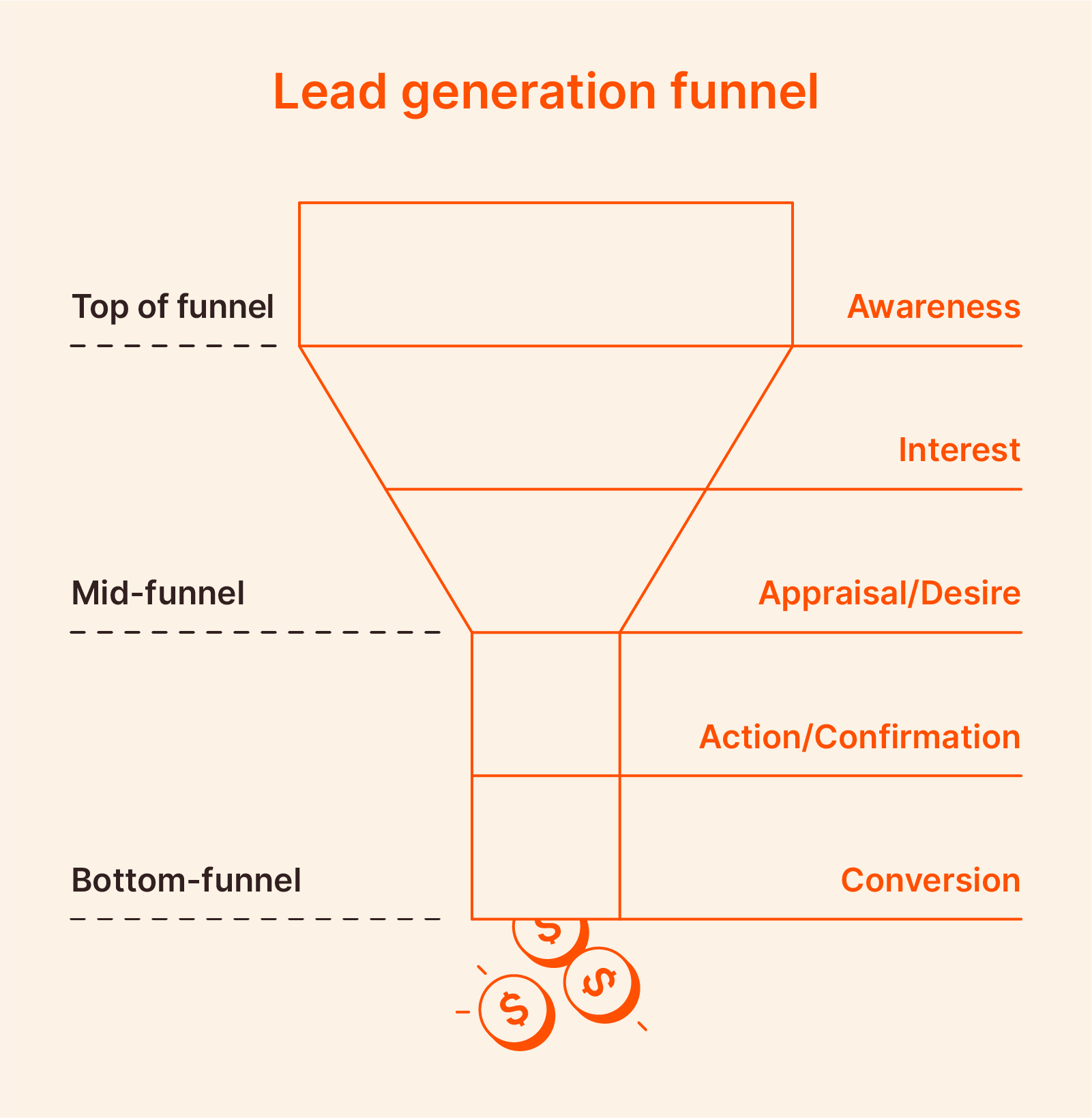
What is a B2B Lead Generation Funnel (Refined Version)
A B2B lead generation funnel is often described as a series of stages that move a prospect from awareness to conversion.
That definition is technically correct. It is also incomplete.
In practice, a B2B lead generation funnel is a filtering system. Its primary job is not just to generate leads, but to identify which prospects are worth a sales team’s time and move them forward with increasing levels of intent.
This distinction matters, especially in Singapore.
In markets where deal cycles are longer and buying decisions involve multiple stakeholders, a funnel that focuses only on volume quickly breaks down. More leads do not translate into more revenue. In many cases, they create friction by overwhelming sales teams with low-quality conversations.
A well-built B2B lead generation funnel does three things consistently.
First, it attracts the right audience, not just a larger one. This means targeting companies that match clear criteria such as industry, size, and readiness to buy.
Second, it introduces friction at the right stages. Not every prospect should move forward. Strong funnels qualify aggressively and early, ensuring that only relevant opportunities reach the sales pipeline.
Third, it aligns marketing and sales around the same definition of a qualified lead. Without this, funnels tend to leak in the middle, where interest exists but intent is unclear.
Most companies focus on the top of the funnel because it is visible and easy to measure. Traffic, clicks, and downloads create the impression of progress. But in B2B, especially in Singapore, the real performance of a funnel is determined in the middle and bottom stages, where deals are either built or lost.
Understanding this shift is the foundation for building a funnel that actually converts.
Why Most B2B Lead Generation Funnels Fail in Singapore
Most B2B lead-generation funnels do not fail for lack of effort. They fail because they are built on the wrong priorities.
The most common mistake is overvaluing volume. Companies invest heavily in driving traffic, increasing form fills, and growing their database. On paper, the funnel looks active. In practice, very little of that activity translates into qualified opportunities.
This becomes more visible in Singapore.
B2B buyers here are more deliberate. Decisions are rarely made quickly and almost never by a single person. Multiple stakeholders are involved, each looking at the decision from a different angle. Financial risk, operational fit, and long-term impact all come into play before any commitment is made.
A funnel that is built to push prospects through quickly tends to break under this pressure.
Another issue lies in how leads are defined and passed through the funnel. In many cases, anyone who shows initial interest is treated as a potential buyer. This creates a gap between marketing and sales. Marketing focuses on generating activity, while sales struggles to convert that activity into real conversations.
Over time, this leads to a familiar pattern. The top of the funnel remains full, but the middle and bottom stages do not move with the same consistency.
This mid-funnel gap is where most opportunities are lost.
Interest exists, but intent is not fully developed. Without a clear qualification process or structured follow-up, prospects stall. Some lose priority, others lose interest, and many simply drop out of the funnel without a clear reason.
Trust also plays a significant role.
In Singapore, buyers rarely move forward based on a single interaction. They evaluate credibility over time, often across multiple touchpoints. Funnels that rely on a single channel or push for early conversion tend to underperform because they do not provide buyers with enough context to make a confident decision.
What remains is a pipeline that appears healthy but behaves unpredictably.
High-performing B2B companies approach this differently. They focus less on how many leads enter the funnel and more on how those leads move through it. Qualification is built into every stage, progression is based on clear signals, and the funnel is designed to reflect how buyers actually make decisions.
Until this shift happens, most funnels will continue to generate activity without producing consistent revenue.
The Complete B2B Lead Generation Funnel (Top to Bottom)
A high-performing B2B lead generation funnel is not built around stages alone. It is built around how buyers move from awareness to decision, especially in a market like Singapore, where evaluation takes time and multiple stakeholders are involved.
Each stage has a specific role. When one stage underperforms, the entire funnel weakens.
Stage 1: Awareness
This is where potential buyers first encounter your company. The goal is not conversion. It is visibility among the right audience.
In Singapore, awareness needs to be precise. Broad targeting creates noise and attracts companies that are unlikely to convert. The focus should be on reaching businesses that match your ideal customer profile, whether that is based on industry, company size, or market position.
Common channels at this stage include content, outbound outreach, and paid campaigns. However, the difference lies in how targeted these efforts are. High-performing funnels do not aim to reach more people. They aim to consistently reach the right ones.
A weak awareness stage usually shows up as high traffic with low engagement or irrelevant inbound leads.
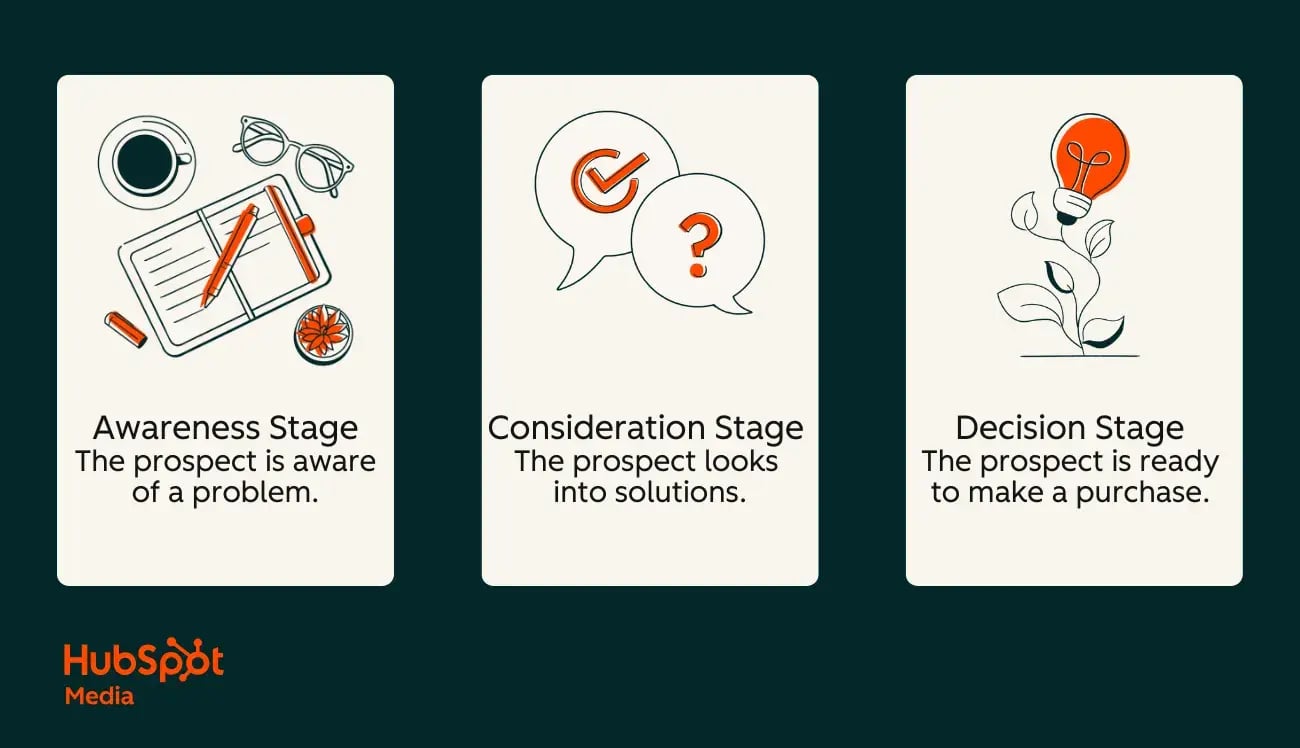
Stage 2: Interest and Engagement
Once awareness is created, the next step is to build interest.
This is where prospects begin to engage with your messaging, content, or outreach. They are not ready to buy, but they are evaluating whether your solution is relevant to their needs.
At this stage, clarity matters more than volume. Messaging should address specific problems, not broad value propositions. Generic positioning often fails to hold attention, especially in B2B environments where buyers are comparing multiple options.
Engagement can take different forms, including replies to outreach, content interaction, or initial conversations. What matters is that there is a signal of genuine interest.
Funnels often lose momentum here when messaging is too vague or when follow-up is inconsistent.
Stage 3: Consideration
In the consideration stage, prospects move from interest to evaluation.
They are now actively comparing solutions, assessing fit, and involving additional stakeholders in the decision-making process. This stage is longer in Singapore compared to many other markets due to the emphasis on due diligence and internal alignment.
A strong funnel supports this stage with structured communication. This includes clear explanations of value, relevant case examples, and consistent follow-up that moves the conversation forward without pressure.
Many funnels underperform here because they assume interest will naturally convert into intent. Without guidance, prospects tend to delay decisions or shift focus.
This is also where qualification becomes more important. Not every interested prospect should move forward. Strong funnels identify which opportunities to pursue based on clear criteria.
Stage 4: Intent and Qualification
This is one of the most critical stages in the B2B sales funnel.
At this point, prospects show clear buying signals. They ask specific questions, request details, or involve decision-makers in discussions. However, intent alone is not enough. It needs to be validated.
Qualification ensures that the opportunity aligns with your offering in terms of need, budget, and timing. Without this step, sales teams risk investing time in deals that are unlikely to close.
In Singapore, where sales cycles can be extended by internal approvals, proper qualification helps prioritise opportunities with a realistic path to conversion.
Funnels that skip or weaken this stage often experience unpredictable pipelines and low close rates.
Stage 5: Conversion
The conversion stage is where opportunities turn into customers.
By the time prospects reach this point, most of the work should already be done. They understand the value, trust the company, and see a clear fit. The role of this stage is to finalise the decision and address any remaining concerns.
Delays at this stage usually indicate issues earlier in the funnel. If prospects are hesitant, it often means that qualification was incomplete or that key stakeholders were not properly engaged during the consideration stage.
A well-structured funnel makes conversion a natural outcome, not a forced step.
Stage 6: Post-Sale Expansion
Most funnels stop at conversion. High-performing ones do not.
In B2B, especially in markets like Singapore, where relationships matter, the real value often comes after the first deal. Expansion through upselling, cross-selling, or long-term partnerships depends on how well the initial experience aligns with expectations.
This stage also feeds back into the funnel. Strong client relationships lead to referrals, case studies, and credibility that improve performance at the top of the funnel.
Ignoring this stage limits long-term growth and increases dependency on constant lead generation.
What Top B2B Companies in Singapore Do Differently
Most companies build a funnel and expect results.
Top B2B companies in Singapore build systems and manage them closely.
The difference shows up in how they approach each stage.
They do not treat lead generation as a volume problem. Instead of asking how to get more leads, they focus on getting the right ones into the funnel from the start. Targeting is tighter, messaging is more specific, and outreach is aligned with a clear ideal customer profile.
This reduces noise early on and makes every subsequent stage easier to manage.
They also treat qualification as an ongoing process rather than a single step.
In many funnels, qualification happens once, usually before a meeting is booked. After that, prospects are moved forward with the assumption that interest equals intent. High-performing teams do the opposite. They continue to qualify at every stage, based on how prospects respond, what questions they ask, and how engaged they remain.
This prevents weak opportunities from moving too far down the funnel and keeps the pipeline focused.
Another key difference is how they manage the middle of the funnel.
Instead of relying on occasional follow-ups, they build structured engagement. Every interaction has a purpose. Conversations move forward step by step, and prospects are guided through the decision process rather than left to navigate it on their own.
This is especially important in Singapore, where decisions take longer and involve more stakeholders. Without structure, momentum is easy to lose.
Clarity also plays a bigger role.
Top companies make it easy for prospects to understand what they do, who they work with, and why it matters. They avoid broad positioning and focus on specific outcomes. This reduces friction during the consideration stage and helps prospects move forward with confidence.
Finally, they measure the funnel differently.
Instead of focusing only on top-level metrics like leads or meetings, they track movement between stages. They look at how many prospects progress, where delays happen, and which stages consistently underperform.
This gives them control.
A strong B2B lead generation funnel is not just active. It is predictable. When each stage is clearly defined and managed, growth becomes easier to sustain.
This is what separates companies that generate leads from those that build consistent pipelines.
How to Build a High-Converting B2B Lead Generation Funnel
Building a B2B lead generation funnel is not about assembling tools or launching campaigns. It is about creating a system in which each stage supports the next, and progression is intentional.
The starting point is clarity.
Before anything else, define who the funnel is built for. This goes beyond broad segments. It requires a clear understanding of which companies are most likely to convert, what problems they are trying to solve, and what triggers them to take action.
Without this, even the best campaigns will attract the wrong audience.
Once targeting is clear, the next step is aligning messaging with intent.
At the top of the funnel, messaging should focus on relevance. It should make it immediately clear that you understand the problem the prospect is facing. As prospects move forward, messaging needs to shift. It should become more specific, more detailed, and more aligned with decision-making criteria.
Many funnels fail because the messaging stays the same across all stages.
Structure comes next.
Each stage of the funnel should have a defined purpose. Awareness should attract the right audience. Engagement should confirm interest. Consideration should build confidence. Qualifications should filter opportunities. Conversion should feel like a natural outcome.
When these roles are not clearly defined, prospects move inconsistently or stall.
Follow-up is where execution often breaks down.
Consistency matters more than intensity. A single strong interaction is rarely enough in B2B, especially in Singapore. Prospects need multiple touchpoints before they are ready to move forward. These touchpoints should not feel repetitive. Each one should add context, address a concern, or move the conversation closer to a decision.
Qualifications should be continuous.
Instead of treating it as a one-time step, strong funnels reassess opportunities as they progress. This ensures that time is spent on prospects who are aligned and ready, rather than on those who show early interest but lack the intent to move forward.
Finally, visibility across the funnel is essential.
You should be able to see where prospects are, how long they stay in each stage, and where their movement slows. This is what allows you to adjust the funnel over time and improve performance without relying on guesswork.
A high-converting B2B lead generation funnel does not depend on individual campaigns. It depends on how well the entire system is designed and managed.
Common B2B Lead Generation Funnel Mistakes
Prioritising Volume Over Relevance
Many funnels are built to generate more leads instead of better ones. This creates early-stage activity but weakens everything that follows. Sales teams end up spending time filtering out poor-fit prospects instead of focusing on real opportunities. A strong funnel starts with relevance, not scale.
Weak or One-Time Qualification
Qualification is often treated as a one-time step before a meeting is booked. After that, prospects are moved forward without reassessing fit or intent. This leads to pipelines filled with opportunities that look active but lack real buying signals. Effective funnels qualify continuously at every stage.
Inconsistent Follow-Up
Interest does not disappear immediately; it fades. When follow-up is irregular or unclear, prospects lose momentum and conversations stall. In B2B, especially in Singapore, consistent and structured follow-up is what keeps deals moving forward.
Premature Progression of Leads
Surface-level interest is often mistaken for intent. Prospects are pushed into later stages too quickly, which creates a false sense of pipeline strength. Deals sit without progressing because the groundwork has not been done properly. Movement through the funnel should be earned, not assumed.
Neglecting the Middle of the Funnel
Most attention goes to generating leads at the top, while the middle stages remain loosely defined. This is where prospects need guidance, clarity, and structured engagement. Without it, even strong leads lose direction and drop off before reaching conversion.
Lack of Visibility Across Stages
When there is no clear view of how prospects move through the funnel, it becomes difficult to identify where they slow down. Decisions are then based on assumptions rather than actual behaviour. Visibility across stages is what allows a funnel to improve over time.
Frequently Asked Questions About B2B Lead Generation Funnels
What is a B2B lead generation funnel?
A B2B lead generation funnel is the process of moving potential business buyers from initial awareness to becoming paying customers.
It is not just a series of stages. It is a system that tracks how prospects move from visitor to lead, then to qualified opportunity, and finally to conversion. The effectiveness of a funnel depends on how well each stage filters and progresses the right prospects.
How does a B2B lead generation funnel work?
A B2B funnel works by guiding prospects through multiple stages of decision-making.
It typically starts with awareness, where potential buyers discover your business. This is followed by engagement, where they show interest. From there, they move into consideration, where they evaluate options, and then into intent, where buying signals become clearer.
At each stage, the funnel should qualify and filter prospects based on relevance and intent, not just activity. High-performing funnels focus on movement between stages rather than just lead volume.
What are the main stages of a B2B sales funnel?
The core stages of a B2B sales funnel include:
- Awareness
- Interest and engagement
- Consideration
- Intent and qualification
- Conversion
- Post-sale expansion
While these stages appear linear, in practice, B2B buyers often move back and forth between them, especially in complex markets like Singapore, where multiple stakeholders are involved.
What is a good conversion rate for a B2B lead generation funnel?
There is no single “ideal” conversion rate, but most B2B funnels operate within a narrow range.
On average, B2B lead-to-customer conversion rates are typically low, often around 2% to 3% across the full funnel.
This is because:
- Buyers take longer to decide
- Multiple stakeholders are involved
- Qualification filters out a large percentage of leads
The focus should not be on increasing the overall conversion rate alone, but on improving how leads move through the stages.
Why do most B2B lead generation funnels fail?
Most funnels fail due to misalignment, not lack of effort.
Common reasons include:
- Poor targeting leading to low-quality leads
- Weak qualification processes
- Inconsistent follow-up
- Over-reliance on top-of-funnel activity
- Lack of structure in the middle stages
Research also shows that up to 80% of leads never convert, highlighting the gap between lead generation and actual revenue.
How long does a B2B sales cycle usually take?
B2B sales cycles are significantly longer than B2C cycles and vary by deal size and complexity.
In many cases, deals can take weeks to several months to close. This is because modern B2B buying involves multiple touchpoints and stakeholders. On average, buyers now interact across around 10 different channels before making a decision.
This makes consistent follow-up and structured engagement critical.
What is more important: lead volume or lead quality?
Lead quality is more important than volume.
High lead volume can create the illusion of growth, but if those leads are not aligned with your offering, they do not convert. Many high-performing B2B teams prioritise targeting and qualification over generating large numbers of leads.
Data also shows that top-performing teams focus on qualified opportunities and buying signals rather than cost per lead alone.
How can you improve a B2B lead generation funnel?
Improving a funnel starts with identifying where prospects are dropping off.
Instead of focusing only on generating more leads, strong teams:
- Refine targeting to attract the right audience
- Improve qualification at every stage
- Structure follow-up and engagement
- Align messaging with buyer intent
- Track movement between stages, not just top-level metrics
Small improvements in mid-funnel progression often lead to better results than increasing top-of-funnel activity.
Which channels work best for B2B lead generation?
There is no single best channel. High-performing funnels use a combination.
However, certain patterns are consistent:
- SEO and content marketing deliver long-term results
- Email remains one of the most effective channels
- LinkedIn plays a major role in B2B outreach and engagement
- Multi-channel strategies outperform single-channel efforts
Modern buyers use multiple touchpoints before making decisions, which makes channel integration essential.
What makes a B2B lead generation funnel successful in Singapore?
Funnels that work in Singapore reflect how buyers make decisions.
This includes:
- Strong emphasis on trust and credibility
- Structured engagement across multiple touchpoints
- Clear qualification to handle longer sales cycles
- Alignment with multiple stakeholders
Funnels built for speed or volume tend to struggle. Funnels built for clarity and progression perform more consistently.
Conclusion
A B2B lead generation funnel is often treated as a structure. A set of stages that move prospects from awareness to conversion.
In reality, it is a system that needs to be managed with intent.
The difference between funnels that generate activity and those that generate revenue is not complexity. It is clarity. Clear targeting, clear qualification, and clear movement between stages.
This becomes even more important in Singapore.
Buyers take longer to decide. More stakeholders are involved. Trust is built over time, not in a single interaction. A funnel that does not reflect this will struggle, no matter how much activity it generates.
The companies that perform consistently do not rely on volume. They focus on control. They know which leads to prioritise, how to move them forward, and where to intervene when momentum slows.
That is what makes their pipeline predictable.
A well-built B2B lead generation funnel does not just bring in leads. It creates direction. It ensures that every stage has a purpose and that every opportunity is handled with the level of attention it requires.
Over time, this is what separates inconsistent growth from a scalable system.
Share This Post
Recent Posts
What We Offer
Get Your Quote