

Finding the right marketing strategy can be challenging. With “account-based marketing” becoming a buzzword in the business world, it’s crucial to understand what ABM is and why it’s essential.
Account-Based Marketing (ABM) is a focused approach to B2B marketing. It treats individual accounts as markets in their own right. This means targeting specific companies rather than a broad audience. By personalizing your marketing efforts, ABM can significantly boost your engagement and sales.
Choosing the correct type of ABM for your business is not just a choice, it’s a potential game-changer. The right strategy, tailored to your goals, resources, and target audience, can drive better results and a higher return on investment (ROI), offering a brighter future for your marketing efforts.
In this blog, we will empower you to explore different types of account-based marketing. We’ll guide you on how to choose the best one for your business, giving you the confidence to make informed decisions. Let’s dive in!
What is Account-Based Marketing (ABM)?
Account-Based Marketing (ABM) is a strategic approach targeting specific high-value accounts rather than a broad audience. It’s about treating each account as a unique market and creating personalized campaigns to engage and convert these key targets.
The key benefits of ABM are that it is a strategy worth considering for your business.
- Higher ROI: By focusing on high-value accounts, resources are used more efficiently, leading to better returns.
- Improved alignment between sales and marketing: Both teams identify target accounts and tailor strategies.
- Personalized customer experience: Tailored content and campaigns make prospects feel valued and understood.
Account-based marketing (ABM) stands apart from traditional marketing in several ways. While traditional marketing aims for volume over precision by casting a wide net to attract leads, ABM takes a more targeted and personalized approach. It focuses on quality over quantity, concentrating efforts on accounts most likely to convert. This distinction is key to understanding the unique value of ABM.
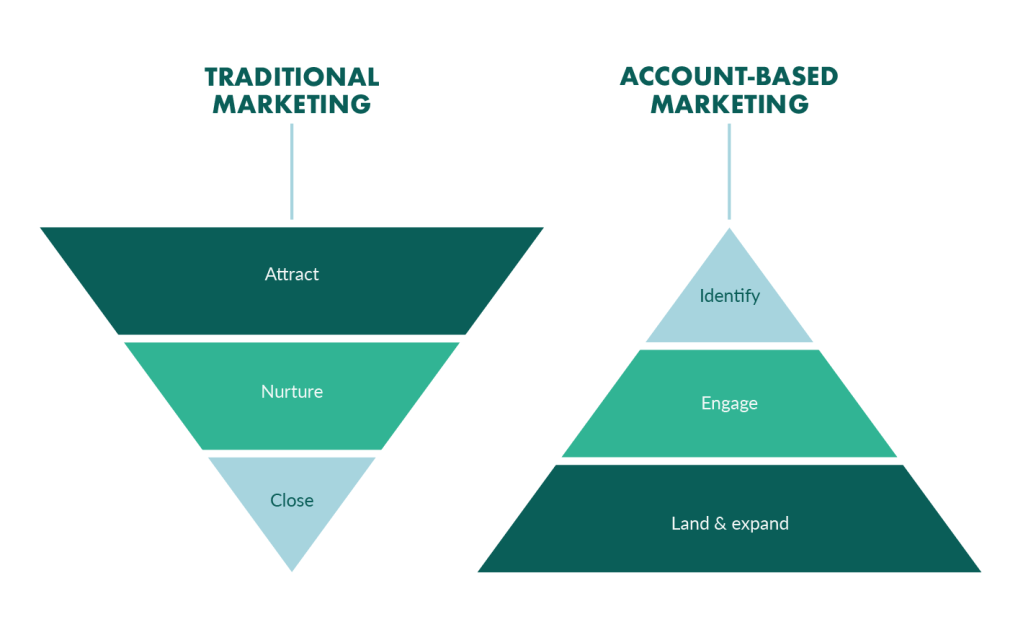
Link: https://www.superoffice.com/blog/account-based-marketing/
The different types of account-based marketing are not just options but solutions. They help you select the best approach for your business goals. ABM can be tailored to fit your specific needs, whether you are a small business or a large enterprise, providing a secure path to success.
Importance of Choosing the Right Type of ABM
Choosing the correct type of account-based marketing (ABM) can significantly impact your sales and ROI. When you tailor your marketing efforts to specific high-value accounts, you use your resources more efficiently and achieve better results. This targeted approach ensures that your efforts are focused on accounts more likely to convert, leading to higher sales and a greater return on investment.
When selecting an ABM approach, consider several factors:
- Business size and resources: Smaller businesses benefit from a more streamlined ABM approach, while larger companies can handle more complex strategies.
- Target account characteristics: Understand the needs and preferences of your target accounts to tailor your ABM strategy effectively.
- Marketing and sales alignment: Ensure your sales and marketing teams work together towards common goals.
Aligning ABM with your business goals is crucial. For example, a broader ABM approach targeting multiple accounts might be best if your goal is to increase market penetration. Conversely, deepening relationships with key clients will make a more personalized ABM strategy more effective.
The types of account-based marketing available allow you to choose the one that fits your business objectives. Whether you opt for a strategic, ABM Lite, or programmatic approach, aligning it with your business goals ensures that your marketing efforts are practical and efficient.
Types of Account-Based Marketing
Strategic ABM (One-to-One)
Strategic ABM, also known as one-to-one ABM, focuses on creating highly personalized marketing campaigns for individual high-value accounts. This approach involves deep research into each target account to understand their needs and challenges. It’s best suited for businesses aiming to win and nurture relationships with key accounts with significant revenue potential.
Characteristics of strategic ABM include:
- Highly customized content and campaigns.
- Close collaboration between sales and marketing teams.
- Long-term engagement with the target account.
Examples of successful strategic ABM campaigns often include tailored proposals, personalized content, and dedicated account managers who work closely with the client to address their unique needs.

ABM Lite (One-to-Few)
ABM Lite, or one-to-few ABM, targets a small group of accounts with similar characteristics. This approach is ideal for businesses looking to scale their ABM efforts without the resource intensity of one-to-one ABM. It involves creating semi-personalized campaigns that address these accounts’ common pain points and needs.
Characteristics of ABM Lite:
- Semi-customized content for account clusters.
- Focused on accounts with similar profiles or industries.
- Efficient use of resources compared to one-to-one ABM.
Case studies of ABM Lite often showcase how businesses have successfully targeted a cluster of similar accounts, leading to increased engagement and conversion rates. This approach allows for a balance between personalization and scalability.
Programmatic ABM (One-to-Many)
Programmatic ABM, or one-to-many ABM, uses technology and automation to target many accounts with personalized messages at scale. This approach suits businesses that want to reach a broader audience without sacrificing ABM’s customized touch.
Characteristics of programmatic ABM:
- Use of data and technology to automate personalization.
- Broad reach with targeted messaging.
- Cost-effective for large-scale campaigns.
Marketing automation platforms, data analytics tools, and AI-driven personalization engines are among the tools and technologies used in programmatic ABM. These tools help create and deliver customized content to a broad audience efficiently.
Knowing the types of account-based marketing helps businesses choose the right strategy based on their goals and resources. Whether it’s the deep personalization of strategic ABM, the balanced approach of ABM Lite, or the scalability of programmatic ABM, each type offers unique benefits for driving sales and engagement.
How to Determine Which Type is Right for Your Business
Choosing the correct type of account-based marketing for your business involves several key steps:
- Assessing your business size and resources:
- Smaller businesses with limited resources might find ABM Lite or programmatic ABM more feasible.
- These approaches require less intensive customization compared to strategic ABM.
- Larger enterprises with more resources can afford the deep personalization of strategic ABM, making it a better fit for targeting high-value accounts.
Identifying your target accounts and their value is crucial. Strategic ABM is best suited for high-value accounts with significant revenue potential. ABM Lite could be the perfect fit if you have a group of accounts with similar needs and characteristics. Programmatic ABM works well for reaching a broader audience with a more generalized approach.
- Aligning the types of account-based marketing with your sales and marketing goals:
- If you aim to build deep, lasting relationships with key accounts, strategic ABM offers the personalized touch needed.
- ABM Lite strikes a good balance when scaling your efforts to target multiple accounts with similar traits.
- When aiming for broad reach and efficiency, programmatic ABM leverages technology to deliver personalized messages at scale.
Each type of account-based marketing offers unique advantages, so selecting the right one depends on your business context. By considering your business size, target accounts, and goal alignment, you can make an informed decision that maximizes your marketing efforts.
Implementing Your Chosen ABM Strategy
Implementing your chosen type of account-based marketing starts with clear steps:
- Steps to get started:
- Identify and prioritize your target accounts. Make sure they align with your business goals.
- Develop personalized content and campaigns tailored to each account or group of accounts.
- Ensure alignment between your sales and marketing teams. Both should collaborate closely for seamless execution.
Tips for a successful ABM implementation:
- Leverage technology and data analytics to gain insights into your target accounts. This helps in crafting more effective and personalized campaigns.
- Maintain constant communication between your sales and marketing teams. Regular check-ins and updates ensure everyone stays on the same page.
- Invest in high-quality content. Personalized, relevant content engages your target accounts and drives better results.
Measuring the success of your ABM campaigns is crucial:
- Track key metrics such as engagement rates, conversion rates, and ROI. These metrics provide insights into the effectiveness of your campaigns.
- Use tools like CRM systems and marketing automation platforms to gather data and analyze performance.
- Adjust your strategies based on the data. Continuous optimization helps refine your approach and achieve better outcomes.
Implementing suitable types of account-based marketing can significantly impact your business. Following these steps, tips, and measurement practices can ensure a successful ABM strategy that drives engagement and boosts ROI.
Common Challenges and How to Overcome Them
Implementing the various types of account-based marketing can be challenging. Knowing these challenges and how to address them is crucial for success.
Typical obstacles in ABM implementation:
- Resource allocation: ABM requires significant time and effort, which can strain resources, especially for smaller businesses.
- Alignment between sales and marketing: Misalignment can lead to inconsistent messaging and missed opportunities.
- Personalization at scale: Creating personalized content for multiple accounts can be challenging and time-consuming.
- Measuring success: Tracking the right metrics and accurately measuring the success of ABM campaigns can be complex.
Solutions and best practices to address these challenges:
- Resource allocation:
- Prioritize high-value accounts to focus efforts where they matter most.
- Use automation tools to streamline repetitive tasks and save time.
- Alignment between sales and marketing:
- Foster regular communication and collaboration between teams.
- Establish shared goals and metrics to ensure everyone achieves the same objectives.
- Personalization at scale:
- Leverage data and analytics to create detailed account profiles.
- Use templates and modular content that can be easily customized for different accounts.
- Measuring success:
- Identify key performance indicators (KPIs) that align with your business goals.
- Use CRM and analytics tools to track engagement, conversion rates, and ROI.
Overcoming these challenges ensures that your chosen types of account-based marketing are effectively implemented. You can optimize your ABM strategy and drive better results by addressing resource constraints, fostering team alignment, achieving personalization, and measuring success accurately.
Conclusion
Choosing the right types of account-based marketing is crucial for maximizing your marketing efforts. Whether you choose strategic, ABM Lite, or programmatic ABM, each type has its benefits.
Starting with ABM can significantly boost your sales and ROI. Targeting specific high-value accounts can create more personalized and effective marketing campaigns.
Contact our sales outsourcing company for expert assistance with your ABM strategy. We’re here to help you implement the best types of account-based marketing to achieve your business goals. Let’s get started!
Share This Post
Recent Posts
What We Offer
Get Your Quote