

Sales Pipeline has become harder to predict.
Deals take longer to close. Buyers involve more stakeholders. And even when marketing generates leads, not all of them convert into real opportunities.
This is where most companies begin to consider B2B sales outsourcing.
Not because it is trendy. But because internal teams are stretched. Hiring takes time. Training takes longer. And by the time a team becomes productive, the market has already shifted.
At the same time, revenue targets have not slowed down.
Companies still need a consistent pipeline. They still need qualified meetings. And they still need a system that works without constant rebuilding.
According to HubSpot, 61% of marketers say lead generation is their biggest challenge. That gap between demand and execution is exactly where outsourcing has grown.
In 2026, outsourcing is no longer just about reducing costs. It is about building a repeatable outbound engine without starting from zero every time.
Instead of hiring multiple SDRs, investing months in onboarding, and experimenting with messaging, companies are choosing to plug into teams that are already built, trained, and operational.
The shift is simple.
From building everything in-house. To scale what already works
This report breaks down what is actually driving revenue in B2B sales outsourcing, how pricing works, the kind of ROI companies are seeing, and when it makes sense to switch.

What is B2B Sales Outsourcing
B2B sales outsourcing is when a company partners with an external team to handle part or all of its outbound sales process.
Instead of building an in-house team of SDRs and hiring managers and setting up systems from scratch, companies work with specialised teams that are already trained, equipped, and ready to execute.
At its core, it is not just about outsourcing tasks. It is about outsourcing execution.
The external team typically takes ownership of:
- identifying target accounts
- building prospect lists
- running outbound campaigns
- qualifying leads
- booking meetings
The goal is simple. Generate a consistent flow of qualified opportunities without slowing down internal teams.
This is especially relevant in 2026, where outbound sales is no longer just about sending emails or making cold calls. It involves multiple touchpoints, data-driven targeting, and constant iteration.
According to Salesforce, 79% of B2B buyers say it is critical to interact with a salesperson who is a trusted advisor. That expectation has changed how outbound sales work.
It is no longer about volume alone. It is about relevance, timing, and context.
This is where SDR outsourcing becomes effective.
Instead of relying on junior hires to figure things out, companies work with teams that already understand:
- How to position value
- How to personalise outreach at scale
- How to qualify prospects properly
- How to move conversations forward
Another important shift is how companies use outsourcing.
Earlier, it was seen as a cost-saving tactic.
In 2026, it will be used as a growth lever.
Companies use outbound sales outsourcing to:
- enter new markets without building local teams
- test messaging before hiring internally
- scale pipeline quickly during growth phases
- support internal sales teams with consistent lead flow
The model has evolved from “outsourcing work” to “building a pipeline on demand.”
And that difference is what drives real revenue outcomes.
What an Outsourced SDR Team Actually Does
An outsourced SDR team is responsible for one thing above everything else.
Creating a pipeline.
Not just activity. Not just outreach. But actual, qualified opportunities that sales teams can close.
Most companies underestimate how many moving parts sit behind a single booked meeting.
It is not just sending emails or making calls. It is a structured process that combines targeting, messaging, timing, and follow-ups.
An outsourced team handles this end-to-end.
It starts with defining the right audience.
Before any outreach begins, the team builds a clear Ideal Customer Profile. This includes company size, industry, geography, and decision-maker roles. Without this step, even high-volume outreach fails.
According to LinkedIn, 62% of B2B marketers say identifying the right audience is their biggest challenge. That is why strong SDR teams spend time getting targeting right before scaling outreach.
Once targeting is clear, the next step is building prospect lists.
This is not just pulling data from tools. It involves filtering for relevance, verifying contacts, and ensuring the list closely matches the ICP. Poor data leads to wasted effort, no matter how good the messaging is.
Then comes outbound execution.
This is where most people simplify the process, but it is far more layered in reality.
Outreach today is multi-channel.
It includes:
- email sequences
- cold calling
- LinkedIn touchpoints
- follow-ups across different timelines
Each prospect is contacted multiple times, often across different channels, before they respond.
According to Gartner, buyers spend only 17% of their time meeting with potential suppliers. That means most outreach is competing for a very small window of attention.
This is why consistency matters more than volume alone.
A good SDR team does not stop after the first message. They follow structured sequences, test messaging, and adjust based on response patterns.
Next comes qualification.
Not every response is a good opportunity.
The SDR team filters prospects based on:
- need
- timing
- budget alignment
- decision-making authority
This ensures that the sales team only speaks to prospects who are worth the time.
Finally, meetings are booked and handed over.
But even here, the work does not stop.
Strong teams ensure:
- the prospect shows up
- the context is clearly passed to the sales team
- expectations are aligned before the call
Because a booked meeting only matters if it converts.
The difference between an average and a strong outsourced SDR team is simple.
One focuses on activity. The other focuses on outcomes.
In 2026, companies are no longer paying for outreach volume. They are paying for pipeline quality. And that is exactly what a well-structured SDR outsourcing model is built to deliver.

Benefits of B2B Sales Outsourcing
The decision to invest in B2B sales outsourcing usually comes down to three things.
Cost. Speed. Execution.
But the real value is not in any one of these individually. It is in how they work together to create a consistent pipeline.
Cost efficiency without long-term overhead
Building an in-house SDR team is expensive.
Salaries are only one part of it. There is also hiring time, onboarding, tools, management, and ramp-up costs.
Most SDRs take months before they become productive.
According to Bridge Group, the average ramp time for an SDR is over 3 months. During that time, companies are paying without seeing a meaningful pipeline.
With SDR outsourcing, that ramp time is removed.
Teams are already trained. Systems are already in place. Outreach starts faster.
Instead of investing upfront and waiting for results, companies start generating conversations earlier.
Faster pipeline generation
Speed is one of the biggest reasons companies shift to outbound sales outsourcing.
When internal hiring slows down execution, the pipeline suffers.
Outsourced teams are built to launch quickly.
They already have:
- tested outreach frameworks
- data sources
- sequencing systems
- experience across industries
This reduces the time between planning and execution.
According to McKinsey, companies that respond to leads within the first hour are 7 times more likely to qualify them. Speed directly impacts conversion.
Outsourcing helps companies move faster without compromising structure.
Access to specialised expertise
Outbound sales have become more complex.
It is no longer just about sending emails at scale. It requires:
- strong positioning
- personalised messaging
- channel mix optimisation
- constant testing
Most internal teams learn this over time.
Outsourced teams already operate with this knowledge.
They have seen what works across different campaigns, industries, and markets. That experience reduces trial and error.
According to RAIN Group, 82% of buyers accept meetings when sellers reach out proactively. But that only happens when outreach is relevant and well-timed.
Expertise is what makes that possible.
Flexibility without hiring risk
Hiring is a long-term commitment. Outsourcing gives flexibility.
Companies can:
- scale outreach up or down
- test new markets
- adjust strategy quickly
Without restructuring internal teams.
This is especially useful for companies in growth phases or entering new regions.
Instead of committing to full-time hires, they can validate demand first.
Focus for internal sales teams
One of the less obvious benefits is focus.
When internal sales teams handle both prospecting and closing, performance drops.
Outbound work is time-consuming. It takes away from closing opportunities.
- Outsourcing separates these roles.
- SDRs focus on generating a pipeline.
- Closers focus on converting it.
This division improves efficiency across the sales process.
The biggest shift in 2026 is how companies view outsourcing.
Companies are not outsourcing because they cannot build teams. They are outsourcing because it helps them move faster, reduce risk, and generate a pipeline more consistently.
Pricing Models in 2026
One of the biggest questions around B2B sales outsourcing is pricing.
Not just how much it costs, but how the structure works and what companies are actually paying for.
In 2026, pricing has become more transparent, but also more outcome-driven. Most providers fall into three core models.
Monthly retainers
This is the most common model.
Companies pay a fixed monthly fee for a dedicated SDR team or a defined level of activity.
The pricing usually includes:
- SDR resources
- campaign setup
- tools and infrastructure
- ongoing optimisation
The advantage is predictability.
You know what you are paying every month, and the team focuses on consistent execution rather than short-term results.
Typical retainers range from mid to high four figures per month, depending on:
- number of SDRs
- markets targeted
- complexity of the campaign
According to Deloitte, 59% of businesses outsource to reduce costs, but cost alone is no longer the driver. Companies are paying for structured execution, not just lower spend.
Performance-based pricing
This model is built around outcomes.
Instead of paying a flat monthly fee, companies pay based on results, usually:
- per meeting booked
- per qualified opportunity
- sometimes revenue-linked incentives
On paper, this sounds attractive.
You only pay when results come in.
But in practice, this model often leads to trade-offs.
To maximise output, some providers prioritise volume over quality. This can result in:
- poorly qualified meetings
- low conversion rates
- misalignment with your ICP
This is why fully performance-based models are less common for complex B2B sales.
They work better in high-volume, lower-ticket environments.
Hybrid models
This is where most serious providers operate in 2026.
A hybrid model combines:
- a base monthly retainer
- performance incentives tied to results
This balances both sides.
The base ensures the team invests in proper strategy, targeting, and messaging.
The performance component aligns incentives with outcomes.
It also reduces risk for both parties.
Companies are not relying purely on promises, and providers are not forced to prioritise short-term volume.
What companies are really paying for
Regardless of the model, the real cost is not just about SDR hours.
It is about:
- speed to pipeline
- quality of conversations
- consistency of execution
According to Forrester, 74% of B2B buyers conduct more than half of their research online before engaging with sales. By the time outreach happens, expectations are already high.
This means poor execution is expensive.
Not just in wasted budget, but in missed opportunities.
That is why companies are shifting away from choosing the cheapest provider.
They are looking at:
- How quickly is the pipeline generated
- How well leads convert
- How predictable the system is
Pricing in SDR outsourcing is no longer just a cost decision. It is a revenue decision.
ROI of Outsourced Sales
ROI is where most decisions around B2B sales outsourcing are actually made.
Cost matters. But what companies really care about is whether outsourcing produces more pipeline and revenue than building internally.
To understand this properly, it helps to break ROI into two parts. Input costs and output results.
The cost side
Hiring an in-house SDR is not just a salary.
There is recruitment time, onboarding, tools, management, and the gap before performance stabilises.
According to Glassdoor, the average base salary for an SDR in the US is over $55,000 per year. When you include tools and overhead, the real cost is significantly higher.
On top of that, productivity does not start immediately.
Ramp time delays pipeline generation, which directly affects revenue timelines.
With SDR outsourcing, these upfront costs are replaced with a predictable monthly investment. There is no hiring delay, and execution begins faster.
The output side
ROI improves when the pipeline is generated consistently and converts into revenue.
This is where execution quality becomes critical.
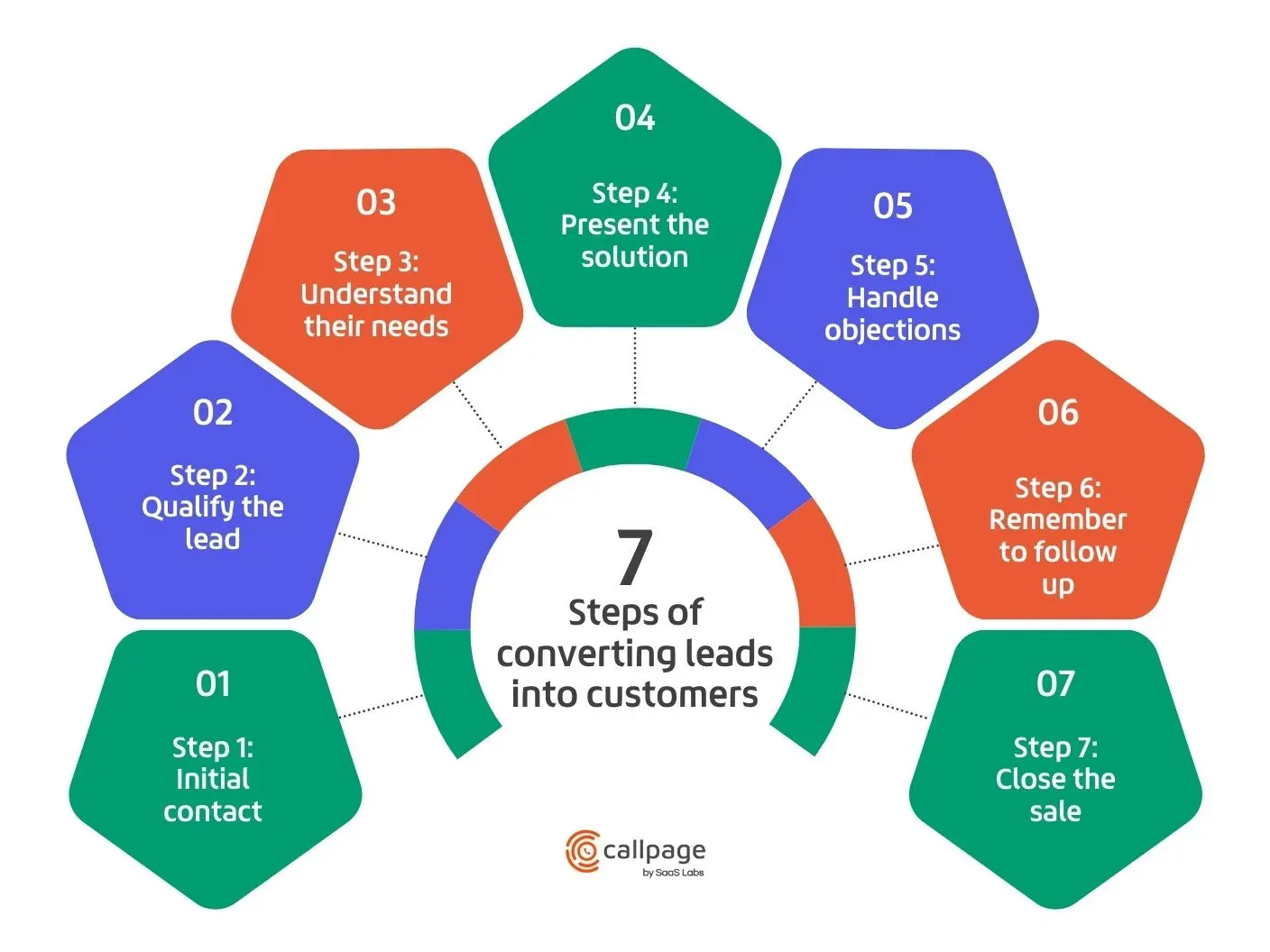
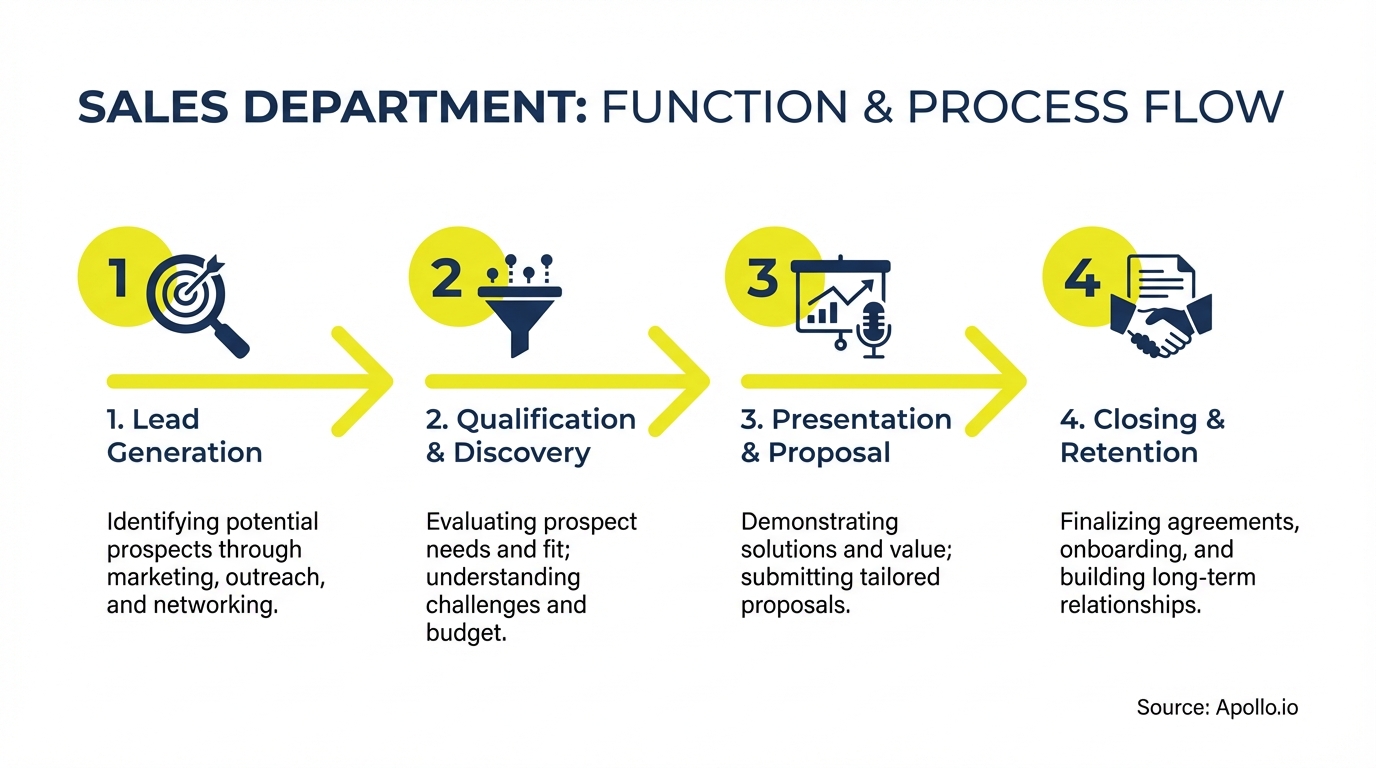
A typical outbound funnel looks like this:
- outreach sent
- responses generated
- conversations started
- meetings booked
- opportunities created
- deals closed
Even small improvements at each stage compound over time.
According to TOPO, top-performing SDR teams generate 3 times more pipeline per rep than average teams. That gap usually comes down to targeting, messaging, and consistency.
Outsourced teams that already have structured processes tend to perform closer to the top end of this range.
A simple ROI scenario
Consider a company investing $6,000 to $10,000 per month in an outsourced SDR programme.
If that programme generates:
- 15 to 25 qualified meetings per month
- with a 20% to 30% opportunity conversion rate
- and an average deal size of $8,000 to $15,000
Even a few closed deals can cover the monthly cost.
Beyond that, the value comes from pipeline consistency.
Sales teams are not relying on unpredictable inbound leads. They have a steady flow of conversations to work with.
Time-to-revenue matters
ROI is not just about how much revenue is generated. It is also about how quickly it starts.
Delays in building internal teams push revenue further out.
Outsourcing reduces that delay.
According to Harvard Business Review, companies that respond quickly to prospects are far more likely to win deals. Faster execution leads to a faster pipeline, which leads to earlier revenue.
Where companies see the biggest returns
The strongest ROI usually comes from specific use cases:
- entering new markets without hiring locally
- supporting underperforming pipelines
- scaling outbound during growth phases
- testing messaging before expanding internal teams
In these cases, outsourcing serves to validate and scale simultaneously.
ROI in outbound sales outsourcing becomes clear when the pipeline turns into predictable revenue.
The companies that see the best results are not the ones looking for the lowest cost.
They are the ones focused on execution quality, speed, and consistency.
When Should You Outsource Sales
Timing matters more than most companies realise.
B2B sales outsourcing works best when there is a clear gap between growth goals and current execution capacity.
Not every company needs it early. But when the right signals appear, delaying the decision usually slows down the pipeline even further.
Here are the situations where outsourcing starts to make sense.
After raising funding
Once a company raises capital, expectations change quickly.
There is pressure to grow faster, enter new markets, and build a pipeline at scale.
Hiring internally sounds like the obvious step, but it takes time.
Roles need to be defined. Candidates need to be sourced. Training needs to happen before any results show.
Outsourcing allows companies to begin outbound efforts immediately while internal hiring is still underway.
This reduces the gap between funding and revenue generation.
When entering new markets
Expanding into a new geography comes with uncertainty.
Different buyer behaviour. Different messaging. Different response patterns.
Building a local team without validating demand can be risky.
Outsourced teams help test these markets faster.
They can run targeted campaigns, gather response data, and identify what resonates before a company commits to long-term hiring.
This is often how companies avoid expensive expansion mistakes.
When the pipeline is inconsistent
This is one of the most common triggers.
Inbound leads fluctuate. Some months look strong, others slow down without warning.
Sales teams end up reacting instead of planning.
According to Salesforce, 57% of sales professionals say competition has become harder than last year. That increased competition makes relying on inbound alone less predictable.
Outbound brings structure.
It provides a controlled way to generate conversations rather than waiting for them.
When sales teams are stretched
In many companies, account executives handle both prospecting and closing.
This works in the early stages, but it does not scale well.
Prospecting takes time. Follow-ups require consistency. And when closing deals becomes the priority, outreach slows down.
Outsourcing separates these roles.
It ensures that pipeline generation continues while internal teams focus on converting opportunities.
When hiring becomes a bottleneck
Hiring SDRs is not just about finding candidates.
It involves:
- evaluating skills
- training on messaging
- managing performance
- maintaining consistency
Even after hiring, results take time.
If growth depends on the immediate pipeline, waiting for internal teams to ramp can slow everything down.
Outsourcing removes that dependency.
When messaging is still unclear
Many companies struggle with positioning.
They know their product works, but they are not sure how to communicate it in outbound campaigns.
Instead of hiring a full team to experiment, outsourced teams can test messaging faster.
They run campaigns, measure response rates, and refine positioning based on real conversations.
This shortens the feedback loop significantly.
The decision to outsource usually comes down to one question.
Is the pipeline keeping up with growth expectations?
When the answer is no, outsourcing becomes less of an option and more of a practical step to fix the gap.
Common Mistakes Companies Make
Outsourcing can accelerate the pipeline. But when it is done without the right approach, it leads to poor results and wasted budget.
Most failures do not come from outsourcing itself. They come from how companies approach it.
Choosing based on price alone
This is the most common mistake.
Lower pricing often looks attractive, especially when comparing multiple providers. But in outbound sales, cheaper execution usually means weaker targeting, generic messaging, and inconsistent follow-ups.
The result is predictable.
Low response rates. Poor-quality meetings. Little to no pipeline impact.
According to Gartner, 77% of B2B buyers say their last purchase was very complex or difficult. That level of complexity requires thoughtful outreach.
When execution is rushed or low quality, prospects simply ignore it.
No clear strategy before starting
Many companies expect outsourcing to “just work” without defining key inputs.
But outbound depends heavily on clarity.
Without a strong foundation, even the best SDR team struggles.
This includes:
- unclear Ideal Customer Profile
- weak value proposition
- no clear differentiation
- unrealistic expectations on timelines
Outsourcing works best when there is alignment on who to target and why they should care.
Poor targeting
Targeting is where most outbound efforts fail.
If the wrong audience is selected, everything that follows breaks.
Messages do not resonate. Response rates drop. Meetings become irrelevant.
According to LinkedIn, 40% of B2B marketers say improving data quality is a top priority. That reflects how critical accurate targeting has become.
Strong outbound campaigns start with precision, not volume.
Expecting immediate results
Outbound sales require consistency.
There is always a ramp period where messaging is tested, sequences are refined, and data improves.
Companies that expect results in the first few weeks often stop too early.
This leads to incomplete campaigns and no meaningful insights.
A structured approach usually shows stronger results over time as patterns become clearer.
Focusing on meetings instead of quality
Not all meetings are valuable.
Some providers optimise for volume because it is easier to show numbers.
But if those meetings do not convert into opportunities, the pipeline does not improve.
The focus should always be on:
- relevance of the prospect
- alignment with ICP
- likelihood to convert
This is where many outsourcing engagements fail quietly.
On paper, the activity looks high. In reality, revenue does not move.
Lack of internal alignment
Outsourcing does not replace internal teams. It works alongside them.
When there is no coordination between SDR teams and sales teams, problems appear quickly.
- messaging becomes inconsistent
- follow-ups are missed
- prospects receive mixed signals
Successful campaigns require alignment on expectations, feedback loops, and handover processes.
Most of these mistakes are avoidable.
Companies that treat outsourcing as a structured extension of their sales function tend to see better results.
Those who treat it as a quick fix usually do not.
Why Konsyg
Most outsourcing providers focus on activity. More emails, more calls, more meetings. The assumption is that higher volume will eventually lead to results. In reality, that approach rarely translates into a consistent pipeline.
What matters is not how much outreach is done, but how relevant it is and how well it aligns with the right audience.
Konsyg approaches B2B sales outsourcing differently. The focus is not on volume-driven execution, but on building a structured outbound system that produces qualified opportunities over time.
Every engagement starts with clarity. Targeting is defined carefully, positioning is refined early, and expectations are aligned before campaigns begin. This avoids the common issue of outreach being launched quickly but failing to generate meaningful responses.
According to Demand Gen Report, 77% of B2B buyers say their purchase decision is influenced by relevant content. This is where most outbound efforts fail. They reach the right people, but with messaging that does not resonate.
Konsyg’s model is built around improving that alignment.
Instead of casting a wide net, campaigns are designed around a clearly defined Ideal Customer Profile. This includes not just firmographics, but also use cases, intent signals, and buying context. The goal is to ensure that outreach is directed at accounts that are more likely to convert, rather than simply increasing volume.
Execution is not treated as a fixed process. Messaging is tested, refined, and adjusted based on response patterns and market feedback. This allows campaigns to improve over time rather than plateau after the initial launch phase.
Another key difference is how success is measured. Many providers optimize for booked meetings because it is easy to track. Konsyg focuses on what happens after the meeting. Whether the prospect is qualified, whether the conversation progresses, and whether it contributes to the real pipeline.
This reduces the common gap between activity and revenue.
Consistency is also a major factor. Internal teams often struggle to maintain outbound efforts alongside closing responsibilities. Outreach slows down, follow-ups are missed, and the pipeline becomes uneven. Konsyg operates with dedicated teams that focus only on generating and maintaining pipeline, ensuring that execution does not drop off.
Over time, this creates a more predictable system.
Konsyg is not positioned as a short-term fix or a volume-based vendor. It operates as a long-term extension of the sales function, helping companies build a repeatable outbound engine that supports growth.
FAQ
How much does B2B sales outsourcing cost
Most companies spend between $4,000 and $12,000 per month, depending on scope, markets, and team size. According to Glassdoor, the average SDR salary exceeds $55,000 per year, making outsourcing a comparable or lower-cost option when overhead is factored in.
Is SDR outsourcing worth it
Yes, when the goal is a faster pipeline. According to RAIN Group, 82% of buyers accept meetings when sellers reach out proactively, which makes structured outbound highly effective when executed properly.
How quickly can outsourcing generate results
Most campaigns start generating conversations within 3 to 6 weeks, depending on targeting and messaging clarity.
What does an outsourced SDR team handle
They manage prospecting, outreach, follow-ups, qualification, and meeting booking.
Is outbound sales still effective in 2026
Yes. According to Gartner, buyers spend only 17% of their time meeting with suppliers, making proactive outreach essential to get attention.
How many meetings can I expect per month
Typically, 10 to 30 qualified meetings per month, depending on industry, offer, and targeting.
What industries benefit most from SDR outsourcing
SaaS, B2B services, tech, and companies selling high-ticket solutions benefit the most.
How do I know if the leads are qualified
Qualification is based on ICP fit, intent, and buying potential, not just responses or booked calls.
What is the difference between SDR outsourcing and lead generation
SDR outsourcing handles the full outbound process, while lead generation often focuses only on providing contact lists or basic leads.
How do I choose the right outsourcing partner
Look for clear targeting, strong messaging, transparency, and a focus on pipeline quality rather than just meeting volume.
Ready to Build a Predictable Pipeline
Most companies do not struggle with demand.
They struggle with execution.
Pipeline slows down when outreach is inconsistent, targeting is unclear, or internal teams are stretched too thin. Fixing that internally takes time. And in most cases, time is the one thing revenue teams do not have.
If you are looking to consistently generate qualified conversations without rebuilding your sales process from scratch, it makes sense to work with a team that is already structured to do so.
Konsyg works with B2B companies to build outbound systems that are focused on the right accounts, the right messaging, and steady pipeline generation.
No unnecessary complexity. No volume-driven outreach. Just a clear process that is built to produce results over time.
Share This Post
Table of Contents
Recent Reports
Learn More