

Sales campaigns are the lifeline of any business, and sales campaign optimisation is essential for driving success. They generate leads, drive revenue, and build your brand. But what happens when your carefully planned campaign does not deliver the results you expected?
Leads are not converting, sales are stagnant, and your team is scratching their heads. If this sounds familiar, you are not alone. Many businesses face challenges with sales campaigns, but the good news is that these issues are often fixable.
This blog will break down simple, actionable steps to diagnose the problem and turn your underperforming sales campaign into a success story.
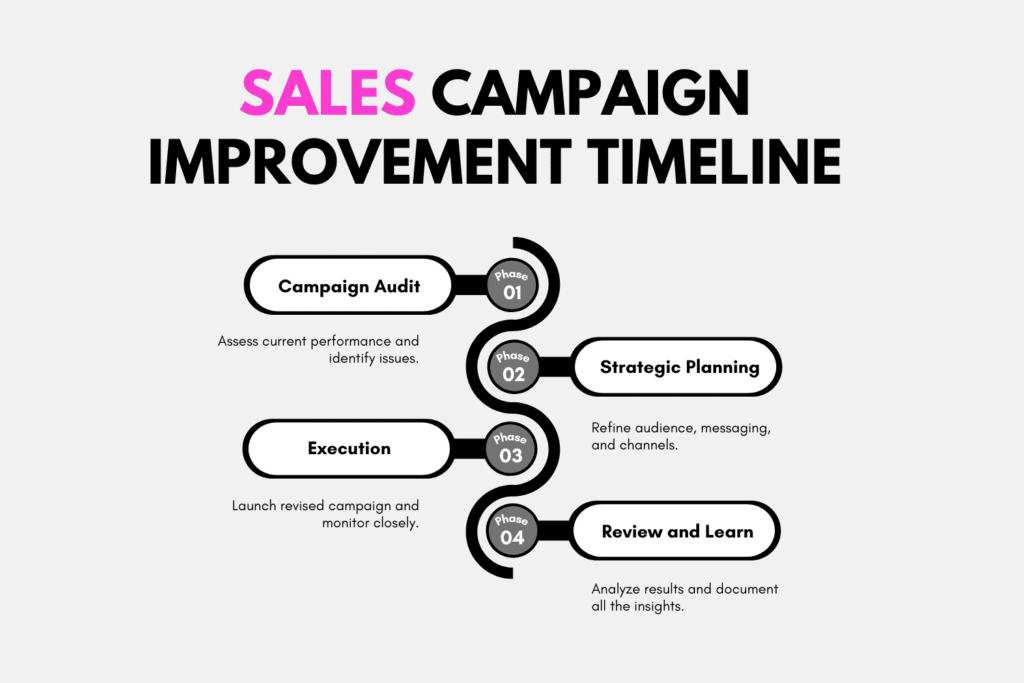
Step 1: Analyze Your Current Campaign
The first step to fixing any problem is understanding what went wrong. Dive deep into your current sales campaign and analyse every aspect: Are your email open rates lower than expected? Are leads failing to respond after initial outreach? These common issues can indicate deeper problems in targeting, messaging, or execution.
- Look at the Data: What do the numbers tell you? Analyse metrics like open rates, click-through rates, conversion rates, and ROI. Low numbers in any of these areas could point to specific issues.
- Check Your Target Audience: Are you reaching the right people? A campaign targeting the right audience will only gain traction if the offer is excellent.
- Evaluate Your Messaging: Is your value proposition clear and compelling? Confusing or irrelevant messaging could be driving potential leads away.
Write down your findings and identify specific weak points in your campaign. For example, a campaign with a 5% open rate on emails might indicate a need for better subject lines.
Step 2: Refine Your Target Audience
A sales campaign can only be as effective as its audience targeting. If your results are underwhelming, it might be because you are not speaking to the right people. Here is how to refine your audience:
- Review Your Ideal Customer Profile (ICP): Revisit your ideal customer. Are they in the right industry, location, or company size? If your campaign is too broad, it might miss the mark.
- Segment Your Audience: Break down your target audience into smaller, more specific groups. For example, if you target B2B clients, separate them by job title, industry, or pain points.
- Use Data to Validate: Analyze past campaigns or customer data to confirm that your updated audience aligns with your most successful leads and customers. For instance, if most of your sales come from mid-sized companies, focus on similar prospects.
When targeting new regions, consider cultural differences and local market conditions. For instance, businesses expanding to Southeast Asia might find LinkedIn more effective than email marketing.

Step 3: Revamp Your Messaging
Your messaging is what connects you to your audience. Effective sales messaging ensures your value proposition resonates with potential customers and drives engagement. If it does not resonate, your campaign is unlikely to succeed. Here is how to improve it:
- Simplify Your Value Proposition: What makes your product or service unique? Focus on one clear, powerful message that solves a key problem for your audience.
- Use Customer-Centric Language: Avoid jargon or overly technical language. Speak directly to the needs and desires of your audience in simple, relatable terms.
- Test Headlines and CTAs: Your subject lines, ad headlines, and calls-to-action (CTAs) need to grab attention. A/B test different versions to find what works best. For example, “Save Time and Money” might perform better than “Efficiency Solutions for Professionals.”
Consider incorporating customer testimonials or success stories into your messaging to build credibility and trust.
Step 4: Optimize Your Channels
Your sales campaign might be struggling because it is not leveraging the proper channels. For example, if your audience is highly active on LinkedIn but your campaign relies heavily on email marketing, you may not be reaching them effectively. Similarly, platforms like social media advertising on Facebook or Instagram might work better for B2C products, while Google Ads or cold email might be more suitable for B2B audiences.
Here is how to fix this:
- Identify High-Performing Channels: Look at which platforms or communication methods have worked well for your business.
- Test New Channels: If you have not already, experiment with platforms like LinkedIn, Google Ads, or cold outreach. Different audiences respond to other channels.
- Align Messaging Across Channels: Ensure your messaging is consistent but tailored to the strengths of each channel. For example, LinkedIn posts might be professional, while email campaigns can be more conversational.
Use data to understand where your audience spends the most time. For instance, younger audiences may engage more with Instagram Stories, while executives prefer LinkedIn articles.
Step 5: Focus on Lead Quality, Not Quantity
One of the biggest mistakes in sales campaigns is prioritising the number of leads over their quality. Generating hundreds of leads that are unlikely to convert wastes time and resources. Here is how to focus on quality:
- Qualify Leads Early: Implement a lead qualification process to filter out unqualified prospects. Use criteria like budget, decision-making authority, and needs.
- Personalised Outreach: High-quality leads require personalised attention. Tailor your approach to show you understand their specific pain points. For example, mention a recent challenge they shared on LinkedIn or address their industry-specific concerns.
- Nurture Leads: Not all leads are ready to buy immediately. Use email drip campaigns or follow-up calls to nurture relationships over time.
Step 6: Common Mistakes to Avoid
Sometimes, knowing what not to do is as important as knowing what to do. Here are common sales campaign mistakes:
- Overloading Your Audience: Sending too many emails or messages can annoy potential leads.
- Ignoring Feedback: Failing to adapt based on audience responses or campaign data.
- Relying on Generic Messaging: Audiences expect tailored, relevant communication.
- Skipping Follow-Ups: Many sales are lost due to poor follow-up practices. Always circle back to promising leads.
- Neglecting Team Training: Your sales team must be equipped to handle incoming leads effectively. Without proper training, even the best campaign can falter.
Avoiding these pitfalls can save time and resources while improving your results.
Step 7: How to Set Realistic Campaign Goals
Every successful campaign starts with clear and realistic goals. Without well-defined objectives, it is easy to lose focus or misallocate resources. Here is how to set goals effectively:
- Use SMART Goals: Ensure your goals are Specific, Measurable, Achievable, Relevant, and Time-bound. For example, instead of “Increase sales,” aim for “Increase sales by 20% in Q3.”
- Define Success Metrics: Decide how you will measure success. This might include metrics like conversion rates, lead response times, or customer acquisition costs.
- Break Goals Into Milestones: Divide larger goals into smaller, actionable steps. For instance, if your goal is to generate 500 leads, set weekly targets of 125 leads.
- Involve Your Team: Align your goals with your sales team’s capabilities and gather their input to ensure buy-in.
By starting with clear, achievable goals, you can guide your campaign efforts with purpose and direction.

Step 8: Leverage Technology and Tools
Technology can be a game-changer for improving campaign performance. Here are some tools to consider:
- CRM Software: Use a CRM like HubSpot or Salesforce to track leads, manage communication, and analyse performance.
- Email Automation Tools: Automate follow-ups and drip campaigns to save time and stay top of mind with leads.
- Analytics Platforms: Tools like Google Analytics or LinkedIn Insights can provide valuable data on campaign performance and audience behaviour, such as tracking which blog posts lead to conversions.
Step 9: FAQs
Q: How long does it take to see results from a revamped campaign? A: It depends on the scope of changes. Minor adjustments may show results within weeks, while more extensive overhauls can take months to fully realise their impact.
Q: What budget should I allocate to fix a sales campaign? A: This varies based on your industry, audience, and channels. Start with a test budget for new strategies and increase as you see positive returns.
Q: How can Konsyg help with my sales campaigns? A: Konsyg specialises in outbound sales and data-driven strategies. Their team can audit your current campaign, refine your audience, and implement targeted solutions to improve ROI.
Q: What makes Konsyg different from other sales outsourcing companies? A: Konsyg offers a unique combination of global expertise, advanced technology, and a proven track record in outbound sales. Their personalised approach ensures that every campaign is tailored to meet your goals, giving you an edge in competitive markets.
Q: Can Konsyg handle multi-regional campaigns? A: Absolutely. Konsyg has experience executing sales campaigns across Asia, Europe, and North America, ensuring local expertise and seamless execution in diverse markets.
Step 10: Evaluate and Learn After the Campaign
Once your campaign has run its course, evaluate its overall performance. Ask yourself:
- What Worked? Identify the elements of your campaign that delivered the best results.
- What Did Not Work? Pinpoint the areas that fell short and analyse why.
- What Can Be Improved? Use your findings to inform future campaigns. For example, if webinars generated more leads than whitepapers, consider allocating more resources to that format.
Document what you have learned to avoid repeating the same mistakes and build on your successes.
Final Thoughts
Fixing a sales campaign that is not getting results might feel daunting, but it is entirely possible with the right approach. If you seek expert help to transform your underperforming sales strategy, Konsyg offers tailored solutions to analyse, optimise, and deliver results. Konsyg has helped businesses achieve their sales goals worldwide by focusing on audience insights, innovative strategies, and data-driven results. Contact Konsyg today to unlock the full potential of your sales campaigns.
Remember, sales success is not about perfection but constant improvement. Every campaign teaches you something new. Use those lessons to build better, more effective campaigns in the future.
Share This Post
Recent Posts
What We Offer
Get Your Quote